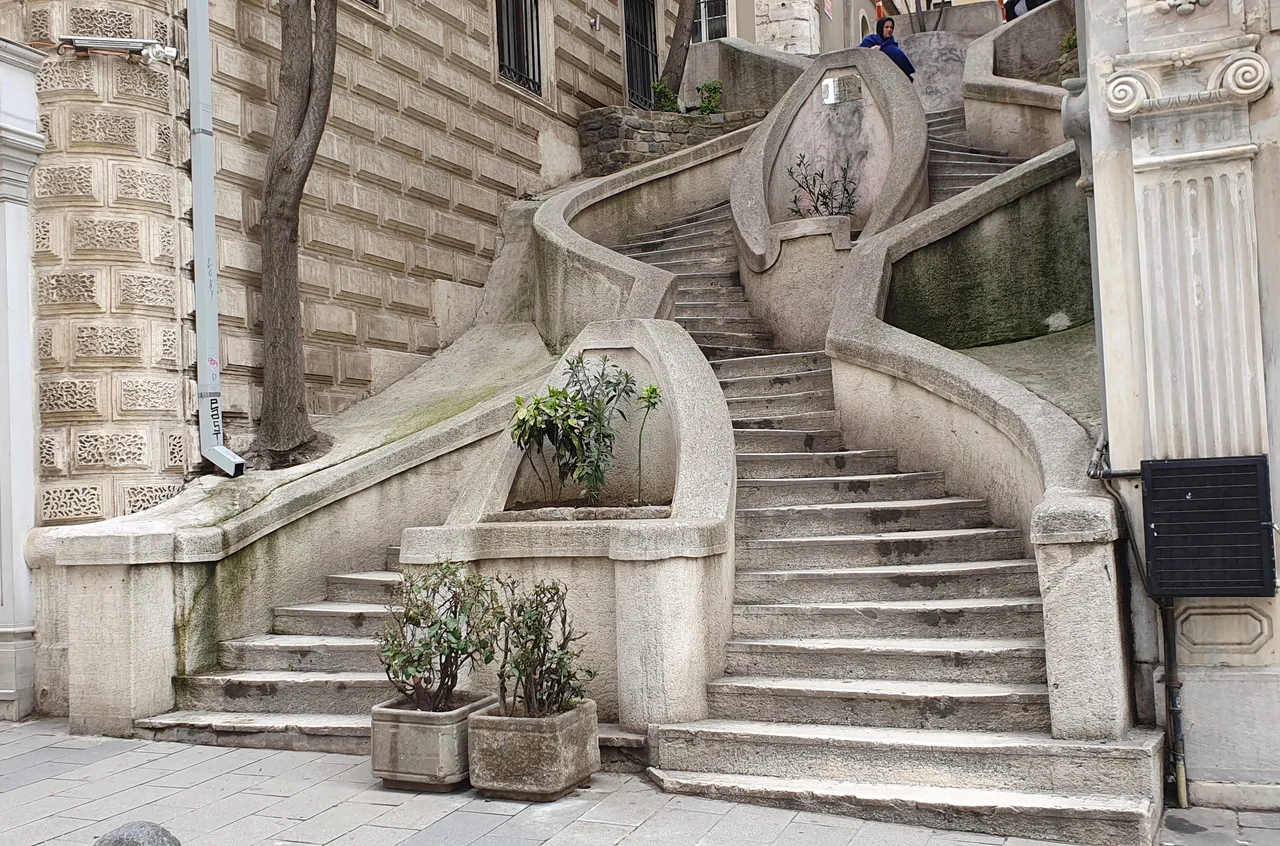

Camondo Stairs
Abraham Salomon Camondo built these stairs for practical reasons: he lived on Kart Çınar Sokak, worked on Bankalar Caddesi below, and the steep hillside of Galata made the daily commute a nuisance. So he commissioned a staircase. The result, built sometime between 1870 and 1880, was not merely practical — it was a small masterpiece of Neo-Baroque and early Art Nouveau design, its curved balustrades and double-branching flights making a simple urban shortcut feel like the entrance to a palace. What began as one banker's quality-of-life project became one of Istanbul's most distinctive pieces of urban architecture, still photographed today as it was by Henri Cartier-Bresson in 1964.
The Family That Shaped Galata
The Camondos were Sephardic Jews — descendants of the Jewish community that fled the Iberian Inquisition and found refuge in the Ottoman Empire in 1492. By the 19th century, the House of Camondo had grown into one of the most powerful banking dynasties in Istanbul. Abraham Salomon Camondo, the family patriarch, served as the Ottoman Empire's primary banker until the Imperial Ottoman Bank was founded in 1863. At the height of his influence, he was considered the wealthiest Jew among the Ottoman Empire's some 800,000 Jewish subjects. For his role in supporting Venice's liberation from Austrian control, King Victor Emmanuel II of Italy ennobled him in 1870. The street beside these stairs bore the family name — Rue Camondo — well into the 20th century. The school where the Camondo children studied, St. George's Austrian High School, stood just steps away. The stairs were not a monument to wealth; they were the texture of a family's daily life, woven into the stone of the hill.
Art Nouveau in a Ottoman Lane
Istanbul in the late 19th century was not immune to the currents flowing through European architecture, and Galata — the old Genoese trading quarter north of the Golden Horn — was particularly porous to those influences. The Camondo Stairs reflect this cosmopolitan moment exactly. Their design blends Neo-Baroque grandeur with the sinuous organic lines of early Art Nouveau: the staircase splits and curves back on itself in sweeping arcs rather than proceeding in straight utilitarian flights. The stone balusters ripple rather than stand at rigid attention. Walking up, you do not feel you are climbing a hill — you feel you are moving through a composition. Lonely Planet would later describe them as "one of Beyoğlu's most distinctive pieces of urban design," and that description, while well-worn, is accurate. The stairs connect the lower financial district of Bankalar Caddesi — the street once so dense with banks that it was called the Wall Street of the Ottoman Empire — to the quieter residential lanes above.
A Lens, a Novel, a Memory
Henri Cartier-Bresson came to Istanbul in 1964 and found the stairs. The photograph he took — a figure caught mid-ascent, the curving stone framing the moment — became one of the defining images of mid-century Istanbul street photography. The stairs have since attracted filmmakers and novelists. Barbara Nadel set a scene in her Istanbul crime novel Pretty Dead Things here, drawn to the same quality that made Cartier-Bresson stop: the way the stairs seem to exist outside of ordinary time, a 19th-century gesture surviving in a city that has shed so many of its layers. Today the surrounding neighborhood is called Karaköy, a buzzing district of coffee shops, galleries, and antique dealers. The stairs rise above the noise unchanged.
Paris, and What Was Lost
The Camondo family's story does not end in Istanbul. In the late 19th century, a branch of the family — grandchildren of Abraham Salomon — took French citizenship and resettled in Paris. Moïse de Camondo, who had been born in Istanbul, became a prominent collector and built a mansion near the Parc Monceau to house his collection of 18th-century French decorative art. He named it the Musée Nissim de Camondo, in memory of his son Nissim, who was killed flying for France in the First World War. The loss compounded. Nissim's sister Béatrice, her husband Léon Reinach, and their two children were arrested by the German occupiers and deported. They were murdered in Auschwitz in 1943 and 1944. The last of the Paris Camondos was gone. The Istanbul stairs that Abraham Salomon built for his children's school run survive; the children of that later generation did not. The stairs stand now as both a triumph of one family's ambition and a quiet monument to what the 20th century erased.
Climbing the Hill Today
The stairs are easy to miss if you don't know to look for them. They're tucked off Bankalar Caddesi, squeezed between buildings in the dense fabric of Karaköy, rising steeply toward the upper neighborhood. Take them slowly. At each landing the city opens up a little differently — the rooflines of Galata, the distant water, the minarets above the noise. Cartier-Bresson saw something worth stopping for here. The stairs reward the same attention now that they did then: a moment of grace built into a working hillside by a man who simply wanted an easier path between where he lived and where he worked, and who chose, in solving that small problem, to build something beautiful.
From the Air
The Camondo Stairs are located at 41.0240°N, 28.9738°E in the Galata/Karaköy district on the European side of Istanbul, rising from Bankalar Caddesi toward the upper Beyoğlu hills. Approaching from the west at around 2,000 feet, the Golden Horn waterway and the Galata Tower (at 41.025°N, 28.974°E) provide clear orientation — the stairs are roughly 300 meters southeast of the tower. The nearest major airport is Istanbul Airport (LTFM), approximately 35 km to the northwest. Visibility is best in the morning before the sea haze builds over the Bosphorus.
Nearby Stories
- Kocaeli Peninsula 7.6 km away
- Second Battle of Çatalca 11 km away
- Istanbul's Rural Outskirts 14 km away
- MV Struma 20 km away
- HMAS AE2 36 km away
- Bursa 66 km away
- Sangarius Bridge 71 km away
- Januarius MacGahan 101 km away