
Cathedral of the Holy Spirit
The stone pedestal outside the Cathedral of the Holy Spirit carries a plaque in Turkish and French: "Benefactor of all people, regardless of nationality or religion." The bronze figure above it is Pope Benedict XV, who reigned from 1914 to 1922 and spent much of his pontificate trying, without success, to stop the First World War. The statue was commissioned in 1922 by the Turkish state — Sultan Mehmet VI is thought to have personally donated 500 gold liras toward it — in recognition that Benedict had helped establish a hospital on the Turkish-Syrian border to treat wounded Ottoman soldiers during that same war. A Catholic pope, honored by a Muslim sultan, in a country that had just fought on the losing side of the conflict Benedict had tried to prevent. Istanbul has a talent for such layered ironies, and this cathedral has accumulated more of them than most.
A Baroque Church in an Ottoman City
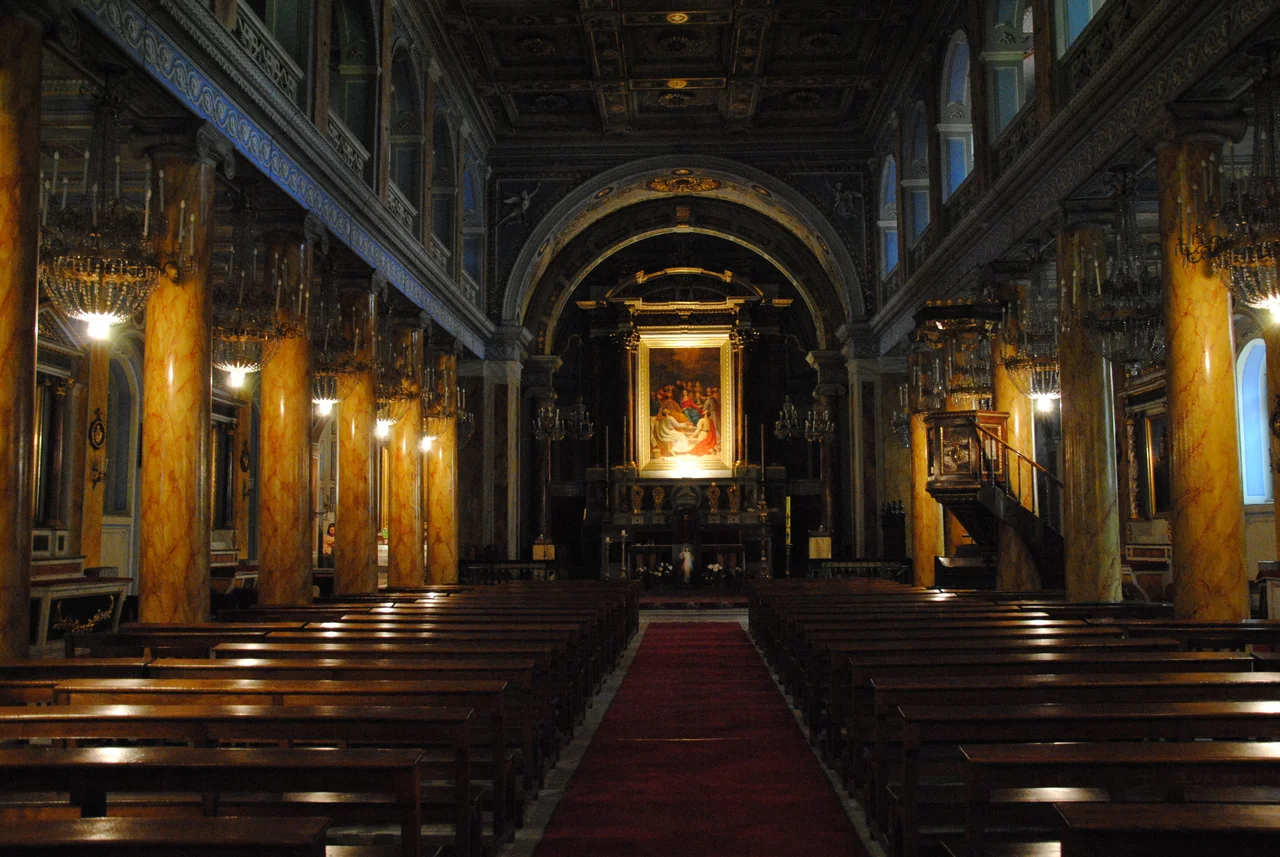
Construction of the Cathedral of the Holy Spirit began and ended in 1846, a single year of building on Cumhuriyet Avenue in what was then the Harbiye district, now part of Şişli. The architect was Gaspare Fossati, a Swiss-Italian who had come to Istanbul when Western-style architecture was becoming fashionable among the Ottoman elite. He was not new to ambitious projects: Fossati and his brother Giuseppe had recently completed the restoration of the Hagia Sophia, one of the most consequential architectural interventions of the 19th century. The cathedral he designed for the Latin Catholic community here is in Baroque style — three naves on a basilica plan, Ionic columns separating the galleries, a coffered ceiling running the length of the nave, and crystal chandeliers providing the light. The façade features a copy of El Greco's Pentecostés. Above the marble high altar hangs an altarpiece by Belgian painter Joseph De Cauwer: The Descent of the Holy Spirit, the scene that gives the cathedral its name.
Earthquake, Repair, and Elevation
The building's first decades were not easy. Financial constraints had forced the use of cheaper materials during construction, and an earthquake in 1865 — less than twenty years after the cathedral opened — heavily damaged the structure. Restoration began the same June and the church reopened that December. Plans to rebuild more substantially were drawn up by architect Pierre Vitalis and Achille Bottazzi, but Vitalis retired before the work could begin, and the project was completed by Father Antoine Giorgiovitch instead. According to historical sources, the church was elevated to the rank of cathedral in 1876, formally becoming the seat of the Apostolic Vicar of Istanbul. The cathedra — the bishop's throne — is still here, giving the building its technical status as a cathedral. New bells were cast in Fermo, Italy, and installed in 1922. Paintings were fully restored in 1980. In 1989 the Salesians of Don Bosco took over administrative responsibility for the cathedral.
A Composer Beneath the Stones
The cathedral crypt held burials until the 1920s, and the names in its vaults tell their own story of Istanbul's Catholic community. Archbishop Julien Hillereau, who directed the cathedral's construction as Apostolic Vicar from 1835 to 1855, is entombed here. So are nuns from the adjacent Lycée Notre Dame de Sion. And so is Giuseppe Donizetti — not the composer of Lucia di Lammermoor, but his older brother, a musician who came to Istanbul at the invitation of Ottoman Sultan Mahmud II and served as the imperial court's music director for decades. Giuseppe Donizetti composed military marches for Mahmud II and Abdülmecid I, including the Mahmudiye March. His family's archives, discovered in the 1970s, are now held at the Topkapı Palace Museum Library. He died in Istanbul in 1856. The crypt that holds him is quiet now.
Popes and the Street That Remembers Them
The side street overlooking the cathedral's bell tower has been known as Papa Roncalli Sokak since 2000, named for Angelo Giuseppe Roncalli — later Pope John XXIII — who served as Apostolic Delegate to Turkey and Greece from 1934 to 1944, using Istanbul as his base. He was known in the city as the Turcophile Pope. The cathedral has since received several papal visits. Pope Paul VI, Pope John Paul II, Pope Benedict XVI, and Pope Francis all came during their respective journeys to Turkey. Francis celebrated Mass for a thousand people here on November 29, 2014, then returned the following day to meet more than a hundred Iraqi and Syrian refugees and African migrants seeking shelter in the city. Pope Leo XIV visited on November 28, 2025, during a joint apostolic journey to Turkey and Lebanon, marking the 1,700th anniversary of the First Council of Nicaea. The cathedral absorbs each visit quietly, as it has absorbed everything else — earthquake, restoration, political change — since Fossati laid its foundations in a year.
From the Air
The Cathedral of the Holy Spirit is located at 41.0447°N, 28.9857°E on Cumhuriyet Avenue in the Pangaltı quarter of Şişli, on the European side of Istanbul between Taksim Square and Nişantaşı. Flying southbound toward the Bosphorus from the northwest, Taksim Square and the grid of Beyoğlu provide clear orientation — the cathedral is approximately 500 meters north-northeast of Taksim. The nearest major airport is Istanbul Airport (LTFM), roughly 30 km to the northwest. The neighborhood is densely built, making the cathedral's Baroque bell tower a useful visual landmark at low altitude.
Nearby Stories
- Kocaeli Peninsula 7.6 km away
- Second Battle of Çatalca 11 km away
- Istanbul's Rural Outskirts 14 km away
- MV Struma 20 km away
- HMAS AE2 36 km away
- Bursa 66 km away
- Sangarius Bridge 71 km away
- Januarius MacGahan 101 km away