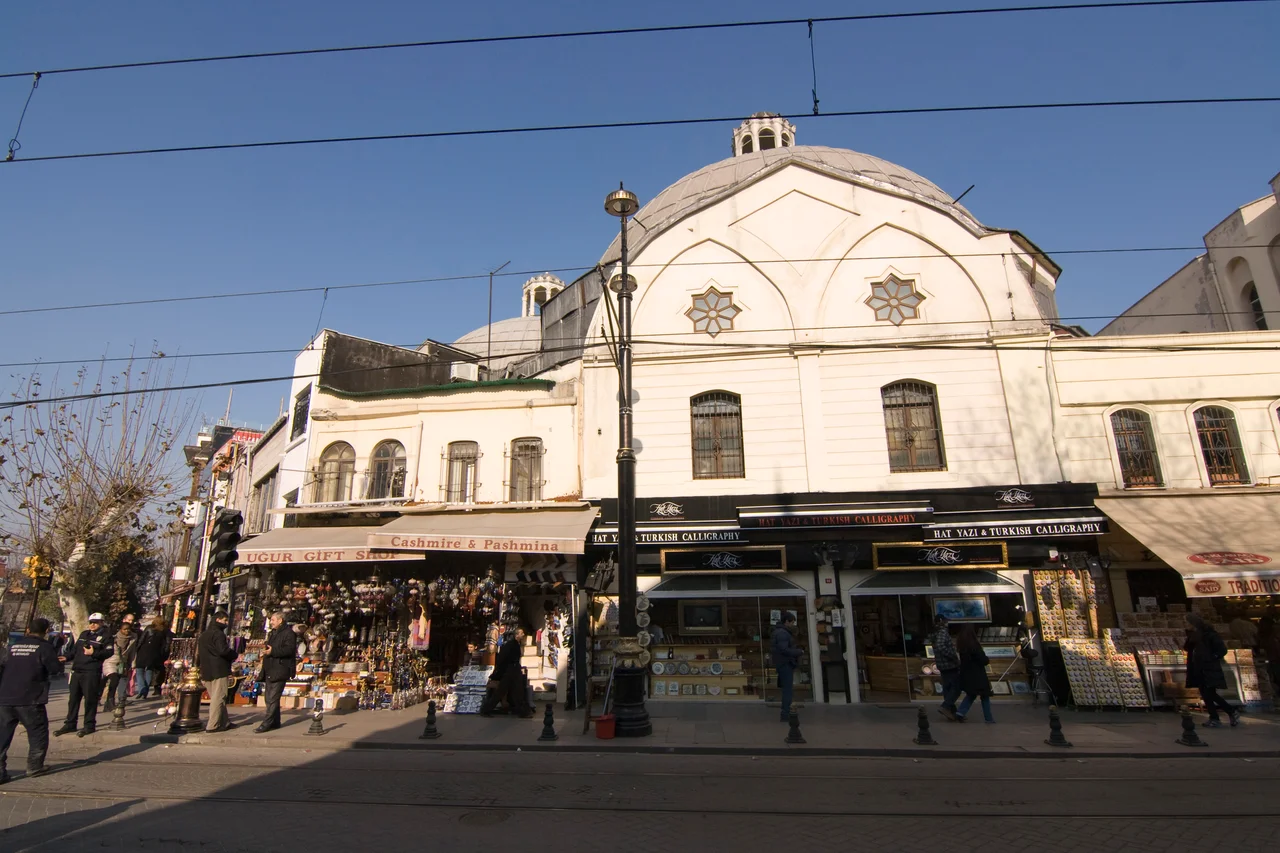

Çemberlitaş Hamamı
The road that runs past the Çemberlitaş Hamamı has been carrying people since the Byzantine Empire. Divan Yolu — the Way of the Divan — follows the line of the ancient Mese, the main processional avenue of Constantinople, the road that once connected the city to Rome. Emperors paraded along it. Pilgrims walked it. Today the T1 tramline runs beside it, and tourists photograph the Column of Constantine that gives the Çemberlitaş district its name. The bathhouse itself, built in 1584, does not advertise its age. It stands between shops on a narrow street off the main road, and you have to look for the entrance. Inside, very little has changed.
The Woman Behind the Marble
The Çemberlitaş Hamamı was not built by an emperor or a great vizier. It was built by Nurbanu Sultan, and her story is worth knowing. Nurbanu had been a concubine in the Ottoman imperial harem, and her position changed completely when her companion Selim II became sultan in 1566 and she became, in the Ottoman hierarchy, the most senior woman at court. After Selim died in 1574, their son Murad III ascended, and Nurbanu took on the role and title of Valide Sultan — Mother of the Sultan. In Ottoman practice, this was a position of genuine administrative power. Nurbanu held authority over the imperial harem, received a stipend calibrated to the number of women in her charge, and used the resources available to her to fund charitable endowments throughout Istanbul. The Çemberlitaş Hamamı was one of them: a public bath on one of the city's busiest streets, designed to serve the population and, through its revenues, to fund mosque complexes elsewhere, including the Atik Valide Mosque complex built in her name.
Sinan's Shadow
Mimar Sinan is almost certainly the name that comes to mind when people learn this bathhouse is from 1584. He was the Ottoman Empire's master builder for most of the 16th century — architect of the Süleymaniye Mosque, the Selimiye in Edirne, hundreds of other structures across the empire. His name has attached itself to the Çemberlitaş Hamamı for centuries. But the attribution is complicated. Sinan compiled five autobiographical lists of his completed works during his lifetime. The Çemberlitaş Hamamı appears in only one of them — the fifth, written after his death. The Atik Valide Mosque, which he clearly valued, appears in all five. Scholars now think the hamam was most likely built by the team of architects who worked under Sinan and completed smaller commissions with limited oversight from the master. Whether or not Sinan personally designed it, the structure reflects the principles of his school: the use of light and space, the careful proportion of the domed chamber, the restraint of its ornament.
Inside the Domed Chamber
A traditional hamam follows a progression: you undress, you rest in the warm room, you enter the hot room, you are washed and scrubbed on the marble slab at the center, and you return slowly to the outside world. The Çemberlitaş Hamamı has followed this sequence for more than four hundred years. The hot room — the hararet — is covered by a dome pierced with small glass windows, so that light enters in filtered shafts and catches the steam. The central marble platform, the göbek taşı, radiates heat from below. For most of the bathhouse's history, this was a necessity: a place where people who had no running water at home could bathe, meet neighbors, and spend a social hour in the warmth. That necessity faded as Istanbul modernized and apartments acquired private bathrooms. Today the visitors who come are looking for something different — not a weekly ablution but an encounter with a place that has been doing exactly this for longer than most institutions in the city have existed.
A Living Fixture on an Ancient Street
The Çemberlitaş Hamamı has survived everything that Divan Yolu has thrown at it over four centuries: fire, earthquake, the slow commercial pressure of a city that never stops rebuilding itself. The entrance is still squeezed between shops, still easy to miss from the street. Inside, the attendants still work the marble, the steam still rises, the dome still filters the light. Nurbanu Sultan built this place as a charitable endowment — a waqf, in Islamic law — intended to generate revenue for the good of the community indefinitely. By that measure, her investment has held. The bathhouse is not a museum. It runs the same operation it has run since Selim II's widow funded it, on the same road that once led to Rome.
From the Air
The Çemberlitaş Hamamı is located at 41.0086°N, 28.9716°E on Divan Yolu in the Çemberlitaş neighborhood of Fatih, on the European (historic peninsula) side of Istanbul. From the air at 1,500 feet, the Column of Constantine — the ancient column of Constantine I — is visible nearby, providing a precise landmark. The Hagia Sophia and Sultanahmet Mosque are roughly 700 meters to the east-southeast. The nearest major airport is Istanbul Airport (LTFM), approximately 37 km to the northwest.
Nearby Stories
- Kocaeli Peninsula 7.6 km away
- Second Battle of Çatalca 11 km away
- Istanbul's Rural Outskirts 14 km away
- MV Struma 20 km away
- HMAS AE2 36 km away
- Bursa 66 km away
- Sangarius Bridge 71 km away
- Januarius MacGahan 101 km away