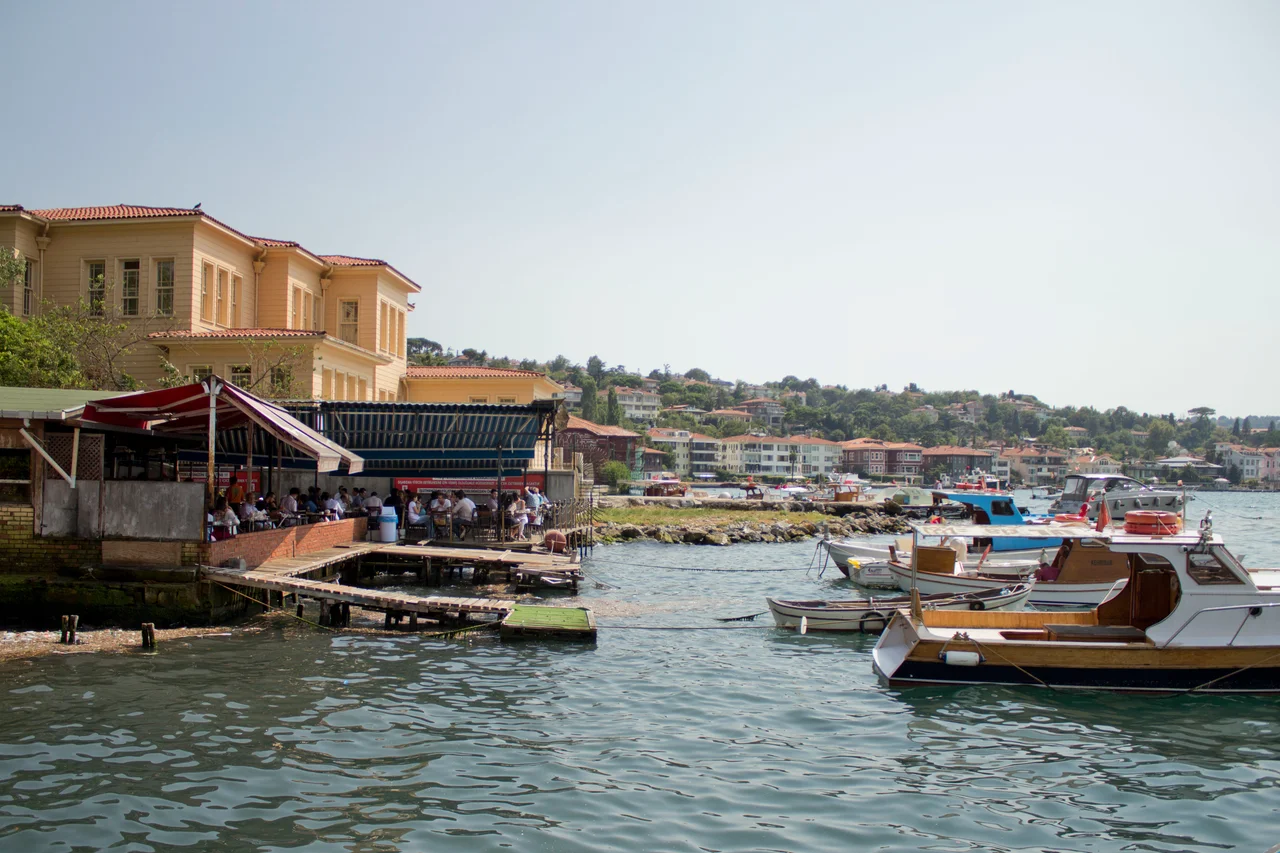

Çengelköy
People come to Çengelköy for the tea garden and stay for the cucumbers — or they used to, before the cucumbers moved to Kandıra. The small, thin-skinned variety of cucumber once grown in the fields above this Bosphorus village became famous across Istanbul: Çengelköy cucumbers were distinct enough in flavor and size that the neighborhood's name attached to them the way a place's name sometimes attaches to a food and never fully lets go. The cucumbers are grown elsewhere now. The tea garden remains. On the Asian shore of the Bosphorus, between the neighborhoods of Beylerbeyi and Kuleli, Çengelköy has been accumulating this kind of gentle notoriety for a very long time.
Sophianai: The Name Before the Name
Before anyone called this place Çengelköy, it had a Greek name: Sophianai. The name came from a palace that the Byzantine Emperor Justin II built on the waterfront in the 6th century for his consort Sophia. Sophia was not merely a consort — she was an unusually powerful empress who effectively co-ruled with her husband during his reign and managed imperial affairs herself when Justin suffered a mental breakdown in the 570s. That a neighborhood still carries the memory of her in its early name, more than fourteen centuries later, is a small testimony to the durability of place names even when everything else changes. The palace is long gone. The port that bore her name became the village that bears a different name entirely.
What the Hook Means
The name Çengelköy means "hook village" in Turkish, and no one is entirely certain which hook it refers to. The most frequently offered explanation traces the name to a 19th-century Ottoman admiral, Çengeloğlu Tahir Pasha, who built a mosque and a waterside mansion here — the kind of Bosphorus yalı, or timber waterfront house, that wealthy Ottomans favored for their cool summers and uninterrupted water views. A street in the neighborhood still bears his family name. A competing theory derives the name from the Persian word çenkar, meaning crab, because of the abundance of seafood once harvested from this stretch of the Bosphorus. A 16th-century Ottoman document refers to the place as "Çenger köyü," which muddies both theories without resolving them. The hook, whatever it referred to originally, has stuck.
The Cucumbers
Çengelköy's most singular claim on the popular imagination was agricultural. The small cucumbers grown here — crispier and more delicate than standard varieties, with a thin skin that bruised easily and did not travel well — became closely associated with the neighborhood through the 19th and early 20th centuries. Vendors sold them to passengers on Bosphorus ferries. Istanbulites recognized them on sight in the markets. They appeared on menus with their provenance noted. This is the kind of food geography that forms slowly and can disappear quickly: when the land was built up and the fields gave way to housing, the cucumber cultivation shifted to Kandıra, a town in Kocaeli Province to the east. The Kandıra cucumbers are related to the original variety. The association between Çengelköy and its cucumber endures in the collective memory of the city even now that the fields are gone.
Ottoman Mansions and a Presidential Pavilion
The Bosphorus shore of Çengelköy is lined with the evidence of the neighborhood's importance to Ottoman elites: the Abdullah Ağa Mansion, the Sadullah Pasha Mansion, and others that have survived the cycles of fire, neglect, and renovation that have claimed so many of Istanbul's wooden waterfront structures. On a hill above the village stands the Vahdettin Pavilion, also called the Çengelköy Pavilion — a former Ottoman royal residence now used as an official guest house of the Turkish presidency. The Greek church of Aya Yorgi stands in the district as well, though it sees little use today. The Çengelköy Campus of the Tarabya British Schools and the Mehmet Çakır Cultural and Sports Center, which opened in 2015 with six indoor swimming pools and claims the title of largest sports complex on Istanbul's Asian side, represent a different kind of neighborhood investment. Çengelköy holds all of this without much apparent strain: the tea garden by the water, the old mansions, the modern sports complex, and somewhere in the collective Istanbul memory, the cucumbers.
From the Air
Çengelköy is located at 41.0491°N, 29.0620°E on the Asian shore of the Bosphorus, in the Üsküdar district of Istanbul. Flying northbound along the Bosphorus from the south at 1,500 feet, the neighborhood is visible between the Bosphorus Bridge and the second Bosphorus Bridge (Fatih Sultan Mehmet Bridge), on the eastern bank. The Kuleli Military High School building provides a clear visual landmark immediately to the south of Çengelköy. The nearest major airport is Sabiha Gökçen International Airport (LTFJ), approximately 25 km to the southeast. The Bosphorus shoreline is best viewed in morning light when visibility is clearest.
Nearby Stories
- Kocaeli Peninsula 7.6 km away
- Second Battle of Çatalca 11 km away
- Istanbul's Rural Outskirts 14 km away
- MV Struma 20 km away
- HMAS AE2 36 km away
- Bursa 66 km away
- Sangarius Bridge 71 km away
- Januarius MacGahan 101 km away