
Church-Mosque of Vefa (Molla Gürani Mosque)
The neighborhood of Vefa sits on the southern slope of Constantinople's third hill, a short walk from the Süleymaniye Mosque's great cascade of domes. Among the Ottoman-era streets, a smaller building stands that does not quite look like anything around it. Its walls speak two architectural languages at once: the brickwork of middle Byzantine Constantinople, with its characteristic recessed courses where alternate layers are set back from the wall face and buried in deep mortar beds, and the more ornate layering of the Palaiologan period, that last creative flourish of an empire already shrinking. This is the Molla Gürani Mosque — also known as the Church-Mosque of Vefa, the Vefa Kilise Camii — a building that began as an Eastern Orthodox church, probably in the tenth or eleventh century, and has been a mosque since the Ottomans took Constantinople in 1453. Its original dedication remains uncertain; it may have been consecrated to Saint Theodore, but the evidence is indirect. What is certain is its architectural importance: alongside the Eski Imaret Mosque nearby, it is one of the most significant surviving examples of Byzantine Komnenian building in the city.
Bricks That Speak of Empire
Byzantine masons of the middle period worked in a distinctive way. Alternate courses of brick were set back from the wall's outer face, buried deep in a thick mortar bed, so that the exposed courses were separated not by thin mortar joints but by ridges of plaster nearly three times the thickness of the brick itself. The effect, when the building was new, was a rhythmic, textured surface of alternating brick and pale render. Judging by this masonry, the main body of the church at Vefa was built sometime in the tenth or eleventh century. The building proper has blind arcades, a triple lancet window interrupting the apse, and occasional decorative snake patterns on the exterior. Light enters the cross arms through triple arcades. Underground, two large cisterns survive to the south and west of the main structure — evidence that whatever stood here was likely a monastery complex, with the water storage that any significant community of monks required.
The Palaiologan Flourish
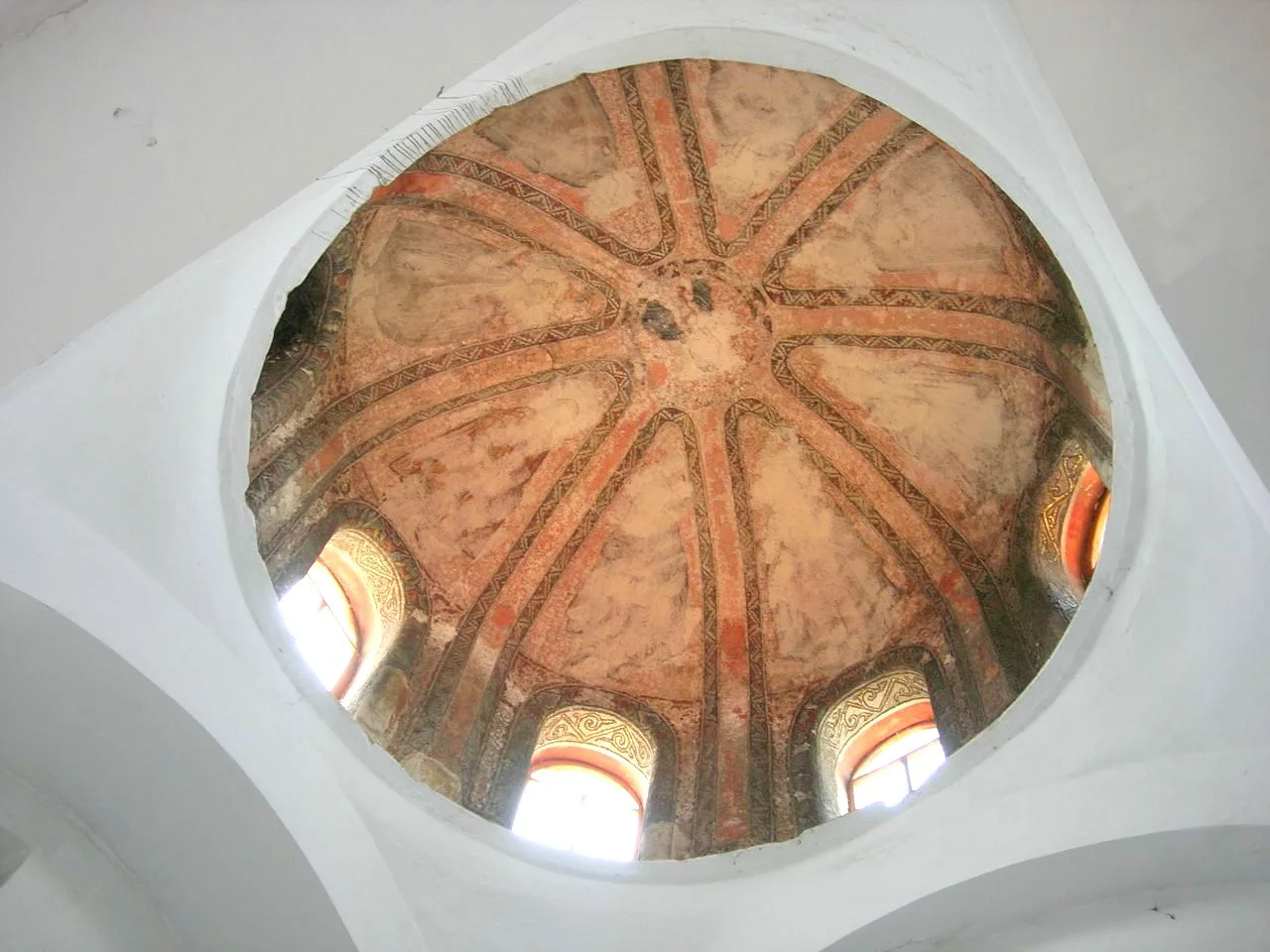
Late in the Byzantine period — after the chaotic interlude of the Latin occupation and the restoration of Greek imperial rule in 1261 — the church received a new exonarthex on its western end. This is where the building becomes genuinely remarkable. The Palaiologan dynasty, ruling a shrinking empire and a capital slowly losing population, nonetheless presided over one of Byzantine architecture's most inventive periods. The exonarthex at Vefa dates to this era, and it shows. Its facade rises in two orders, both articulated with arcades. The lower order alternates angular niches with triple arched openings; the upper presents five semicircular blind arcades framing windows. The masonry here is colorful banded brickwork and stonework, especially pronounced on the north face. Three domes surmount the exonarthex — two of the umbrella type, the central one with ribs — and the columns, capitals, and carved closure slabs inside are reused material from earlier Byzantine buildings, columns and capitals gathered from structures that had already become ruins.
Mosaics Under Plaster
When Ottoman workmen plastered over the interior of the exonarthex after 1453, they sealed beneath it a series of mosaic programs that would not be seen again for centuries. In 1937, work under the direction of M. I. Nomides and the Ministry of Mosques cleaned the south and central domes, revealing mosaics showing the Virgin Theotokos surrounded by prophets, and imperial officers with prophets. By 2007, however, those mosaics had almost entirely disappeared — deterioration, moisture, and time had done what the plaster had not. The main body of the church has never been de-plastered, and whatever decoration survives beneath remains unseen. The potential is tantalizing: the Komnenian and Palaiologan periods are among the richest for Byzantine mosaic art, and the exonarthex mosaics, while now lost, compared in type with those of the great Chora Church and the Pammakaristos. What lies on the walls inside the nave is a question that preservation concerns and the building's active use as a mosque have left unanswered.
A Neighborhood of Layered Time
Vefa today is a quietly historic quarter. A few hundred meters to the northwest, the Kalenderhane Mosque is another Byzantine church-turned-mosque. The Süleymaniye, Sinan's masterpiece, rises not far to the south — its domes dominating the skyline from almost every angle. Wander the streets around the Molla Gürani and the layers of time become almost visible: Ottoman timber houses above Byzantine foundation walls, a minaret beside a Byzantine dome, a modern repair in ancient brick. The building's name in Turkish — Kilise Camii, church-mosque — is a form of honest labeling unusual in any city. Istanbul has dozens of such structures, former churches converted after 1453, but most have lost their hybrid name. This one wears it openly. Inside, the space is functional and lived in, a working mosque that happens to occupy a thousand-year-old shell. Outside, if you know where to look, the alternating brick courses and deep mortar beds of the Komnenian masons are still there, still speaking their measured Byzantine rhythm.
From the Air
The Molla Gürani Mosque sits at approximately 41.016°N, 28.960°E, on the third hill of historic Istanbul in the Fatih district, neighborhood of Vefa. From the air at 2,000 feet, the building is small and largely obscured by surrounding structures, but the Süleymaniye Mosque's massive dome complex provides a clear landmark approximately 300 meters to the south-southeast. The Golden Horn waterway is visible to the north. Nearest airport is LTFM (Istanbul Airport), approximately 35 km to the northwest on the European shore. The entire historic peninsula — Hagia Sophia, the Hippodrome, Topkapı Palace — spreads to the southeast. Best approach for visual reference: fly the Golden Horn from east to west at 2,500 feet and look south at the Vefa neighborhood on the hillside below the Süleymaniye complex.
Nearby Stories
- Kocaeli Peninsula 7.6 km away
- Second Battle of Çatalca 11 km away
- Istanbul's Rural Outskirts 14 km away
- MV Struma 20 km away
- HMAS AE2 36 km away
- Bursa 66 km away
- Sangarius Bridge 71 km away
- Januarius MacGahan 101 km away