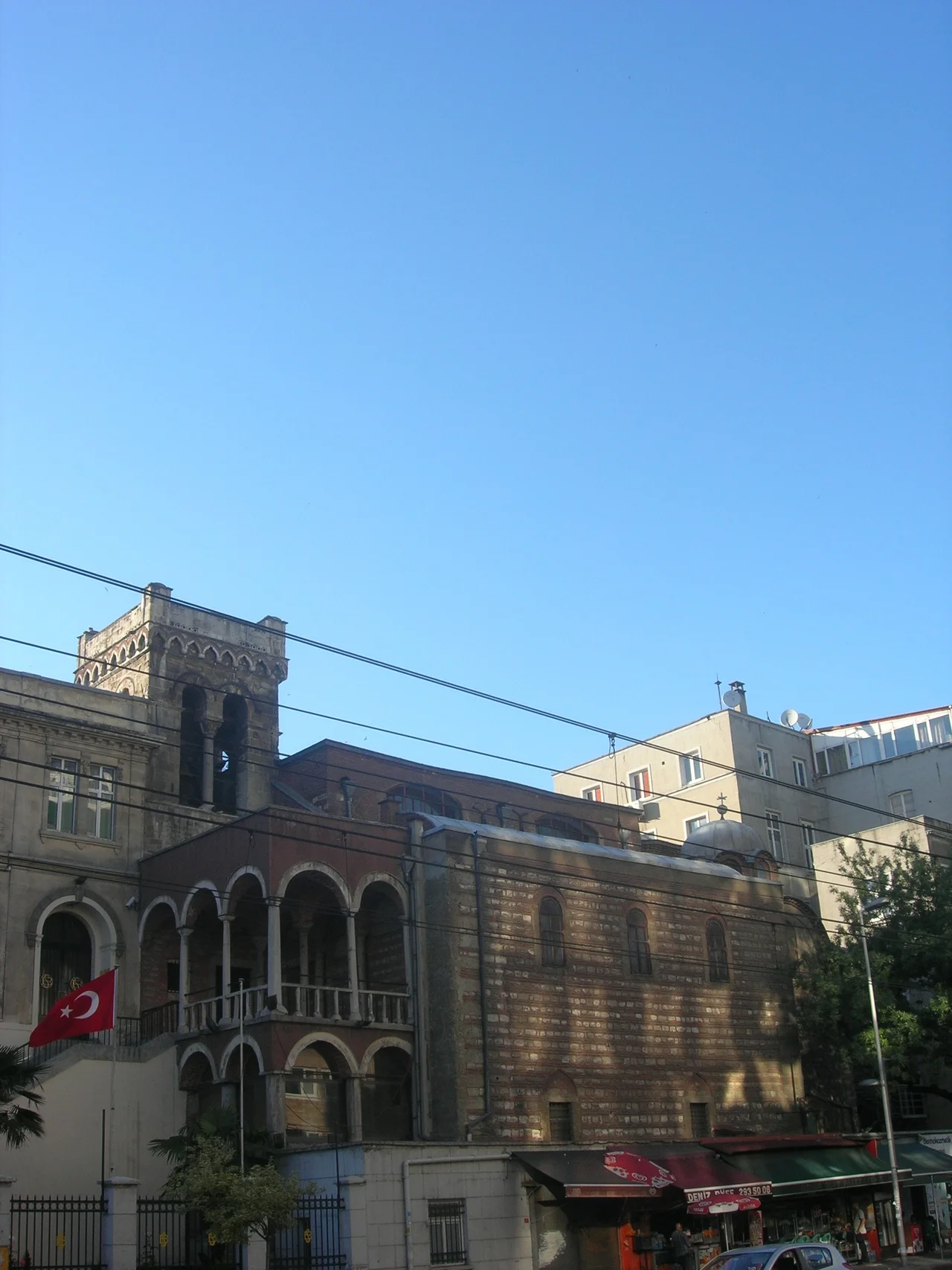

Church of Saint Benoit, Istanbul
On May 12, 1427, a Benedictine friar named Dom Nicolas Meynet climbed the southeastern slope of the Galata hill in Constantinople with a group of brothers from Genoa and founded a monastery. Constantinople was still a Christian city — the Ottomans would not take it for another twenty-six years — but the city was weakening, the Genoese trading colony in Galata was prosperous and politically careful, and the friars built their church just inside the latest expansion of the Genoese citadel walls. The church they raised, jointly dedicated to Saint Benedict and the Virgin Mary, stood on the ruins of an older Byzantine church and beside a large cistern. That foundation has been in continuous use as a Catholic church ever since. Nearly six hundred years later, the Church of Saint Benoit at Kemeraltı Caddesi 11 in Karaköy — ancient Galata — is the oldest Catholic church in Istanbul still serving its congregation.
The Genoese Shore
Galata, the district across the Golden Horn from Constantinople proper, was the Genoese quarter — a semi-autonomous trading settlement that had existed under Byzantine and then Ottoman tolerance for generations. By 1427, the Genoese had enlarged their defensive walls six times, the sixth and final expansion creating the perimeter within which Meynet chose his site. The Galata tower, built by the Genoese in 1348, still rises above the neighborhood today. This was a world of merchants, consuls, and competing European interests on the fringes of a Byzantine empire that everyone could see was fading. The Benedictines who arrived with Meynet were building not only a church but a Catholic institutional presence in a city that was about to change hands. When Mehmed II entered Constantinople in 1453, Galata negotiated a careful surrender and preserved its privileges. The church survived the transition. It continued as a Catholic place of worship under the Ottomans — a fact that speaks to the complex tolerances of early Ottoman rule toward non-Muslim communities in the city.
Under Threat and Under New Management
Not all of Saint Benoit's history was peaceful accommodation. At some point after the conquest — the precise date is not given in the sources — Sultan Suleyman the Magnificent threatened to convert the building into a mosque for Moorish refugees: the Muslims and Jews who had been expelled from Spain beginning in 1492 and were being resettled in Ottoman territories, including Galata. The threat apparently did not materialize, and the church continued. In 1540, the French traveler Pierre Gilles visited and described a remarkable cistern nearby with three hundred columns — probably the same cistern the original Benedictines had noted when they chose the site. The Genoese later dismantled those columns and sold them. The cistern is gone. In 1583, the Jesuits arrived. On November 18 of that year, members of the Society of Jesus led by Giulio Mancinelli, dispatched by Pope Gregory XIII at the request of the Genoese administration in Galata, took charge of the church and founded a school in the monastery's precincts. The first two naves end to the east in small domed chambers — a detail suggesting the building had already undergone significant modification from its original form.
A Staircase, a Terrace, a Church
Saint Benoit is not easy to find if you don't know where to look. At Kemeraltı Caddesi 11, a staircase leads up to a terrace where the church stands slightly above the street, insulated from the noise of the neighborhood by its elevation. Karaköy today is a dense commercial district at the base of the Galata bridge, full of hardware shops, fishmongers, and the new cafés that have colonized the old warehouses. The church is in the middle of all of it and apart from all of it simultaneously. The building that stands today reflects reconstructions and renovations over many centuries — the categories note a rebuilding completed in 1871 — so the structure is not the one Meynet raised in 1427. But the foundation is the same foundation, the site is the same site, and the use is continuous. That continuity is what makes Saint Benoit unusual among Istanbul's religious buildings: it has never been converted, confiscated, abandoned, or repurposed. It has simply been a Catholic church, serving a congregation, for nearly six hundred years.
Faith at the Intersection
What Saint Benoit represents is not just an old building but a thread of Catholic community life in a city that became predominantly Muslim. Istanbul has always been a city of communities existing alongside one another — Greek Orthodox, Armenian, Jewish, Catholic, Syriac, and others — each maintaining its institutions as best it could through successive political upheavals. Saint Benoit belongs to this plural fabric. The Jesuits who ran it for generations made it a center of Catholic education in the city; the school in the monastery continued long after the church's founding. Today the church falls under the jurisdiction of the Apostolic Vicariate of Istanbul. On Sundays, the congregation that gathers here comes from the international Catholic community of the city — French speakers, Italian speakers, and others who find in this building a continuity that neither the Ottomans nor the centuries could entirely erase. Above the staircase, on a terrace on the slope of Galata hill, the church of Dom Nicolas Meynet's Benedictines still stands.
From the Air
Saint Benoit is located at approximately 41.025°N, 28.977°E in the Karaköy neighborhood (ancient Galata) of the Beyoğlu district, on the European shore of Istanbul. From the air at 2,000 feet, Galata is identifiable by the cylindrical tower of Galata Kulesi rising from the hilltop — one of the most distinctive landmarks in the Istanbul skyline. The church lies on the southeastern slope of that hill, close to the waterfront where the Golden Horn meets the Bosphorus. The Galata Bridge is visible below. Nearest airport is LTFM (Istanbul Airport), approximately 30 km to the northwest. The European historic peninsula — Hagia Sophia, the Blue Mosque — is directly across the Golden Horn to the south.
Nearby Stories
- Kocaeli Peninsula 7.6 km away
- Second Battle of Çatalca 11 km away
- Istanbul's Rural Outskirts 14 km away
- MV Struma 20 km away
- HMAS AE2 36 km away
- Bursa 66 km away
- Sangarius Bridge 71 km away
- Januarius MacGahan 101 km away