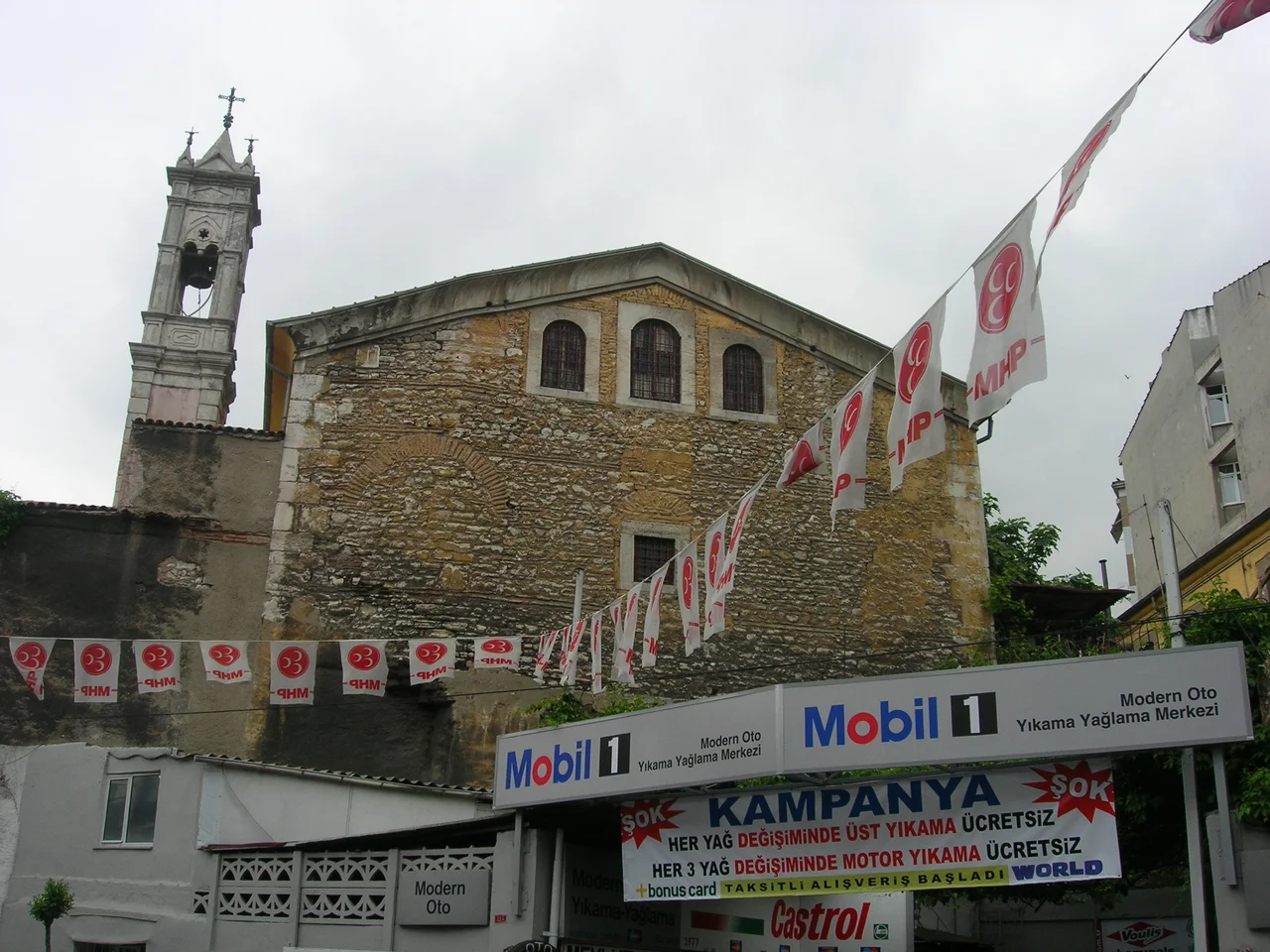

Church of Saint Menas of Samatya
Below the Church of Saint Menas on a street in Samatya, there is a room underground. It is horseshoe-shaped in plan, 2.5 meters wide and 7.5 meters high, with the remains of a spiral staircase at one end and a small cell with an apse at the other. This is a martyrion — a chamber built to mark a place where Christian martyrs died or were buried — and according to the Church Fathers, it dates to the fourth century, when Empress Helena, mother of Constantine the Great, authorized its construction in memory of Saints Carpus and Papylus. If that tradition is accurate, this underground room was already ancient when the Ottoman Turks conquered Constantinople in 1453, already ancient when the Crusaders sacked the city in 1204, already ancient when the Iconoclast controversy was tearing the Byzantine church apart. The church above it, dedicated to Saint Menas, was built in 1833, which makes it relatively new. The ground it stands on is very old.
Samatya: The Greek Shore
Samatya — formally known today as Kocamustafapaşa — is a neighborhood inside the old walled city of Istanbul, elevated above the Sea of Marmara's western shore, not far from the ancient Theodosian Walls. For centuries it was one of the principal Greek Orthodox neighborhoods of Istanbul, part of the arc of communities — Samatya, Yedikule, Kumkapı — that maintained the city's Greek Christian presence through Byzantine, Ottoman, and into the Republican era. The Church of Saint Menas stands on Bestekar Hakkı Sokak, its building enclosed within a high protective wall. A spring dedicated to Saint Menas, known as a hagiasma, lies opposite the martyrion on the street below. These holy water sources — hagiasmas — are central to Greek Orthodox devotional practice and exist throughout Istanbul's old neighborhoods, often at sites of ancient sanctity whose original dedications shift over time but whose waters are considered continuously holy.
From Martyrion to Martyrion
The site has accumulated dedications like geological strata. At the deepest layer, according to tradition, Empress Helena commissioned a martyrion and monastery to Saints Carpus and Papylus in the fourth century, when the Xeropholos hill on which Samatya sits was still outside Constantinople's original walls — before Theodosius II extended them to the sea in the early fifth century. On the same site, or very near it, stood at some point a church dedicated to Hagios Polykarpos — another early Christian martyr. Then the spring and the modern church above adopted the dedication to Saint Menas, an Egyptian military martyr widely venerated in the early church. The martyrion below currently houses an iron workshop and a car wash shop, and is in a dilapidated state. The staircase that once led up from the underground chamber to the church above is ruined. That a sacred space of potentially sixteen centuries of age is being used as a repair workshop is not unusual in a city where Byzantine structures are embedded in the fabric of ordinary urban life — but it is worth pausing over.
The Church Built in 1833
The building above ground was constructed in 1833, during the Ottoman period, at a time when the Greek Orthodox community of Istanbul was still substantial and active. The nineteenth century saw considerable church-building and rebuilding by Istanbul's Greek community, and Saint Menas belongs to that wave. The church sits in an elevated position behind its protecting wall, visible from the street but set apart from it — a common arrangement for Greek Orthodox churches in the old city, which often occupy slightly raised terraces that give them a degree of separation from the surrounding neighborhood. Inside, the church follows the liturgical traditions of the Ecumenical Patriarchate of Constantinople, the ancient seat of Greek Orthodox Christianity whose headquarters at the Phanar in Istanbul continues to this day. The saint to whom it is dedicated — Menas of Egypt, a soldier-martyr of the third or fourth century — is among the most widely venerated figures in both Eastern and Western Christianity.
A Community That Persists
The Church of Saint Menas appears in the historical record in painful context: it is listed among the sites damaged in the Istanbul pogrom of September 6–7, 1955, when organized violence targeted Greek Orthodox, Armenian, and Jewish properties across the city. Mobs destroyed or heavily damaged homes, churches, cemeteries, schools, and businesses. People were killed and thousands were injured. The violence accelerated the emigration of Istanbul's Greek community, which had already been declining since the 1923 population exchange; the community that had numbered in the hundreds of thousands contracted to a few thousand in the following decades. Churches like Saint Menas stand today in neighborhoods where Greek voices are seldom heard and the congregations that fill them are small. The people who built and sustained these institutions, who lit candles before these icons and sang the liturgy in these spaces, did so across centuries of difficult circumstances. Their descendants continue. The spring of Saint Menas still flows. The hagiasma still draws worshippers. The underground room with its horseshoe vault still lies beneath the street, waiting for the attention it deserves.
From the Air
The Church of Saint Menas of Samatya is located at approximately 41.000°N, 28.932°E, in the Kocamustafapaşa neighborhood (historic Samatya) of the Fatih district, inside the old walled city of Istanbul on the European shore. From the air at 2,000 feet, the distinctive arc of the Theodosian Walls is visible running north-south a few hundred meters to the west; the Sea of Marmara shines to the south. The neighborhood sits on the slope between the ancient walls and the shoreline. Nearest airport is LTFM (Istanbul Airport), approximately 32 km to the northwest. The Yedikule Fortress and the land walls are useful visual anchors; Samatya lies just inside the walls from the Marmara shore, roughly midway along their length. Weather from the Marmara can reduce visibility quickly in this area; approach from the north over the walled city for the clearest views.
Nearby Stories
- Kocaeli Peninsula 7.6 km away
- Second Battle of Çatalca 11 km away
- Istanbul's Rural Outskirts 14 km away
- MV Struma 20 km away
- HMAS AE2 36 km away
- Bursa 66 km away
- Sangarius Bridge 71 km away
- Januarius MacGahan 101 km away