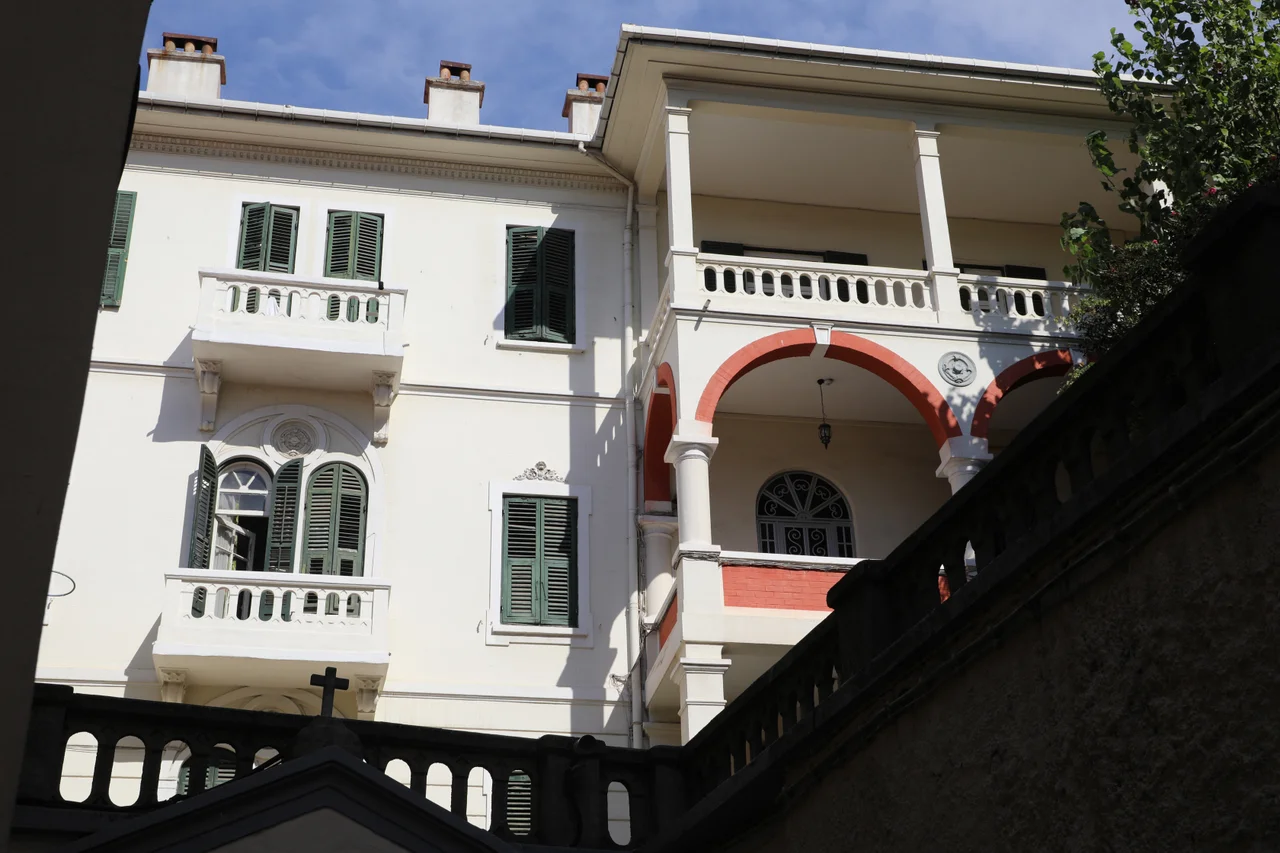

Church of SS Peter and Paul, Istanbul
Somewhere in Galata, tucked below the looming stone cylinder of the Galata Tower, there is a church that has been destroyed and rebuilt, argued over, negotiated, burned, and reborn — and through it all, a single icon survived. The Church of SS Peter and Paul is a Dominican church with a history as layered as Istanbul itself: Genoese landlords, Ottoman law, a candle lit annually in the name of a dead merchant, and a cupola painted sky blue with gold stars that looks, inside, like a fragment of heaven.
A Genoese Bargain
The story begins not with friars but with a family. The Zaccaria — a Genoese dynasty with deep roots in the medieval Mediterranean — owned a house with a chapel in the Galata neighborhood, below the tower that still dominates the district's skyline. Before 1475, the property passed to the Zaccaria from the Bisticcia family, likely through inheritance rather than purchase. That date matters: 1475 was the year Dominican clergy, displaced when their own church of SS. Paolo e Domenico was converted into a mosque after the Ottoman conquest, needed somewhere to go. Antonio Zaccaria let them in.
By 1535, the arrangement was formalized in writing with Antonio's grandson Angelo. But the written agreement was essentially a renewal — the Dominicans had already been there for decades. The terms were clear and curious: the Zaccaria retained patronage rights, could audit the friars' accounts, and could remove clergy found guilty of misconduct. The friars agreed to fund repairs and, as a gesture of gratitude, to present a blessed candle every Feast of Candelora. They also committed to celebrating a mass in memory of Angelo Zaccaria and his ancestors. A renewable contract, every twelve years, between a merchant family and a religious order — the bureaucratic texture of Renaissance piety.
Fire, Law, and the Rescued Icon
In 1603 and 1604, the modest chapel was rebuilt as a proper church with an adjoining monastery. For half a century it stood. Then in 1660, fire took everything — almost. When the flames died, the church and monastery were total losses. Under Ottoman law, the land reverted to the government, because the destruction had been complete. What survived was the icon: an image of the Virgin Mary of the Hodegetria type, a style of icon in which the Virgin points toward the Christ child, indicating the way. This particular icon had traveled a long way. It originally belonged to a Dominican church in Caffa, in Crimea, before making its way to Istanbul.
The friars eventually rebuilt. The current church, which still stands today, was constructed between 1841 and 1843 — a nineteenth-century reconstruction by the Swiss-Italian architects the Fossati brothers, Gaspare and Giuseppe, who are better known for their restoration of Hagia Sophia. The Fossati commission for this church produced something striking in a different register: intimate, baroque-influenced, with a four-sided nave and side altars.
Sky Blue and Gold Stars
Inside, the church reads as a basilica. Four side altars flank the nave, and above the choir rises a cupola painted sky blue and studded with gold stars — a ceiling that seems to lift the eye outward into something imagined rather than built. It is the kind of interior detail that rewards a quiet visit, when the tourist crowds of nearby İstiklal Avenue haven't yet found their way down the hill.
The adjacent building, Saint Pierre Han, has had a stranger life. At various times it housed the Constantinople Bar Association, the Italian Chamber of Commerce, the Ottoman Bank (between 1856 and 1893), a mustard producer, and a denim workshop. In 2011, plans were announced to convert it into a cultural center in partnership with Istanbul Municipality. As of 2022, that renovation remained in progress. The neighborhood, historically one of the first stops for European immigrants arriving in Istanbul, has always accommodated multiple lives within its old stone walls.
The Dominican Parish of Galata
The parish jurisdiction of SS Peter and Paul traditionally extended over the lower part of the Galata neighborhood — the district below the tower, where Genoese merchants once built trading houses and where Catholic communities maintained their presence through five centuries of Ottoman rule. That continuity is the real story: not just architecture, but a community that found ways to persist, negotiate, rebuild, and persist again.
Today the church is known in Turkish as Sen Piyer Kilisesi. Masses are still held here, still Dominican, still in the same location the Zaccaria family held under terms renewable every twelve years. The icon rescued from the 1660 fire still rests inside. Whatever the next transformation of Saint Pierre Han turns out to be, the church at its side carries the longer memory of this corner of the city.
From the Air
The Church of SS Peter and Paul sits at approximately 41.025°N, 28.973°E in the Galata district of Istanbul, on the European side of the Bosphorus. Approaching from the north at 3,000 feet, the Galata Tower — a 14th-century Genoese fortification — is the primary landmark; the church is tucked immediately below it on the tower's southern side. The Golden Horn waterway and the Bosphorus strait are both visible from this altitude, with the historic peninsula of Sultanahmet across the water to the southeast. The nearest major airport is LTFM (Istanbul Airport), approximately 35 km to the northwest. Visibility is typically best in spring and autumn; summer haze can reduce contrast over the dense urban fabric of Beyoğlu.
Nearby Stories
- Kocaeli Peninsula 7.6 km away
- Second Battle of Çatalca 11 km away
- Istanbul's Rural Outskirts 14 km away
- MV Struma 20 km away
- HMAS AE2 36 km away
- Bursa 66 km away
- Sangarius Bridge 71 km away
- Januarius MacGahan 101 km away