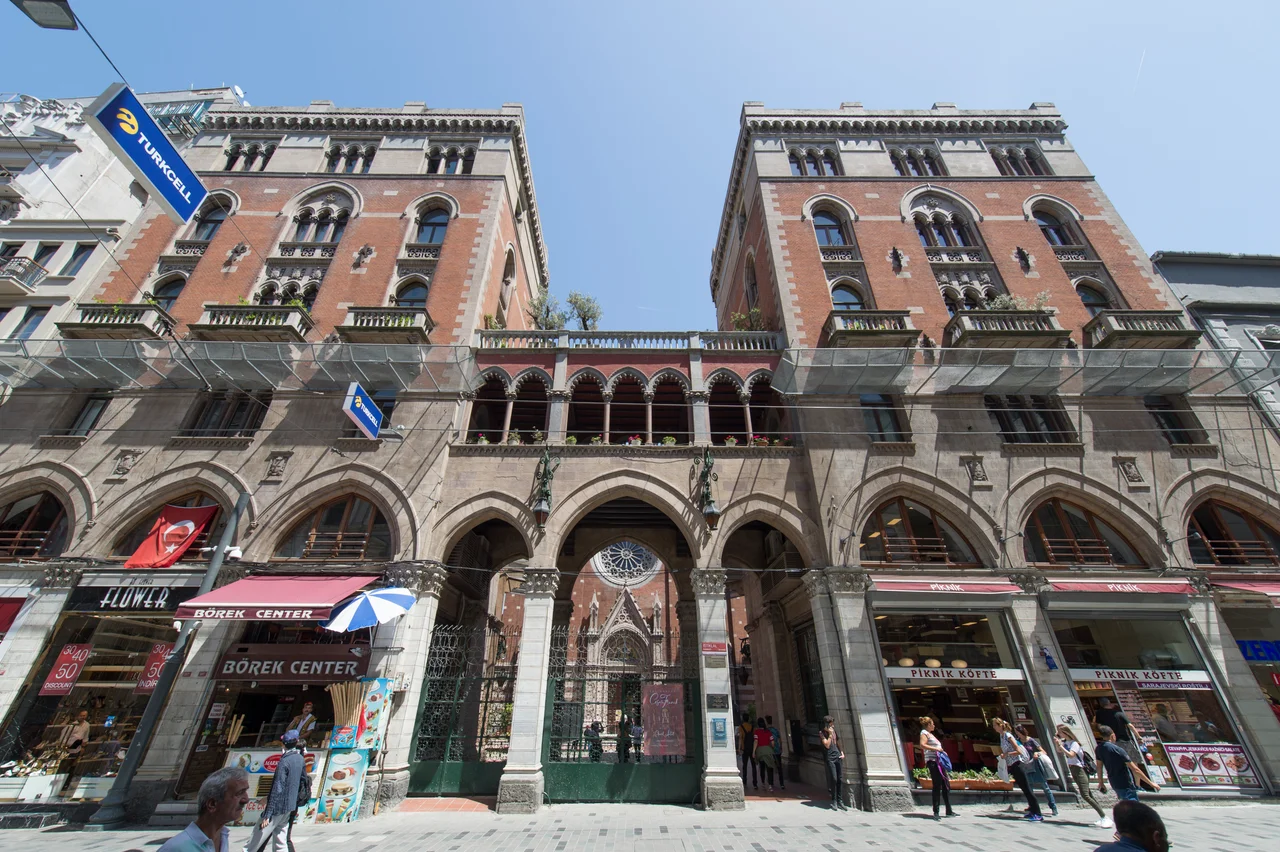

Church of St. Anthony of Padua, Istanbul
For ten years, a Vatican diplomat preached from this pulpit — a diplomat who would eventually become Pope John XXIII, and who spoke Turkish well enough that Turks called him their own. The Church of St. Anthony of Padua on İstiklal Avenue is Istanbul's largest Catholic church, built between 1906 and 1912 in red brick and Venetian Neo-Gothic arches, rising from one of the city's busiest pedestrian streets as an improbable reminder that Istanbul was once home to a thriving Italian community 40,000 strong.
An Italian City Within a City
At the start of the twentieth century, Istanbul's Italian community was large enough to constitute a city of its own. Predominantly descended from Genoese and Venetian merchants who had been trading in the city for centuries, the community numbered around 40,000. In 1725, an earlier Italian church had been built on this site. When that building could no longer serve the congregation, the community commissioned something far more ambitious: a full basilica in the Venetian Neo-Gothic style, designed by the Levantine architect Giulio Mongeri.
Mongeri was the right choice. His portfolio included some of Istanbul's most accomplished early twentieth-century buildings — the Maçka Palas in Nişantaşı, the Neo-Byzantine Karaköy Palas bank building in Galata, and the first headquarters of Türkiye İş Bankası in Ankara. For the church on İstiklal Avenue, he produced something with genuine weight: red brick façades, pointed Gothic arches, and a scale that holds its own against the commercial energy of the street. Construction ran from 1906 to 1912. The residential buildings flanking it — the St. Antoine Apartmanları — were completed in the same campaign, giving the whole complex an integrated presence.
The Turkish Pope
Angelo Giuseppe Roncalli arrived in Istanbul in 1935 as the Vatican's Apostolic Delegate to Turkey and Greece. He would stay for a decade. During those years he preached at St. Anthony's, learned Turkish, and developed what observers described as a genuine affection for the city and its people. Turks who knew him used the informal nickname "the Turkish Pope" — partly for his language skills and partly for the warmth with which he engaged the Muslim-majority country around him.
In 1958, Roncalli became Pope John XXIII. He went on to call the Second Vatican Council, opening the Catholic Church to a process of reform and renewal that reshaped it globally. A bronze statue of him now stands in the church's courtyard on İstiklal Avenue, his hand raised in blessing toward the crowds that pass on one of Istanbul's most walked streets. It is an unusual monument: a pope, on a public avenue, in a majority-Muslim city that he loved.
Three Languages Before Noon
Walk into St. Anthony's on a Sunday morning and you will hear the liturgy in Italian at 11:30 — and in Polish in the crypt at the same hour, and in English at 10:00, and in Turkish at 19:00. The church runs masses in four languages on Sundays, and adds Turkish and English on weekdays. It is, in a functional sense, one of the most multilingual Catholic churches in the world: a reflection of its parish, which draws not only from Istanbul's small remaining Italian-descended Levantine community but from expatriates, tourists, international students, and the city's own Catholic Turks.
That multiplicity is something the church has always had. İstiklal Avenue was once called the Grande Rue de Pera, the main commercial street of the European quarter, thronged with Greeks, Armenians, Jews, Levantines, and Ottoman subjects of every background. The church anchored the Italian portion of that cosmopolitan street.
A Contested Landmark
Since 2016, the church has been the subject of a legal dispute. According to news reports, a man named Sebahattin Gök obtained a power of attorney from the owners of the land underlying the church, then attempted to place the property on the market. Lawyers acting for the Vatican intervened to prevent the sale, and the case has continued through the courts.
The dispute is a reminder of how the legal foundations of historic minority religious properties in Istanbul can be complicated — layered titles, Ottoman-era ownership records, and the complexities of Turkish property law all intersecting in a building that the Catholic Church considers one of its most significant in the region. Whatever the courts ultimately determine, the church itself remains open, its masses said in four languages, the statue of John XXIII presiding in the courtyard.
From the Air
The Church of St. Anthony of Padua is located at approximately 41.032°N, 28.977°E in Beyoğlu on Istanbul's European side, along İstiklal Avenue. From 3,000 feet, İstiklal Avenue is a long pedestrian spine running roughly northeast from Taksim Square — the church is identifiable by its red brick Neo-Gothic façade about halfway along the avenue. The Bosphorus strait is visible to the east, with the Asian shore of Istanbul beyond. The Galata Tower marks the district to the south. The nearest major airport is LTFM (Istanbul Airport), approximately 32 km to the northwest.
Nearby Stories
- Kocaeli Peninsula 7.6 km away
- Second Battle of Çatalca 11 km away
- Istanbul's Rural Outskirts 14 km away
- MV Struma 20 km away
- HMAS AE2 36 km away
- Bursa 66 km away
- Sangarius Bridge 71 km away
- Januarius MacGahan 101 km away