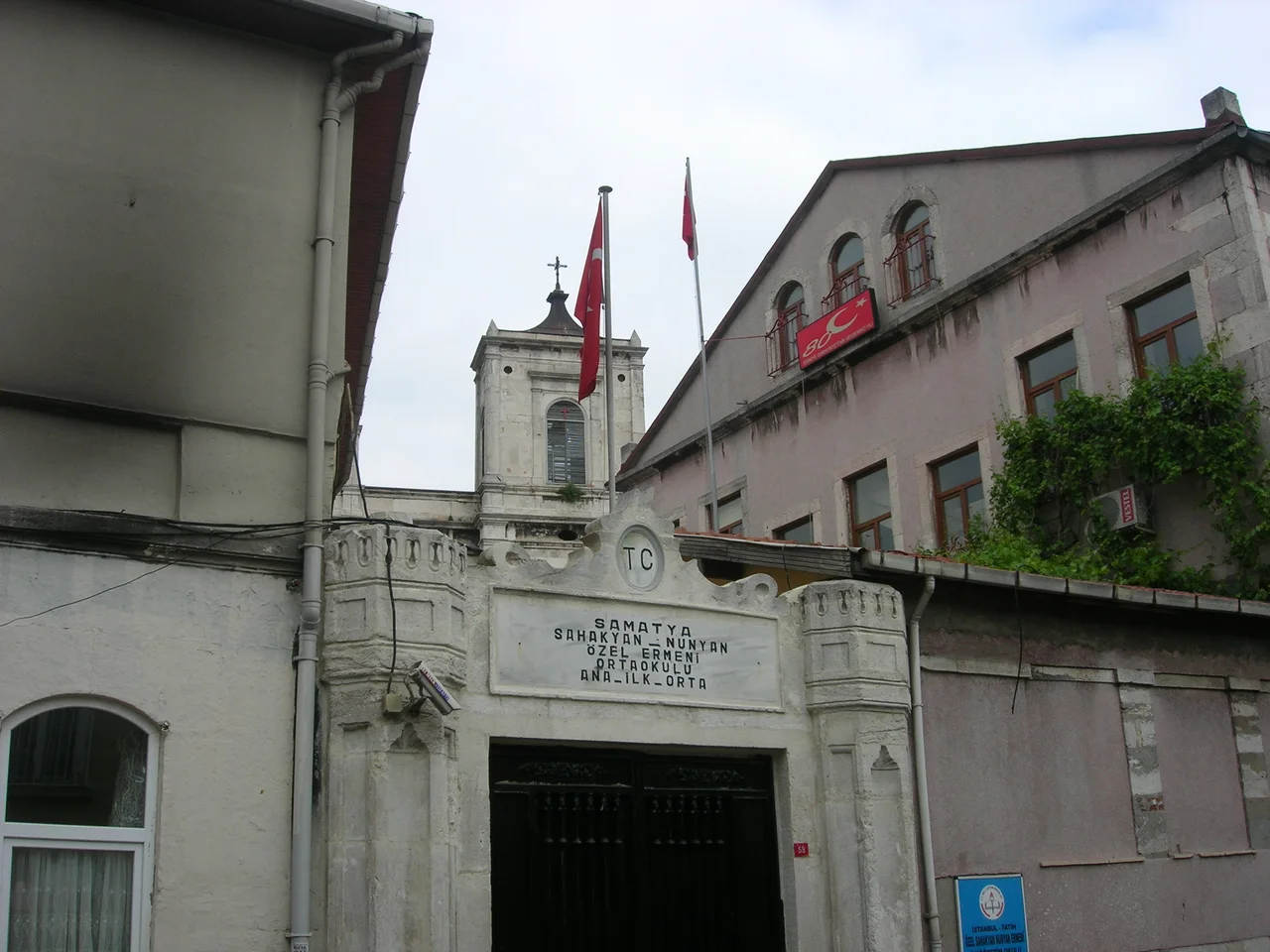

Church of St. George of Samatya
The Turks called it Sulu Manastır — the Water Monastery. The name points to something older than the current building, older than the Armenian community that has called it home for centuries: a spring, sacred long before the first stone of the present church was laid. The Church of St. George of Samatya, known in Armenian as Surp Kevork, stands inside the old city walls a short walk from the Sea of Marmara, a quiet compound on a Fatih neighborhood street where the accumulated weight of fifteen centuries of religious life is compressed into a single modest building.
Layers Beneath the Ground
The current church, built between 1866 and 1887, rests on the foundations of a Byzantine monastery from the eleventh century. That earlier complex was dedicated to the Theotokos Peribleptos — the Ever-Vigilant Mother of God — and was founded by Byzantine Emperor Romanos III Argyros between 1028 and 1034. It was one of the most important Greek Orthodox monasteries in Constantinople. Even before Romanos built his monastery, the site had a religious history: in the fifth century, a church dedicated to Hagios Stephanos en tais Aurelianai stood on the same ground, near the Helenianai Palace.
The Spanish ambassador Ruy González de Clavijo, who visited Constantinople in 1402, wrote that the Byzantine church of St. Mary Peribleptos had a central plan — a square nave surmounted by a dome, with an atrium and side rooms — similar in style to Hosios Loukas and the Daphni Monastery in Greece. The columns were green jasper. Inside, relics were displayed, including what was believed to be the body of Saint Gregory. After the Latin sack of Constantinople in 1204, the church briefly remained in Greek hands before being given to Venetian Benedictine monks.
A Gift of 1453
When the Ottoman sultan Mehmed II conquered Constantinople in 1453, the city's religious landscape was remapped. Many Greek Orthodox churches were converted. Others changed hands. The Peribleptos monastery was transferred to the Armenian community of Constantinople — a community with deep roots in the city, one of the oldest continuously present Christian peoples in Anatolia.
For a period after 1453, the site became the seat of the Armenian Patriarchate of Constantinople, the governing institution of the Armenian Apostolic Church in the Ottoman capital. The Armenian Patriarchate's presence here was not merely symbolic; it anchored the community's religious and cultural life during a period of enormous transformation. The transfer of the Peribleptos to the Armenians was one of several gestures through which the early Ottoman state acknowledged — and formally organized — the city's non-Muslim populations.
The Present Church and Its Holy Spring
The church standing today was built between 1866 and 1887, a rectangular building with sides of roughly twenty and thirty meters. It is oriented southwest to northeast, with an apse at the northeast end and a bell gable. Inside, the nave is covered by a barrel vault, richly decorated. The building is surrounded by a high wall that shields the compound from the street, creating a cloistered interior space.
Over the ayazma — a sacred spring or holy water source — that gave the complex its Turkish name, a chapel was built and dedicated to Saint John the Forerunner (John the Baptist in the Western tradition). The spring is considered one of the most beautiful ayazmalar in Istanbul. The tradition of holy springs in Constantinople and Istanbul runs deep; they were points of veneration long before Christianity and remained sacred across the city's religious transformations. At Surp Kevork, the spring is still a living part of the site.
The Armenian Community of Samatya
The neighborhood of Kocamustafapaşa, historically known as Samatya, has been an Armenian-populated quarter of Istanbul for centuries. It lies inside the old city walls, in the district of Fatih, at the western edge of the historic peninsula — a working-class neighborhood of cobblestone streets and old stone houses that has been slower to gentrify than Beyoğlu or Galata.
The Armenian community of Istanbul has endured enormous pressures over the twentieth century: the catastrophic losses of 1915 and the years that followed, the Varlık Vergisi wealth tax of 1942 that fell disproportionately on non-Muslim citizens, and the pogrom of September 1955 that drove many Greeks, Armenians, and Jews from the city. The community that remains is smaller than it once was, but it persists. Surp Kevork — the Water Monastery, the church of Saint George — is one of the places where that persistence takes visible form, Sunday after Sunday, inside a walled compound that has been Armenian sacred ground since the year the Byzantine Empire ended.
From the Air
The Church of St. George of Samatya (Surp Kevork) sits at approximately 41.002°N, 28.933°E in the Fatih district of Istanbul, on the European side, near the Sea of Marmara shore. From 3,000 feet, the Sea of Marmara is the dominant southern landmark; the historic land walls of Constantinople (Theodosian Walls) run north-south just to the west of this position. The church compound is within the walled city, in a densely built residential neighborhood. The Bosphorus and the Galata Tower are visible to the northeast. The nearest major airport is LTFM (Istanbul Airport), approximately 40 km to the northwest.
Nearby Stories
- Kocaeli Peninsula 7.6 km away
- Second Battle of Çatalca 11 km away
- Istanbul's Rural Outskirts 14 km away
- MV Struma 20 km away
- HMAS AE2 36 km away
- Bursa 66 km away
- Sangarius Bridge 71 km away
- Januarius MacGahan 101 km away