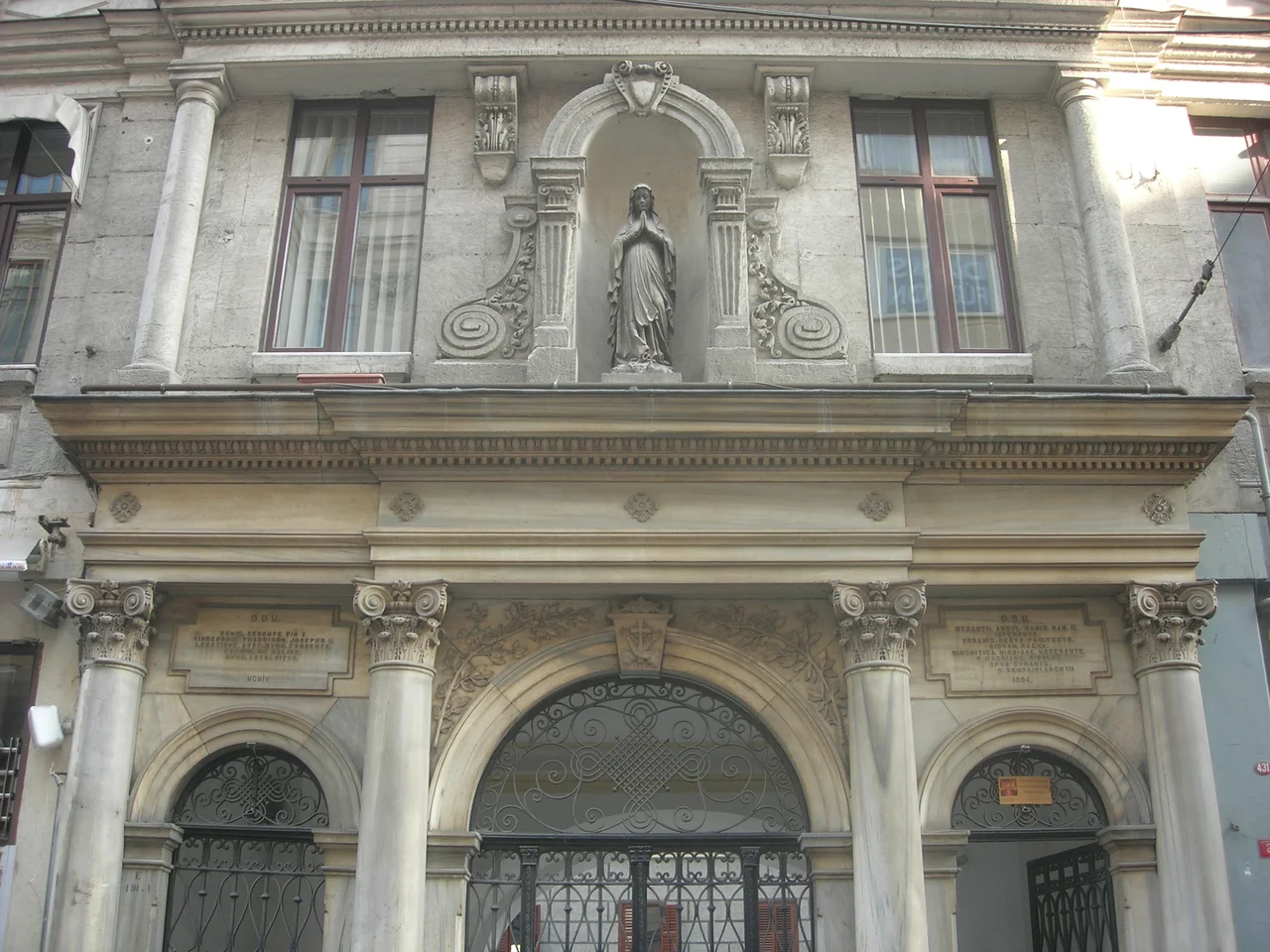

Church of St. Mary Draperis, Istanbul
You could walk past it a dozen times without noticing the entrance. On İstiklal Avenue, between the cafés and the bookshops, a neoclassical doorway with a statue of the Virgin in a niche opens onto a steep flight of stairs descending away from the street — and at the bottom, half-hidden below the level of the avenue, is the Church of St. Mary Draperis. It owes its name to a woman. In 1584, a Levantine woman named Clara Maria Draperis gave Franciscan friars a house with a tiny chapel in the Galata neighborhood, adorned with a wooden icon of the Virgin Mary. That icon, through fire and demolition and reconstruction, has never left.
The Franciscans and the City That Kept Changing
The story of this church begins with displacement. In 1453, just months before the Ottoman conquest of Constantinople, Observant Franciscan friars completed a church in Sirkeci — the neighborhood on the southern bank of the Golden Horn that was then the center of Venetian merchant life in the city. After the conquest, they were forced to leave. For more than a century they moved through the city, finding temporary homes before eventually settling, in 1584, in Galata.
There, Clara Maria Draperis gave them a house and a chapel. The altar held a wooden icon of the Virgin Mary. In 1660 — the same year that devastated several churches across Istanbul — fire destroyed the chapel completely. The icon was rescued by a member of the Draperis family, who carried it out of the flames. When the friars tried to rebuild immediately, they lacked the required Sultan's firman — an imperial decree permitting reconstruction. The hastily rebuilt church was demolished in 1663 by the Ottoman authorities. The friars rebuilt again, more carefully this time. By 1678, the parish was formally established, making it one of the oldest Catholic parishes in Istanbul.
The Staircase and What Lies Below
The church's position below street level is both accidental and quietly dramatic. İstiklal Avenue — once called the Grande Rue de Pera — was raised and rebuilt over centuries, and the church, tucked into the hillside, found itself literally underground in relation to the street above. Entering today, you pass through a neoclassical gateway with the Virgin in her niche, then descend a staircase protected by a wrought-iron fence. The transition from the noise of İstiklal to the hushed interior is abrupt and complete.
The building has a rectangular plan covered by a barrel vault, decorated in 1874, and three naves. A bell tower rises with a square plan, invisible from the street above. The main altar, erected in 1772, is made of pink Carrara marble and still holds the icon that Clara Maria Draperis gave to the friars. On March 25, 1911, in a ceremony of particular significance, the icon was pontifically crowned — a formal Catholic honor recognizing it as an object of deep community veneration.
Venetian Paintings and a Protector Against Plague
The interior is richly furnished. Three of the four paintings are of the Venetian school — a tradition of religious painting with warmth and compositional depth suited to the intimate scale of the church. The first, painted in 1873, shows the Immaculate Virgin with two Franciscan saints. The second represents St. Francis of Assisi receiving the Stigmata at La Verna. To the left of the presbytery, a painting shows the death of Saint Joseph attended by Jesus and Mary.
Near the entrance hangs a painting of Saint Roch, the protector against plague. It is not a decorative afterthought. Plague struck Istanbul multiple times across the centuries, and for communities living in the crowded lanes of Galata and Pera, the threat was intimate and recurring. Saint Roch was a genuine intercessor. The two stained-glass windows on the apse, from the German school, depict Saint Francis and Saint Clare of Assisi. Along the walls, gravestones from the eighteenth and nineteenth centuries — inscribed in Italian and Latin — record the names of Levantine merchant families, bishops, and European consuls who once worshipped here.
Still Franciscan, Still Open
The Church of St. Mary Draperis is still served by reformed Franciscan friars, as it has been for centuries. Daily masses are said in Italian; on Sundays, a mass is said in Spanish. The continuity is not incidental — it is the point. The Franciscan presence in this corner of Istanbul stretches back to the years just before the Ottoman conquest, a thread that was broken and retied many times but never fully cut.
In the gravestones along the walls, the diplomats and merchants of Baroque-era Istanbul are still named, still remembered. The icon Clara Maria Draperis gave in 1584 still sits at the pink marble altar below the avenue's noise. And the staircase below the neoclassical gateway still delivers you, every time, from the rushing present into a quieter room.
From the Air
The Church of St. Mary Draperis is at approximately 41.033°N, 28.977°E in Beyoğlu, Istanbul, on the European side, along İstiklal Avenue. From 3,000 feet, İstiklal Avenue is identifiable as the long pedestrian spine running northeast from Taksim Square; the church is set slightly below street grade and is architecturally embedded in the building fabric of the avenue. The Bosphorus is visible to the east, Galata Tower to the south. LTFM (Istanbul Airport) is the nearest major airport, approximately 32 km to the northwest.
Nearby Stories
- Kocaeli Peninsula 7.6 km away
- Second Battle of Çatalca 11 km away
- Istanbul's Rural Outskirts 14 km away
- MV Struma 20 km away
- HMAS AE2 36 km away
- Bursa 66 km away
- Sangarius Bridge 71 km away
- Januarius MacGahan 101 km away