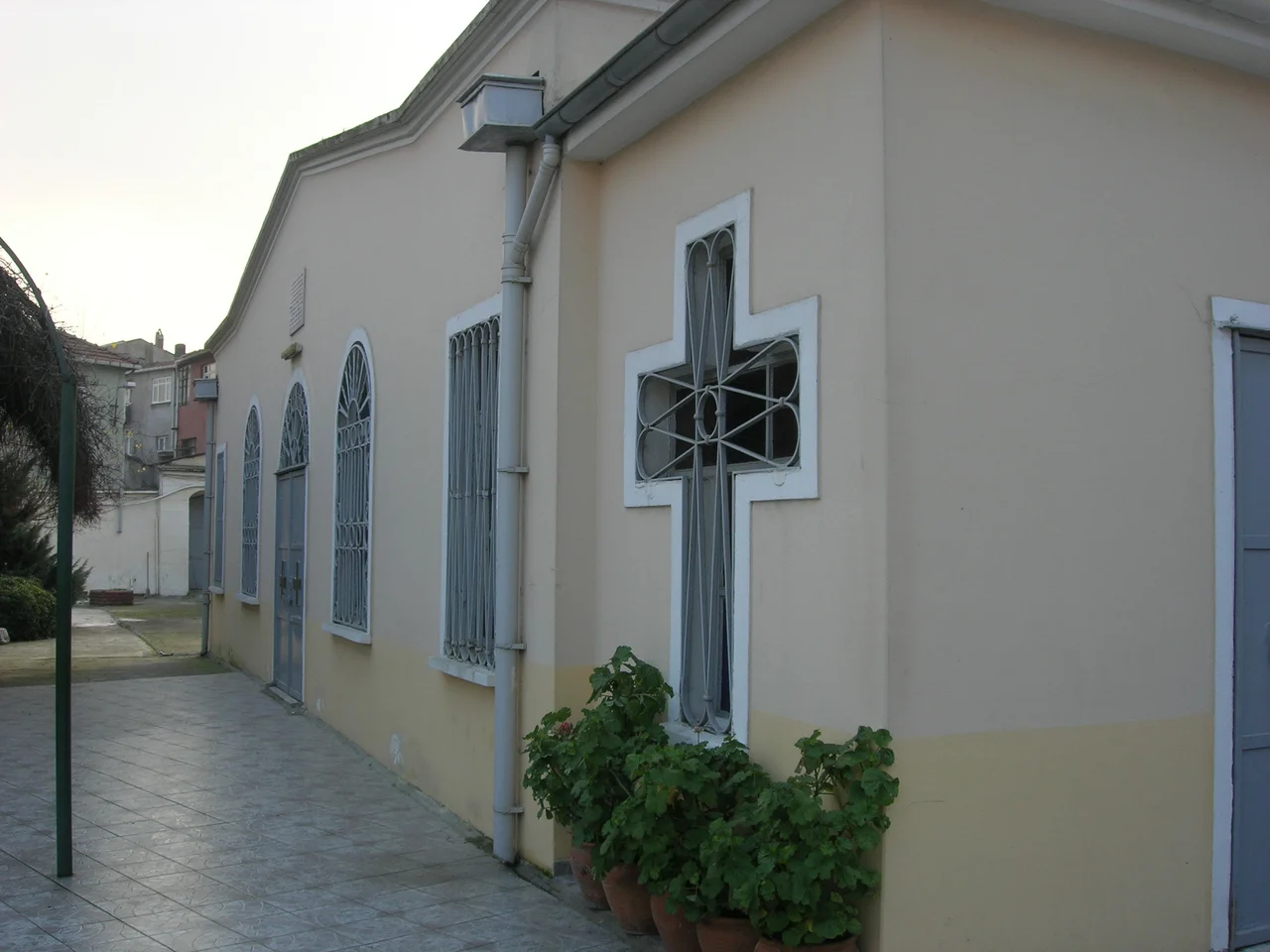

Church of St. Mary of Blachernae
In the summer of 626, with the combined armies of the Avars and the Persians surrounding Constantinople and the emperor away fighting in Mesopotamia, the city's defenders carried an icon along the walls. Shortly after, the Avar army collapsed. The Khan of the Avars, explaining his retreat, said he had been frightened by the vision of a jewel-bedecked woman walking the ramparts. The woman, the Byzantines understood, was the Virgin Mary — and her home was the Church of St. Mary of Blachernae, just inside the city walls at the edge of the Golden Horn. For a thousand years, this was the most powerful sacred site in the Byzantine world.
A Spring, an Empress, and an Empire
The site begins with water. In 450, Empress Aelia Pulcheria began constructing a church near an ayazma — a holy spring — outside the Theodosian Walls, at the foot of the sixth hill of Constantinople. After her death in 453, her husband Emperor Marcian completed the shrine. Then Emperor Leo I added two flanking structures: the Ayía Sorós (holy reliquary), which came to hold the holy mantle and robe of the Virgin after they were brought from Palestine in 473, and the Ayion Loúsma, the sacred bath that enclosed the spring.
The district name itself is disputed. One tradition holds that it derives from the Greek word for a type of fish — "Lakernai" — that locals caught there in quantity. A Romanian scholar suggested it might trace to a word for the Vlachs, a Romance-speaking people, and the remains of a small Vlach settlement in the area. Neither etymology is certain. What is certain is that by the sixth century, the complex at Blachernae had become inseparable from the spiritual identity of Constantinople.
The Icon That Defended the City
The church held an icon of the Virgin called the Vlachernítissa — painted on wood, decorated with gold and silver, and regarded by the Byzantines as a direct source of divine protection. The 626 siege was only the most dramatic demonstration. The Arab siege of 717 to 718 was also credited to the intercession of the Vlachernitissa. In 860, during a Rus invasion, the patriarch plunged the Virgin's veil — the mafórion, another relic kept at Blachernae — into the sea to invoke God's protection for the fleet. The fleet survived. In 926, during war against Simeon of Bulgaria, the relics' spiritual potency helped persuade the Bulgarian tsar to negotiate rather than assault the city.
The miraculous reputation of the icon extended to a weekly phenomenon. Every Friday after sunset, when the church was empty, the veil covering the icon slowly rose to reveal the face of the Virgin. Twenty-four hours later it fell again. The miracle was not considered reliable — it did not happen every week — but when it occurred, it was witnessed and recorded. It ceased entirely after the Fourth Crusade's Latin conquest of 1204.
Destruction and Rebuilding
The church burned completely in 1070 and was rebuilt by Emperors Romanos IV Diogenes and Michael VII Doukas to the same plan. By the time the Spanish ambassador Ruy González de Clavijo visited in 1402, the building was divided into three aisles; the columns were green jasper, with gilded capitals and bases carved in white marble. The dome was gone by then, replaced by a multicoloured compartmented ceiling with golden garlands.
On June 29, 1434, a fire started accidentally by noble children hunting pigeons on the roof destroyed the entire complex and the surrounding quarter. The Byzantine church was never rebuilt in its original form. The Ottoman conquest came nineteen years later. It was not until the nineteenth century that a small new church was constructed on the site. Today that modest church stands, protected by a high wall and fronted by a garden — a quiet compound inside the old city walls of Ayvansaray, in the Fatih district.
The Spring That Still Flows
The sacred bath — the Ayion Loúsma — was where the Byzantine emperors immersed themselves annually, on August 15, the Feast of the Dormition of the Virgin. The bath had three parts: a robing room, a domed pool called the kólymbos where water flowed from the hands of a marble statue of the Virgin, and the hall of Saint Photinos. After the bath complex was eventually incorporated into the rebuilt church, a palindrome inscription was placed above it: Nípson anomímata mi mónan ópsin — "Wash the sins, not only the eyes."
Every Friday morning, the Akathist Hymn is still sung at the church. The Akathist was composed by Patriarch Sergius during the siege of 626 — the same siege that the icon's procession along the walls was said to have ended. To sing it here, at the site where that story began, is to inhabit a long continuity. The spring still flows. The Greek Orthodox congregation still gathers. Above the pool, the same palindrome still asks the visitor the same old question.
From the Air
The Church of St. Mary of Blachernae is located at approximately 41.039°N, 28.943°E in the Ayvansaray area of Fatih district, Istanbul, on the European side just inside the old Theodosian city walls where they approach the Golden Horn. From 3,000 feet, the Theodosian Walls are a prominent linear feature running roughly north-south along the western edge of the historic peninsula; the Golden Horn waterway curves around to the north. The church is near the northern terminus of the walls, close to where they meet the water. LTFM (Istanbul Airport) is the nearest major airport, approximately 37 km to the northwest. The Bosphorus is visible to the east.
Nearby Stories
- Kocaeli Peninsula 7.6 km away
- Second Battle of Çatalca 11 km away
- Istanbul's Rural Outskirts 14 km away
- MV Struma 20 km away
- HMAS AE2 36 km away
- Bursa 66 km away
- Sangarius Bridge 71 km away
- Januarius MacGahan 101 km away