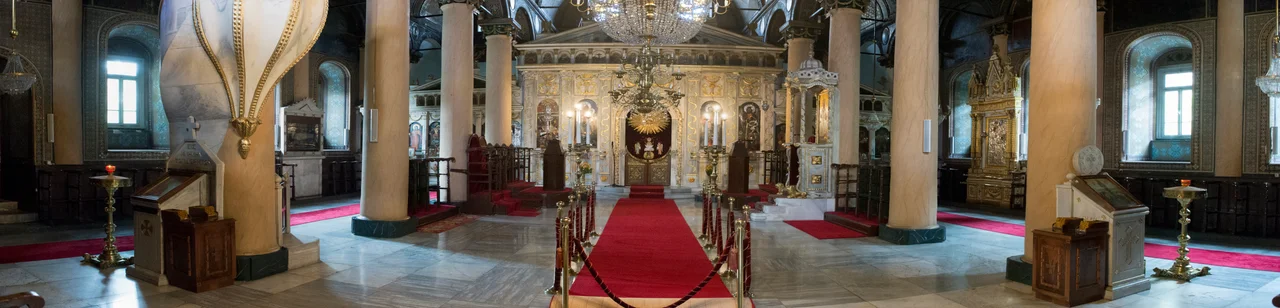

Church of St. Mary of the Spring (Istanbul)
Descend twenty-five marble steps below the church floor and you reach water. The spring has been there longer than any structure built over it — longer, perhaps, than memory reaches. The Greeks call this place Zoödochos Pege, the Life-Giving Spring, and for fifteen hundred years pilgrims have come to drink from its basin, hoping for healing. The Turkish name, Balıklı, means simply "place of fish," and the fish are still there too, circling slowly in the marble pool, carrying with them one of Istanbul's most enduring legends.
The Spring Before the Church
The shrine began with water, not stone. Long before Justinian ordered a church built here — around 559 to 560, according to historians Procopius and Cedrenus — the spring outside the Theodosian Walls was already drawing the sick and the faithful. The emperor himself supposedly came across a small chapel while hunting, surrounded by women who told him it marked "the spring of the miracles." He built his church with marble left over from the construction of the Hagia Sophia, which gives some sense of the scale he had in mind. That first great structure did not survive the centuries intact. By the time the French scholar Pierre Gilles visited in 1547, the church no longer stood at all — only the spring, still drawing the afflicted, still offering its water in the absence of any altar above it.
The Fish and the Fall of Constantinople
The legend attached to Balıklı is precise in its detail, which is part of what makes it stick. On May 23, 1453 — two days before Constantinople fell to the Ottoman forces — a monk was frying fish by the holy spring. Someone ran to tell him the city was lost. The monk refused to believe it. He said he would only accept the news if the fish he was cooking came back to life and leapt into the water. And according to the legend, that is exactly what happened: the half-fried fish dropped into the spring and have been swimming there ever since, their one side still bearing the marks of the fire. The fish are real — they have inhabited the marble basin for centuries. Whether the legend explains them or they inspired the legend is a question the spring does not answer.
Rebuilt, Destroyed, Rebuilt Again
The current church was built between 1833 and 1835, one of the most recent in a long succession of structures on this site. It stands in the Zeytinburnu district, a few hundred meters outside the old land walls near the Gate of Silivri, surrounded by high enclosure walls and two large cemeteries — one Greek Orthodox, one Armenian. The crypt below, adorned with paintings and icons, is surmounted by a dome painted with Christ against a starry sky. Light enters from above and concentrates on the spring. The water flows into a marble basin. The fish circle. It is a place that feels genuinely ancient despite the relatively young building, because the thing that matters here has never changed.
September 1955
On the night of September 6 and into September 7, 1955, mobs moved through Istanbul in coordinated attacks targeting Greek, Armenian, and Jewish communities and their property. At Balıklı, the church was burned to the ground. A 90-year-old archimandrite, Chrisanthos Mantas, was killed. The graves of Ecumenical Patriarchs in the adjacent cemetery were desecrated. The violence — which came to be known as the Istanbul pogrom — caused the deaths of at least 37 people and the destruction of more than 4,000 properties across the city. It accelerated the departure of much of Istanbul's remaining Greek community. The church was subsequently rebuilt. Today, 14 Ecumenical Patriarchs are buried in the cemetery beside it, and the monastery continues as an active Eastern Orthodox institution — one of the last such communities left in Turkey.
A Living Pilgrimage
The sanctuary is still directed by a titular bishop and remains one of the most visited Orthodox sites in Istanbul. Greeks and others come in greatest numbers on the Friday after Easter — a tradition that has persisted across conquest, destruction, and decades of displacement. The crypt, with its icon of the Virgin of the Spring, its marble basin and attending fish, its twenty-five descending steps, receives pilgrims who are, in some sense, doing what pilgrims have always done here: seeking something the city above cannot offer. Nearby, the Balıklı Greek Hospital continues to serve the community. The spring is still life-giving — or at least, that is what fifteen centuries of visitors have come to believe.
From the Air
The Balıklı monastery sits at 41.0065°N, 28.9157°E in the Zeytinburnu district on Istanbul's European side, just outside the Theodosian land walls. At 2,000–3,000 feet, the long line of the ancient walls running north to south is clearly visible; look for the Gate of Silivri about 500 meters to the east of the monastery complex. The nearest major airport is Istanbul Airport (LTFM), approximately 30 km to the northwest. On approach to LTFM from the south, the European shoreline of the Sea of Marmara and the historic peninsula come into view together.
Nearby Stories
- Kocaeli Peninsula 7.6 km away
- Second Battle of Çatalca 11 km away
- Istanbul's Rural Outskirts 14 km away
- MV Struma 20 km away
- HMAS AE2 36 km away
- Bursa 66 km away
- Sangarius Bridge 71 km away
- Januarius MacGahan 101 km away