
Church of St. Polyeuctus
Justinian is said to have stood inside the completed Hagia Sophia and cried out, "Solomon, I have surpassed thee!" It was a remarkable boast — except that a woman had made the same boast first, about a different building, a few years earlier, and she was talking about Justinian. Her name was Anicia Juliana. Her church, the Church of St. Polyeuctus, rose between 524 and 527 as the largest in Constantinople, a monument built not to the glory of God alone but as a deliberate provocation to the new emperor she despised. Today, all that remains of it is a scatter of foundations and carved marble in a park near the Istanbul Metropolitan Municipality City Hall — but what remains is astonishing.
A Noblewoman's Defiance
Anicia Juliana was descended from a line of Western Roman emperors, a pedigree that made the upstart Justinian dynasty look provincial by comparison. When Justin I came to the throne in 518, Juliana was already in her sixties and had spent decades as one of the most powerful women in Constantinople. Shortly after Justinian's accession, he reportedly demanded that Juliana contribute part of her considerable fortune to the imperial treasury. She stalled. Then she had her gold melted down and fashioned into plates, with which she gilded the interior ceiling of her new church at St. Polyeuctus — placing her wealth literally beyond the emperor's reach, in a house of God, while the epigrams carved into the church's walls proclaimed that she had surpassed the builders of Solomon's Temple. The building was a declaration of contempt disguised as piety, and by the standards of late antiquity, an extraordinarily expensive one.
The Architecture of Ambition
The church was roughly square, about 52 meters on each side, with a central nave, two side aisles, a narthex, and a large atrium stretching 26 meters before the entrance. The chief excavator, Martin Harrison, found evidence suggesting the church was topped by a dome — which would make it the first known structure to combine the traditional basilica form with a central dome. If Harrison's interpretation is correct, Justinian's architects Anthemius of Tralles and Isidorus of Miletus — the same team who later built the Hagia Sophia — effectively learned the domed basilica at St. Polyeuctus and perfected it a few years later. The estimated height of the building, given the dome, was over 30 meters. The roof was gilded. The walls were marble. The narthex showed the baptism of Constantine the Great. Ten relief plaques bearing images of Christ, the Virgin Mary, and the Apostles were found during excavations — a remarkable survival given the wholesale destruction of figural art during the Byzantine Iconoclasm of the 8th and 9th centuries.
Peacocks in Blue and Gold
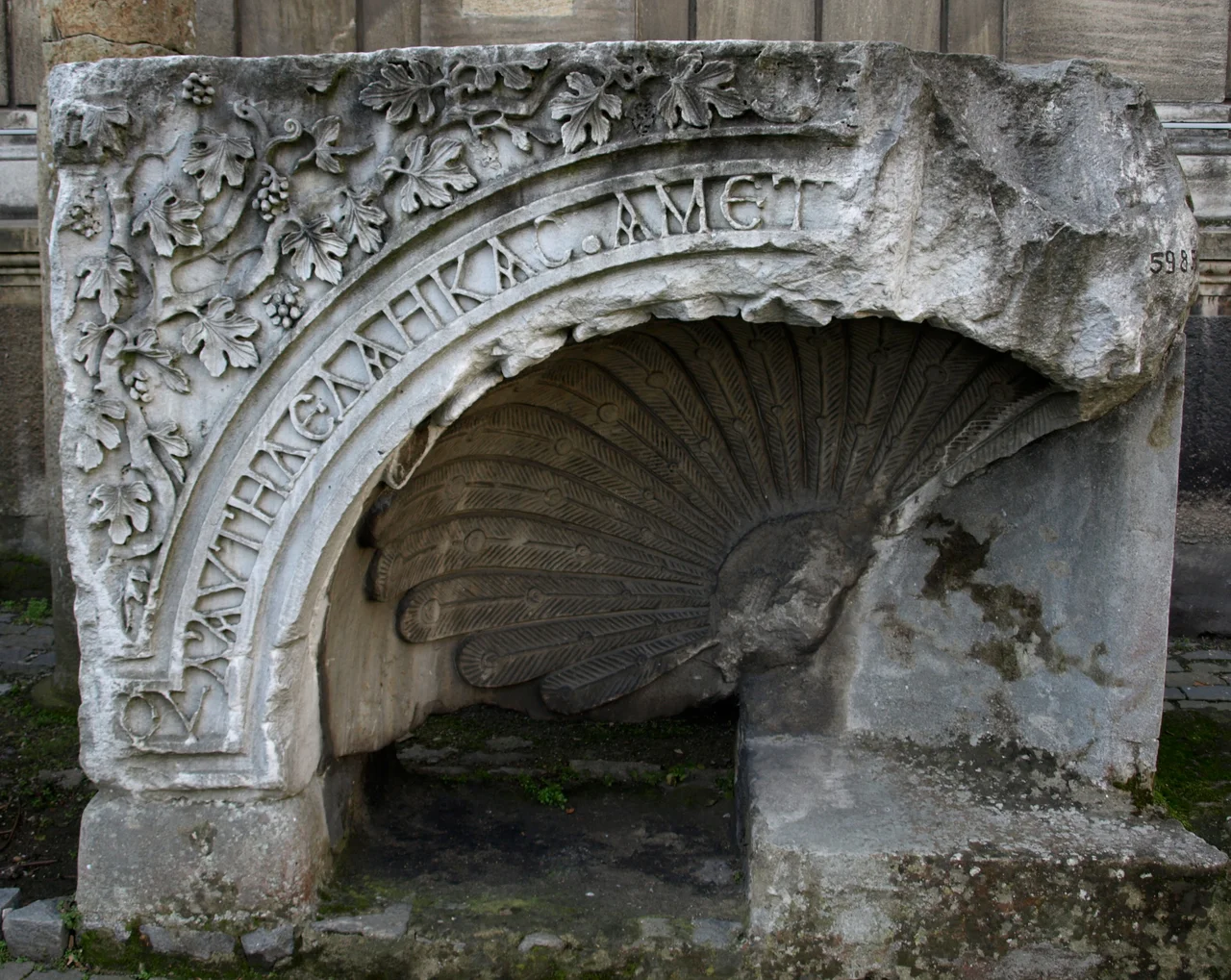
Among the most striking surviving fragments are the niche-head pieces: massive carved marble slabs, each centered on a large peacock with its tail spread wide. The second founding epigram runs along the semicircle of each carving, its letters raised 11 centimeters above the surface, surrounded by grape vines so detailed that individual leaf veins are visible, with some edges frayed and torn, the layers carved to create depth. The colors — blues, greens, purples — were applied afterward, and the peacocks themselves were painted in blues, greens, and gold. Green glass filled the eye sockets of the birds. The peacock was a symbol of royalty and, for Christians, of resurrection. Juliana chose her symbols carefully.
Scattered Across Christendom
The church survived until the 11th century, when it was abandoned and then systematically stripped. Crusaders who sacked Constantinople in 1204 took some of the finest pieces; Byzantine builders reused others in mosques and churches across the city. The most famous survivors are the so-called Pilastri Acritani — the "Pillars of Acre" — a pair of elaborately carved marble columns that have stood at St. Mark's Basilica in Venice since the 13th century, misidentified for centuries as coming from Acre. Pieces from St. Polyeuctus ended up in Milan, Barcelona, Vienna's Kunsthistorisches Museum, and the Istanbul Archaeological Museum, where the bulk of the sculptural finds are now held. The church itself was gradually buried under Ottoman-period houses and a mosque. In 1960, during road construction at the intersection of Şehzadebaşı Caddesi and Atatürk Bulvarı, excavations began. What they found reshaped the history of Byzantine architecture.
What Remains in the Open Air
The excavated site is now a public archaeological park, open to visitors, directly across from Istanbul's City Hall in the Saraçhane district. Low walls, column bases, and foundation traces are visible across the roughly square footprint of the church. The larger sculptural pieces — including the peacock niche-heads and fragments of the founding epigrams — are in the Istanbul Archaeological Museum nearby. Standing among the exposed foundations, it takes some effort to visualize the gilded ceiling and marble walls that once rose above this ground. But the scale of the footprint helps. Juliana's church was not modest. She built it, as the epigram declared, to surpass Solomon — and for a few decades before Justinian answered her, it did.
From the Air
The Church of St. Polyeuctus ruins sit at 41.0144°N, 28.9531°E in the Fatih district on Istanbul's historic peninsula, about 500 meters north of the Şehzade Mosque and roughly 1 km northwest of the covered Grand Bazaar. At 2,000–3,000 feet, the historic peninsula is clearly delineated by the Sea of Marmara to the south, the Golden Horn to the north, and the Bosphorus to the east. Istanbul Airport (LTFM) is approximately 35 km to the northwest on the European shore.
Nearby Stories
- Kocaeli Peninsula 7.6 km away
- Second Battle of Çatalca 11 km away
- Istanbul's Rural Outskirts 14 km away
- MV Struma 20 km away
- HMAS AE2 36 km away
- Bursa 66 km away
- Sangarius Bridge 71 km away
- Januarius MacGahan 101 km away