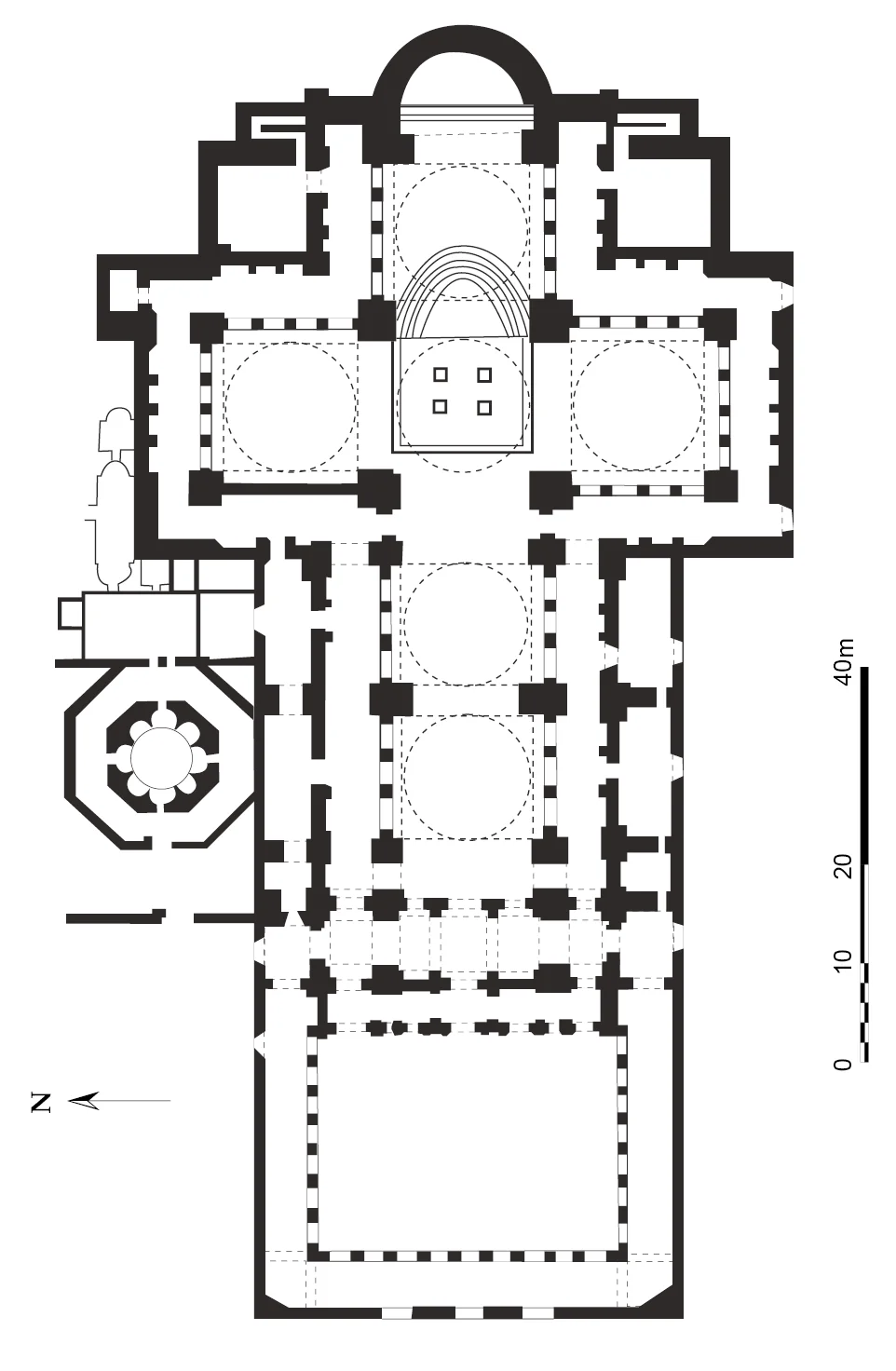

Church of the Holy Apostles
Where the Fatih Mosque now stands, emperors were buried for seven hundred years. The church that stood on this hill — dedicated to the Holy Apostles, consecrated in 550, rebuilt on the foundations of one Constantine himself had started — was the second most important church in Constantinople after the Hagia Sophia. The great thoroughfare of the Mese Odós passed nearby. Most of the Eastern Roman Empire's rulers ended up inside its walls. When Constantinople fell in 1453 and the church was handed over to the Orthodox Patriarch for a brief few years, it was already crumbling from neglect. In 1461, Mehmed II had it demolished to build his mosque. What survives of it now exists only in descriptions, fragments, and a handful of ancient porphyry sarcophagi — some of which you can see today outside the Istanbul Archaeological Museum.
Constantine's Unfinished Intention
Constantine the Great dedicated the original Church of the Holy Apostles around the year 330, intending it as a gathering place for the relics of all twelve apostles. He did not live to see it finished; he died in 337, and his son Constantius II completed it and buried his father there. The relics of only three saints were actually obtained — Andrew, Luke, and Timothy — and in later centuries the church came to be understood as theirs specifically, the original Apostolic ambitions somewhat diminished. But what it lacked in relics it made up in imperial dead. Emperor after emperor was interred here, beginning with Constantine himself and running through to Constantine VIII, who died in 1028. After that, space ran out and emperors were buried elsewhere.
Justinian's Rebuild, and the Architects Who Mattered
By the time Justinian I came to power, the original church was considered insufficiently grand. A new building rose on the same site, designed by Anthemius of Tralles and Isidorus of Miletus — the same architects responsible for the rebuilt Hagia Sophia. The new Church of the Holy Apostles was consecrated on June 28, 550. It was cruciform in plan, a design that would prove enormously influential: dozens of churches in the late 4th and early 5th centuries had already been built in imitation of the earlier structure, including St. Ambrose's Church of the Apostles in Milan and the martyrium of St. Babylas in Antioch. The cruciform plan replaced the older basilica form with a centralized, shrine-focused layout that shaped Christian architecture for centuries. Inside the Justinian church, the relics of Constantine and the three saints were reinstalled, and a new mausoleum for Justinian and his family was added to the end of its northern arm.
What the Church Held
The treasury accumulated over centuries. The skulls of Saints Andrew, Luke, and Timothy were the most prized possessions, but the church also claimed to hold part of the Column of Flagellation, to which Jesus had been bound before his crucifixion. Relics of John Chrysostom and other Church Fathers joined the collection. Gold, silver, and gems donated by the faithful filled the treasury. Emperor Basil I renovated the church in the 9th century. The historian and patriarch Nikephoros I of Constantinople was reinterred there after his death, and the site became a focus of annual imperial devotion. Then came 1204. The Fourth Crusade looted Constantinople with a thoroughness that still shocks. The historian Nicetas Choniates recorded Crusaders breaking open the imperial tombs, stripping the gold and gems. The golden crown of Emperor Heraclius was stolen with his hair still attached to it. Some of what was taken can be found today in St. Mark's Basilica in Venice.
The Last Years
After the Crusaders were expelled and Michael VIII Palaeologus recaptured Constantinople in 1261, he erected a statue of the Archangel Michael at the church to mark the occasion. Andronicus II partially restored the building in the early 14th century. But the Byzantine Empire was contracting. Constantinople's population was falling. The Florentine traveler Cristoforo Buondelmonti saw the church in 1420 and noted its decay. After 1453, Sultan Mehmed II initially gave the building to the Orthodox Patriarch Gennadius Scholarius as the seat of the Patriarchate. Three years later, Gennadius moved the Patriarchate to the Theotokos Pammakaristos Church — the Holy Apostles was too dilapidated to serve. In 1461, the remaining structure was demolished to make way for the Fatih Mosque complex, Mehmed's great Ottoman commission for the hilltop the church had occupied.
The Sarcophagi That Survived
Though the Crusaders raided the imperial tombs in 1204, the oldest porphyry sarcophagi proved too massive and too heavy to carry away entirely. Some survived. Two are now in the atrium of the Hagia Eirene. Four stand outside the Istanbul Archaeological Museum. A seventh fragment — believed to be from the sarcophagus of Constantine I himself — is inside the museum in its "Istanbul through the Ages" pavilion. Porphyry, the deep purple-red stone quarried in Egypt, was reserved exclusively for imperial use in the Byzantine world. To be buried in porphyry was to have your mortality framed in the color of power. The stone outlasted the church, the dynasty, and the city that gave it meaning.
From the Air
The Fatih Mosque (which replaced the Church of the Holy Apostles) stands at 41.0197°N, 28.9497°E on the Fourth Hill of Istanbul's historic peninsula, visible from considerable distance as one of the dominant domed structures on the skyline. At 2,000–3,000 feet, look for the large mosque complex roughly centrally placed on the peninsula, west of the Şehzade Mosque. Istanbul Airport (LTFM) is approximately 35 km northwest. The ancient land walls are visible to the west, the Golden Horn to the north.
Nearby Stories
- Kocaeli Peninsula 7.6 km away
- Second Battle of Çatalca 11 km away
- Istanbul's Rural Outskirts 14 km away
- MV Struma 20 km away
- HMAS AE2 36 km away
- Bursa 66 km away
- Sangarius Bridge 71 km away
- Januarius MacGahan 101 km away