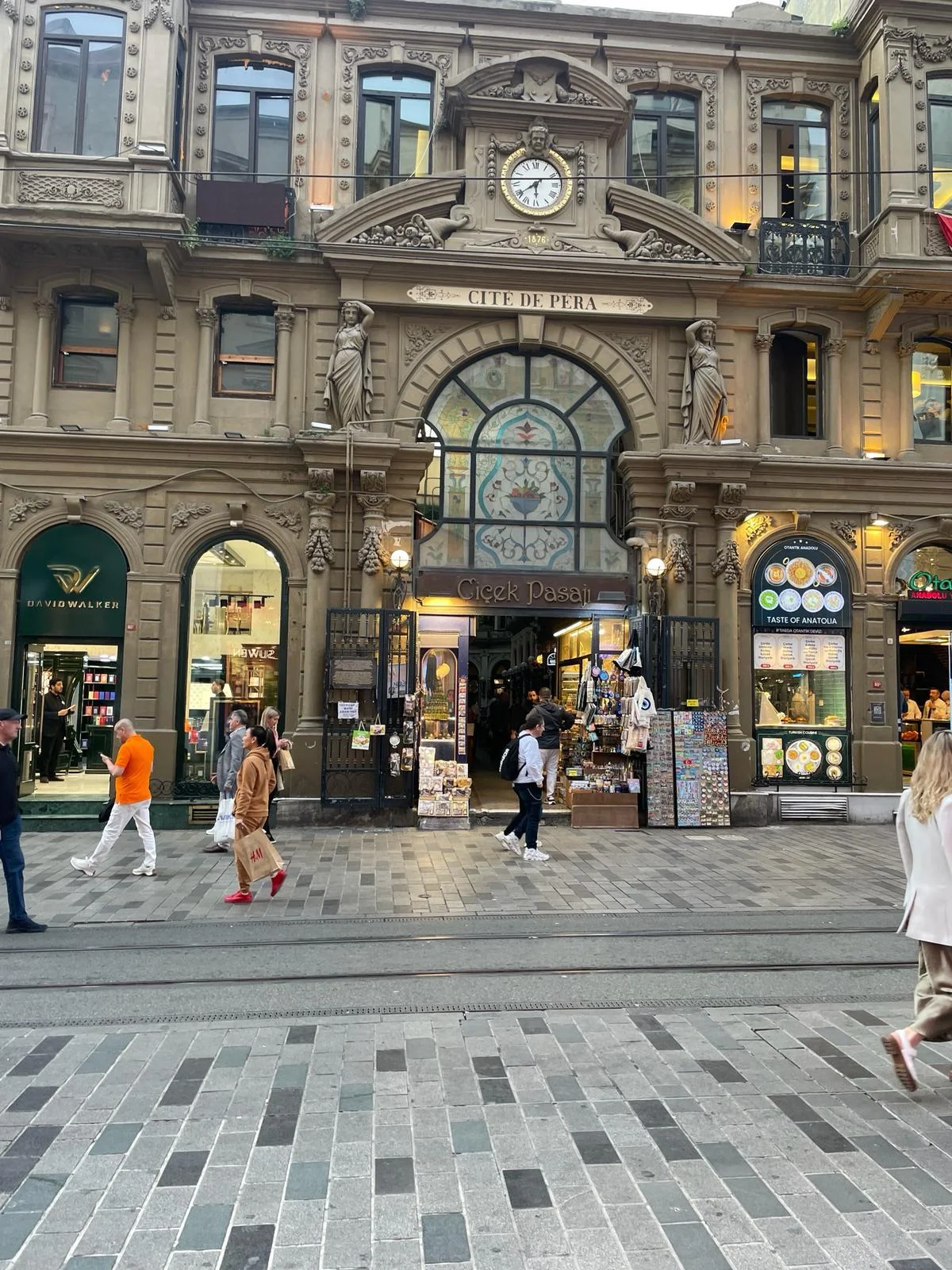

Çiçek Pasajı
The name means Flower Passage, but flowers are not really the point anymore. Step off the current of İstiklal Avenue through the tall arched entrance and you enter a high-ceilinged galleria where the restaurants and meyhanes press close on either side and the glass cupola above admits a pale filtered light. The building has been called several things in its life — Cité de Péra, Hristaki Pasajı, Sait Paşa Pasajı — and the flowers that gave it its current name were sold here by Russian aristocrats who had lost everything. Çiçek Pasajı is the kind of place that accumulates history without trying.
Before the Fire: The Naum Theatre
The site that became the Flower Passage first held the Naum Theatre, one of the Ottoman Empire's premier venues for European opera. Sultans Abdülaziz and Abdülhamid II were among its regulars. The theatre staged Giuseppe Verdi's Il Trovatore before the opera houses of Paris had done so — which gives some sense of how seriously Pera, the cosmopolitan district across the Golden Horn from the old city, took its cultural ambitions. Then came the Fire of Pera in 1870, which swept through the neighborhood and severely damaged the Naum Theatre. The theatre was not rebuilt as a theatre.
The Banker's Arcade
After the fire, the burned theatre site was purchased by an Ottoman Greek banker named Hristaki Zoğrafos Efendi. He commissioned architect Kleanthis Zannos to design a new building in its place, and in 1876 the current structure was completed: a covered arcade of shops and winehouses, ornate in the European style, opening off İstiklal Avenue at one end and connecting through to the Balık Pazarı — the Fish Market — at the side. It was called Cité de Péra in its early years, a name that positioned it squarely in the cosmopolitan, Francophone culture of 19th-century Beyoğlu. The first winehouse in the passage, Yorgo'nun Meyhanesi (Yorgo's Winehouse), set the tone for what the arcade would eventually become. In 1908 the Grand Vizier Mehmed Said Pasha bought the building, and it took his name briefly — the Sait Paşa Pasajı.
The Russian Baronesses and the Flowers
The Russian Revolution of 1917 sent waves of refugees westward, and some of them ended up in Istanbul. Among those who made their way to Beyoğlu were a number of impoverished Russian noblewomen — women who had grown up in comfort and privilege and now needed to earn a living with whatever resources remained to them. Several opened flower stalls in the arcade. A baroness was said to be among them. By the 1940s, the passage was so thoroughly given over to flower sellers that it acquired the name it carries today: Çiçek Pasajı, the Flower Passage. The flowers are mostly gone now, replaced by restaurants and bars, but the name they left behind is the one that stuck.
An Arcade Restored
The building was restored in 1988 and reopened as a galleria of pubs and restaurants, which is the form it takes today. A more recent restoration was completed in December 2005, and the building was repainted again in 2022. The ornate 19th-century facade facing İstiklal Avenue is one of the street's landmarks. Inside, under the glass cupola, the atmosphere is different from the avenue's busy commercial energy — louder in some ways, more enclosed, the tables crowded and the light softer. The passage connects through to Sahne Street and has a side entrance that opens directly onto the Balık Pazarı, the Fish Market, where the smell of the Bosphorus is never far away.
A Short Walk That Covers a Long History
Çiçek Pasajı is about 150 meters from one end to the other. The walk from İstiklal Avenue through to the Fish Market doesn't take long. But the arcade manages to hold its history lightly — the lost theatre, the banker's vanity project, the exiled aristocrats selling flowers to stay afloat, the meyhanes where generations of Istanbullus have argued and drunk and sung. Beyoğlu has always been the district where Istanbul's cosmopolitan past shows most clearly in the architecture, and the Flower Passage is one of the places where that past is most legible. The cupola still lets in the same pale afternoon light it always has.
From the Air
Çiçek Pasajı sits at 41.0339°N, 28.9779°E in the Beyoğlu district on the European side of Istanbul, just off İstiklal Avenue. The Beyoğlu district is on the northern shore of the Golden Horn; at 2,000–3,000 feet, İstiklal Avenue is the long, densely built boulevard running northeast from Taksim Square, which is clearly visible. The Galata Tower, one of the most recognizable landmarks in the area, is about 700 meters to the south. Istanbul Airport (LTFM) is approximately 25 km to the northwest.
Nearby Stories
- Kocaeli Peninsula 7.6 km away
- Second Battle of Çatalca 11 km away
- Istanbul's Rural Outskirts 14 km away
- MV Struma 20 km away
- HMAS AE2 36 km away
- Bursa 66 km away
- Sangarius Bridge 71 km away
- Januarius MacGahan 101 km away