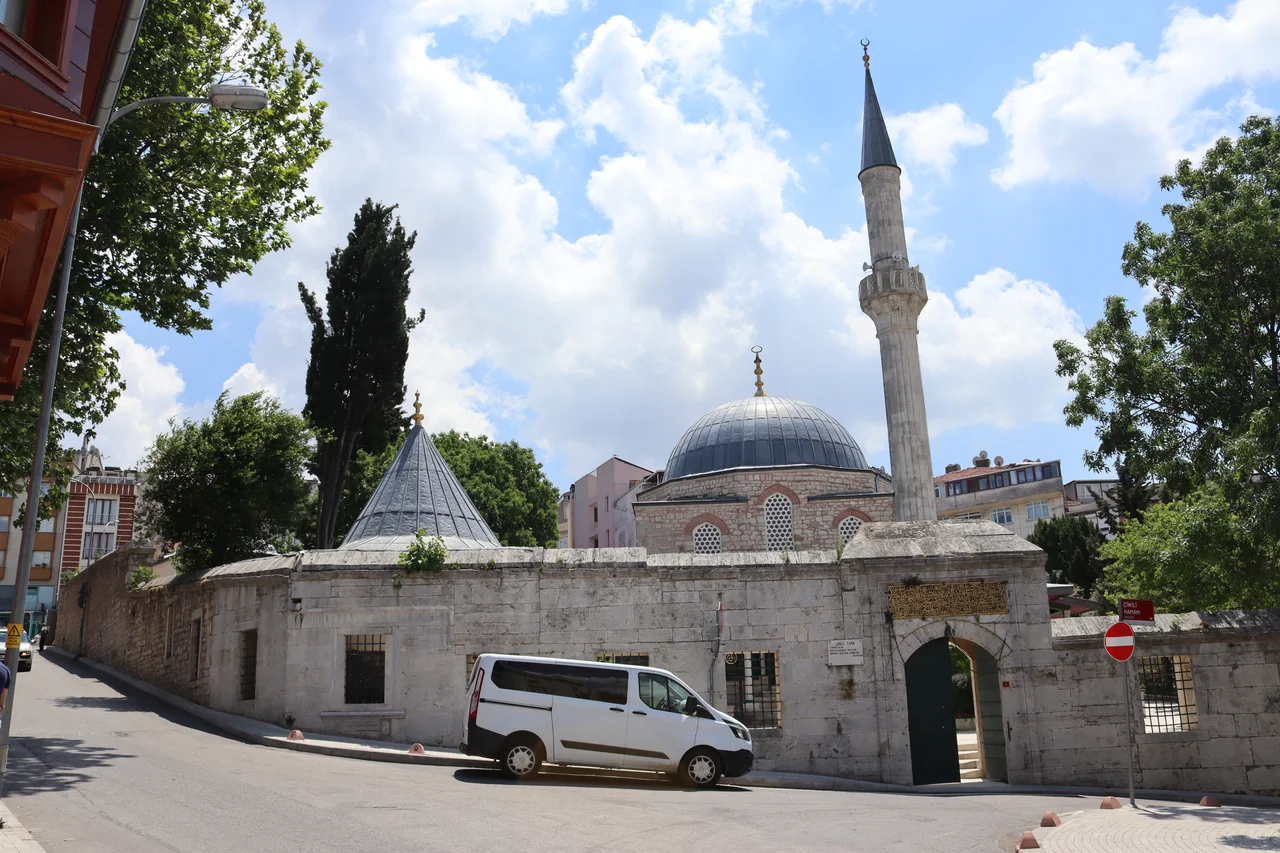

Çinili Mosque
Kösem Sultan was not a woman who did things quietly. As regent for two Ottoman sultans and the most influential figure in the imperial court for decades, she shaped the empire's politics from behind a latticed screen. The mosque she commissioned in 1640–41 in Üsküdar is, by the standards of Istanbul's great imperial complexes, a modest structure. Its dome measures roughly nine meters across. But step through the entrance and every surface — walls, window frames, the canopy of the pulpit — erupts in tile. Tulips, peonies, and hyacinths climb the walls in blue, turquoise, and grey, the Ottoman tilework vocabulary of the mid-17th century at its considered best.
The Woman Behind the Tiles
Mahpeyker Kösem Sultan — her name means "moon-faced leader of the flock" — entered the Ottoman imperial harem as a young Greek girl, probably from one of the Aegean islands, and rose to become the most powerful woman the Ottoman dynasty would ever see. She served as regent during the reigns of her sons Murad IV and Ibrahim, and later for her grandson Mehmed IV. The Çinili Mosque was one of several pious foundations she endowed across Istanbul, all supported by the revenues of her vakif (charitable endowment). The endowment for this mosque drew income from the Büyük Valide Han, a great caravanserai she built in 1651 near the Grand Bazaar — a commercial enterprise funding a religious one, which was exactly how the Ottoman charitable system was designed to work. Kösem was strangled in the harem in 1651, victim of a political coup orchestrated by her daughter-in-law. The mosque she built outlasted her by nearly four centuries.
What the Tiles Say
The mosque takes its name — Çinili means "tiled" in Turkish — from what you see the moment you step inside. By the 1640s, the great age of Iznik tilework that had peaked in the 16th century was already fading: the vivid coral reds and dense botanical encyclopedias of the earlier period had simplified into a narrower palette. What covers the walls of the Çinili Mosque is beautiful in a more restrained register — blues and turquoises and greys in floral arrangements of tulips, peonies, and hyacinths, punctuated by inscription friezes that run across three walls on either side of the mihrab, the niche indicating the direction of Mecca. More inscriptions appear in tiled lunettes above each window. Even the minbar — the marble pulpit — carries a conical tiled canopy at its peak. The tilework also extends to part of the mosque's exterior facade, visible behind the portico, an unusual feature that earns the building its name from outside as well as in.
A Full Community in a Small Footprint
The mosque is the centerpiece of a külliye — an Ottoman religious complex — that packs a surprising range of functions into its walled precinct. A fountain (şadırvan) with a large curved pointed roof stands at the center of the courtyard. The madrasa, or religious school, occupies the northeast corner of the precinct in an unusual triangular floor plan, forced into that shape by the constraints of the available space. A cistern sits behind the mosque's southeast wall. Just outside the precinct walls stands a mektep — a small primary school under its own dome. Slightly to the southwest, a double hammam offers separate sections for men and women. The whole ensemble was designed to serve the neighbourhood of Üsküdar, providing education, worship, water, and bathing within a single patron's philanthropic reach. The mosque underwent a full restoration completed in 2018, reopening for worship after the work was finished.
Across the Water from the Minarets
Üsküdar is Istanbul's Asian shore — the first district you reach if you cross the Bosphorus from the European side by ferry, which is exactly how most visitors arrive. The neighbourhood has a different character from Beyoğlu or Sultanahmet: quieter, more residential, with a conservative religious identity that has deepened over recent decades. The Çinili Mosque sits a short walk up from the Üsküdar ferry terminal into the district's hillside streets, among old wooden houses and newer apartment buildings. Its modest exterior — a single dome, a single minaret, a walled outer precinct — gives little indication of what lies inside. That gap between the understated exterior and the tile-covered interior is part of the building's point. In Ottoman architecture, as in much of Kösem Sultan's career, the power was often held quietly, and revealed only once you were already inside.
From the Air
The Çinili Mosque is located at approximately 41.0199°N, 29.0292°E in the Üsküdar district on the Asian shore of Istanbul. From the air at 2,000 feet, Üsküdar reads as a dense hillside district rising from the Bosphorus ferry terminals, with the Çinili Mosque sitting a few blocks inland and uphill. The Bosphorus Bridge is visible approximately 2 km to the north; the Sea of Marmara opens to the south. The nearest airport is Sabiha Gökçen International Airport (LTFJ) approximately 35 km southeast on the Asian side. The Bosphorus itself is the dominant landmark from any altitude — the mosque sits on its eastern bank, in the first district of the Asian city.
Nearby Stories
- Kocaeli Peninsula 7.6 km away
- Second Battle of Çatalca 11 km away
- Istanbul's Rural Outskirts 14 km away
- MV Struma 20 km away
- HMAS AE2 36 km away
- Bursa 66 km away
- Sangarius Bridge 71 km away
- Januarius MacGahan 101 km away