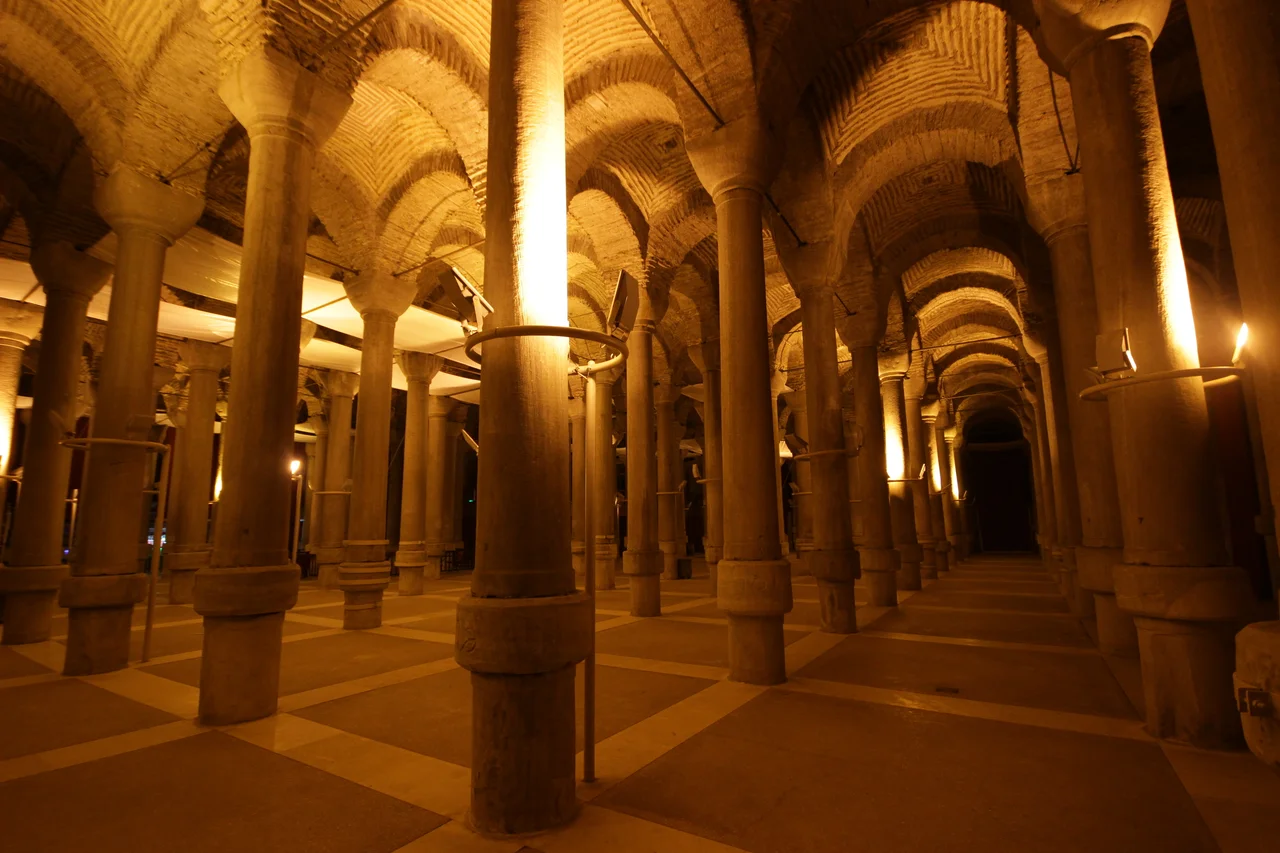

Cistern of Philoxenos
Count the columns yourself if you dare: 224 is the real answer, though the name insists on a thousand and one. That gap between fact and name is deliberate. In Turkish, 'binbir' — a thousand and one — is not arithmetic but poetry, a way of saying 'more than you can count, more than you can imagine.' The Cistern of Philoxenos earned its nickname, Binbirdirek, honestly. Step inside and the forest of columns seems to go on forever, each one twinned with a second drum stacked on top, the original ground level excavated away to reveal how deep the builders really went.
A City Hidden Underfoot
The cistern sits in Sultanahmet, Istanbul's historic peninsula, wedged between two of the ancient city's great public spaces: the Forum of Constantine and the Hippodrome of Constantinople. In Byzantine times this was premium real estate, and the underground chamber that fills the space beneath it tells you something about how seriously Constantinople took its water supply. The reservoir covers 3,640 square meters and was designed to hold 40,000 cubic meters of water — enough to serve an entire quarter of the ancient city during a siege or a drought. It is the second-largest covered cistern in Istanbul, surpassed only by the famous Basilica Cistern a short walk to the east. But where the Basilica Cistern leans into theater — dim lights, mood music, the occasional art installation — Binbirdirek keeps its character more austere, the columns more legible, the engineering more visible.
The Double Column Trick
The cistern's most distinctive feature is the way its columns are built: each support consists of two marble drums stacked one atop the other, giving the forest of pillars an unusual height. The trick was not decorative — it was structural necessity. The builders needed to span a substantial vertical distance between floor and the vaulted ceiling above, and doubling the columns was the most elegant solution available. Stonemasons left their marks on many of the capitals, evidence of the individual craftsmen whose work has stood for over fifteen centuries. The cistern was constructed under a palace complex, often identified as the Palace of Antiochos, in the fifth century AD. The owner, Philoxenos, was a Roman senator whose name the structure carried into history.
Elephants, Weavers, and Tourists
After the Ottoman conquest of Constantinople in 1453, the great cisterns of the city lost their original purpose. The water infrastructure of Byzantium was gradually replaced or simply fell into disuse, and the vast underground halls took on new lives. Binbirdirek became a workshop. Weavers set up their looms inside the cool, dark chamber, finding in a former reservoir the kind of large, stable, humidity-controlled space that cloth work demands. For centuries the columns held up not a city's water supply but the production of textiles, the sound of looms replacing the drip of aqueduct water. Restoration in the modern era returned the cistern to public access as a tourist attraction. Today visitors can walk between the columns, read the mason's marks on the capitals, and look down at excavated pools that show how far the original floor lies below present ground level.
What 'A Thousand and One' Really Means
The name Binbirdirek has outlasted every other name for this place. Neither 'Cistern of Philoxenos' — the Roman senator who may have commissioned it — nor any Byzantine designation stuck as firmly as the evocative Turkish count. The phrase echoes through Ottoman and Turkish culture: the Thousand and One Nights, the thousand and one varieties of anything too varied to tally precisely. It speaks to an experience, not an inventory. Walk among the columns and you feel that the builders would have approved of the name, even knowing the math was wrong. The columns seem to multiply, to recede, to multiply again. One historian's precise count of 224 does nothing to diminish the overwhelming impression that the builders achieved what they set out to build — a space that felt inexhaustible.
Layers of Meaning Beneath the Street
Today İmran Öktem Sokak, a modest street in the Sultanahmet district, carries no obvious hint of what lies below. You descend a staircase and emerge into a world built fifteen hundred years ago, still structurally sound, still echoing. The conservation is imperfect — some sections are closed, some columns show the wear of centuries — but the essential achievement is intact. To stand inside Binbirdirek is to understand something fundamental about how the Byzantine Empire built: not for a generation, but for an eternity they half-believed they would inhabit. The columns held. The water is long gone, but the columns held.
From the Air
The Cistern of Philoxenos lies at 41.0075°N, 28.9744°E in the Sultanahmet district of Istanbul's historic peninsula, roughly 200 meters southwest of the Hippodrome and 350 meters southeast of the Grand Bazaar. From the air at 3,000 feet, the densely built historic peninsula is easily identified by the distinctive silhouette of Hagia Sophia's dome and the minarets of the Blue Mosque to the south. The cistern itself is underground and invisible from altitude, but the Sultanahmet square provides a clear visual anchor. Nearest major airport: LTFM (Istanbul Airport), approximately 35 km to the northwest on the European shore. Approach over the Bosphorus Strait offers exceptional views of the historic peninsula and its layered skyline.
Nearby Stories
- Kocaeli Peninsula 7.6 km away
- Second Battle of Çatalca 11 km away
- Istanbul's Rural Outskirts 14 km away
- MV Struma 20 km away
- HMAS AE2 36 km away
- Bursa 66 km away
- Sangarius Bridge 71 km away
- Januarius MacGahan 101 km away