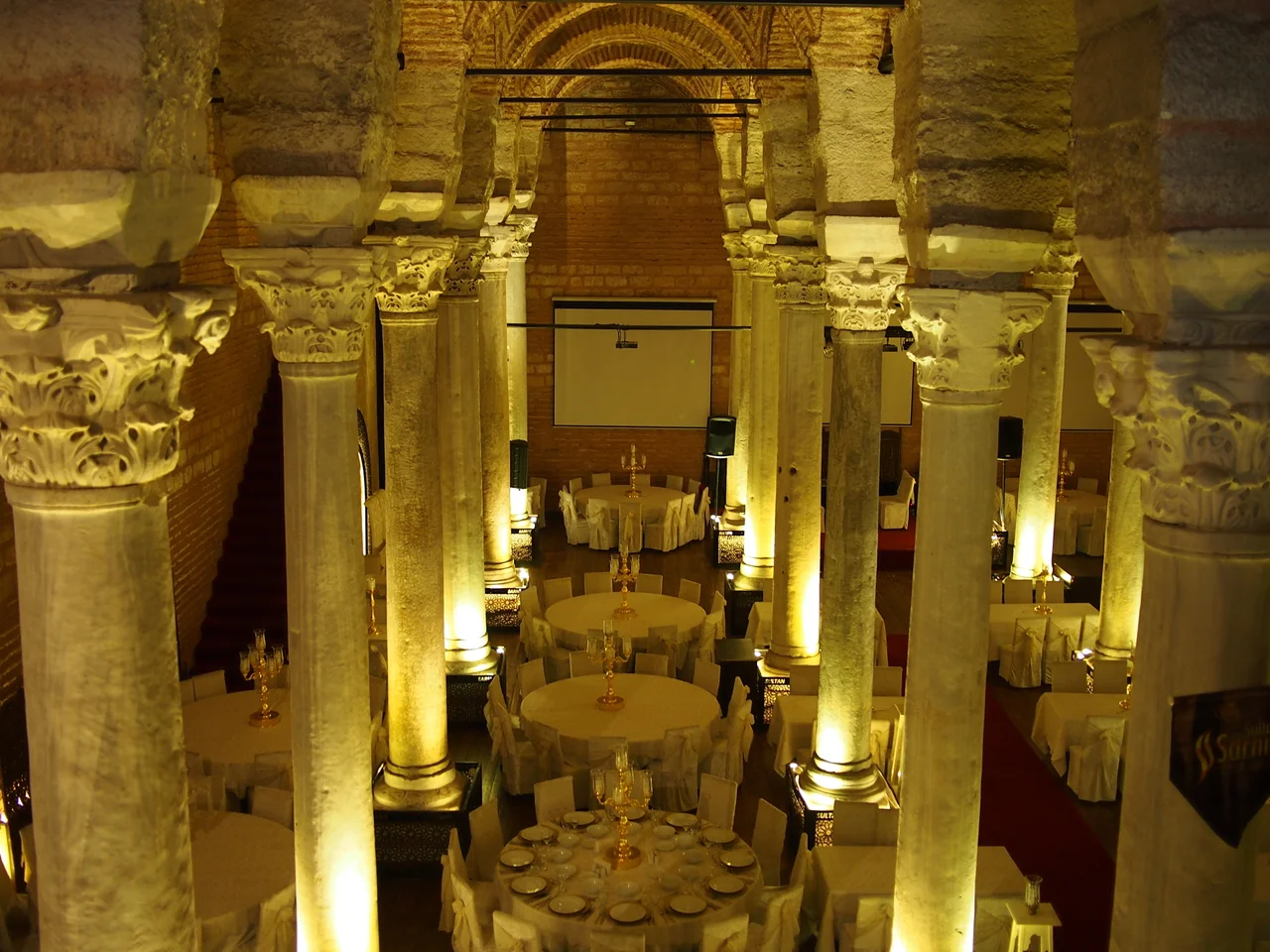

Cistern of Pulcheria
On the thirteenth day of February in the year 421 AD, water flowed for the first time into a new underground reservoir on Constantinople's fifth hill. The Chronicon Paschale, a meticulous seventh-century Greek chronicle, bothered to record the exact date — the Ides of February — which tells you how significant the moment was considered. Water was power in the ancient city. The person who ensured it arrived was Aelia Pulcheria, a princess who had already been governing the Eastern Roman Empire in practice for years, nominally in the name of her younger brother, the emperor Theodosius II.
An Empress Who Built
Pulcheria was not supposed to wield the kind of power she did. Born around 399 AD, she became regent for her brother when she was only fifteen, managing the imperial administration with a competence that her contemporaries found remarkable and her opponents found threatening. She was devout, politically shrewd, and unusually interested in architecture and public works — unusual because such projects were typically the province of emperors, not imperial sisters. The Chronicon Paschale records that she served as a construction advisor to Theodosius II, which by the standards of the time was a diplomatic way of saying she supervised building projects herself. The cistern that carries her name was located in the quarter known as the Pulcherianae, a district named after the palace she had built in the area — the cistern identified by its neighborhood, and the neighborhood identified by its builder.
The Question of When
There is a complication at the heart of the Cistern of Pulcheria's history: the date does not quite add up. The Chronicon Paschale says the cistern was filled with water for the first time in 421 AD, which would place its construction in the early fifth century. But the architectural historian Ernest Mamboury, examining the cistern's stylistic elements in the twentieth century, concluded that the structure looks more like a sixth-century building — the period of Justinian's great construction campaigns. The contradiction has never been fully resolved. Either the cistern was built earlier than its stonework suggests, or the chronicle is recording a re-filling or renovation of an existing structure rather than its first use. Whatever the answer, the cistern stands as one of the best-preserved examples of Byzantine water infrastructure in Istanbul, its physical quality testifying to the seriousness with which its builders approached the work.
Where the Hills Meet
The cistern's location was carefully chosen. It lay in the eleventh region of Constantinople, at the eastern end of the valley that separates the fourth and fifth hills of the city. Constantinople's seven hills, like Rome's, were a constant organizing principle for ancient urban planning, and the valleys between them were natural gathering points for water infrastructure. Here, on the slopes between two hills, the cistern caught what the topography directed downward. Today that valley is completely built up, the hills themselves visible mainly as changes in gradient beneath the dense urban fabric of modern Istanbul. But the cistern remains, below street level, in the district that still preserves the memory of the empress who built here through the name of the neighborhood itself.
From Reservoir to Workshop and Beyond
After the Ottoman conquest of Constantinople in 1453, the city's Byzantine cisterns gradually emptied and fell out of use as the new rulers developed their own water systems. The Cistern of Pulcheria's fate followed a pattern familiar from other Istanbul cisterns: the dry underground hall became repurposed space. For centuries, weavers used it as a workshop — the cool, stable environment made it practical for textile production, and the solid Byzantine vaulting offered reliable shelter. The practice continued into the early twentieth century, when the cistern was finally abandoned. It has been preserved since then as a historical monument. Unlike the more famous Basilica Cistern, it is not a tourist attraction in the conventional sense, which means it survives in something closer to archaeological quiet.
Pulcheria's Lasting Presence
Aelia Pulcheria eventually married the soldier-emperor Marcian in 450 AD, a political arrangement that let her retain imperial authority to the end of her life. She was later canonized as a saint by the Eastern Orthodox Church, her feast day observed on September 10. The cistern that bears her name is one of several traces she left on Constantinople's built environment. It is also one of the most durable: the palace she built in the Pulcherianae quarter is long gone, but the underground reservoir — whether it dates from 421 AD or the century after — still stands, its vaults intact, its walls holding in the dark beneath a city that has changed four times over since she filled it.
From the Air
The Cistern of Pulcheria lies at 41.025°N, 28.95°E on Istanbul's historic peninsula, near the valley between the fourth and fifth hills of the ancient city. The surrounding district corresponds to the modern Fatih neighborhood. From the air at 3,000 feet, the peninsula's dense urban fabric spreads below the flight path; the Golden Horn inlet to the north and the Sea of Marmara to the south define its edges. Nearest major airport: LTFM (Istanbul Airport), approximately 33 km to the northwest. The Bosphorus Strait is visible as a landmark corridor running north-south on the eastern edge of the peninsula, with Hagia Sophia's dome providing a reliable visual anchor for orientation.
Nearby Stories
- Kocaeli Peninsula 7.6 km away
- Second Battle of Çatalca 11 km away
- Istanbul's Rural Outskirts 14 km away
- MV Struma 20 km away
- HMAS AE2 36 km away
- Bursa 66 km away
- Sangarius Bridge 71 km away
- Januarius MacGahan 101 km away