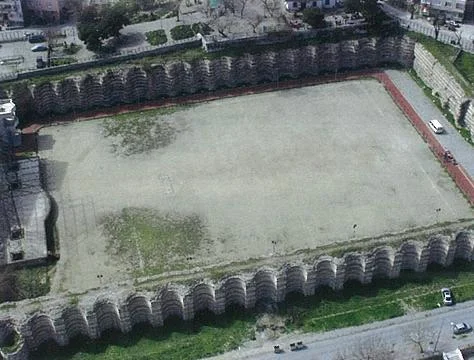

Cistern of the Hebdomon
The Ottomans called it Fildamı: the elephant house. After the fall of Constantinople in 1453, the great open-air reservoir on the city's western outskirts stood empty, its Byzantine purpose dissolved along with the empire that built it. The new rulers found it practical rather than symbolic. Elephants require space, shade, and solid walls. The abandoned cistern offered all three, and so the Sultan's elephants moved in, lending the place the Turkish name that has outlasted every other designation. That name — Fildamı Sarnıcı, the cistern of the elephant stable — tells you more about the history of this place than any monument plaque could.
The Seventh District and Its Water
The Hebdomon was the seventh district of Constantinople, a semi-rural quarter that lay roughly two kilometers west of the Golden Gate — the great triumphal entrance in the Theodosian Walls. The district sat in a small valley that runs southward to the Sea of Marmara, and it was in the western portion of this valley that Byzantine engineers chose to build their reservoir. The cistern was open to the sky, a different design from the great covered cisterns of the city's interior, and it followed the same general pattern as the cisterns of Aetius, Aspar, and Mocius built within the walled city itself: massive masonry walls reinforced with projecting semicircular niches that acted as buttresses against the pressure of both stored water and surrounding hillside. The outer western wall disappeared into the hill entirely. The dating of the cistern's construction is uncertain, placed somewhere between the fifth and eighth centuries.
Engineering on the Hillside
The builders of the Hebdomon cistern were solving a specific topographical problem. The western wall of the reservoir was buried in the slope of the hill, which meant it needed no reinforcement — the earth itself held it. The inner western wall and the outer eastern wall faced the open, and these were given nineteen semicircular projecting niches each, creating a rhythmic series of buttresses to bear the lateral load. It is the same structural logic that Byzantine engineers applied everywhere: repetition of a proven solution rather than experiments with untested forms. The cistern also featured towers with a distinctive double-shell construction, an outer casing surrounding a central spiral staircase, with the water supply entering through an inflow at the tower's base. The engineering was confident and durable; the walls that remain standing today demonstrate how well the builders understood their materials.
Elephants, Gardens, and Concerts
The cistern's post-Byzantine life is a compressed history of Istanbul's changing relationship with its own past. After the elephants, the dry reservoir became a vegetable garden. Istanbul's old open cisterns were repurposed this way — low-lying enclosed spaces with good soil and shelter from wind, they were natural gardens. The Turkish term for these repurposed reservoirs was Çukurbostan, meaning 'hollow garden,' and the Hebdomon cistern became one of the city's four surviving examples of this category. In the late twentieth century, the hollow garden gave way to a concert venue: for a period, music events were held inside the old cistern walls. By 2003, however, it had become clear that the vibrations from amplified music were damaging the ancient masonry and disturbing the horses at the nearby Veli Efendi race track. The concerts stopped. The cistern reverted to something quieter.
Bakırköy's Hidden Depth
Today the cistern lies in the Osmaniye neighborhood of Bakırköy, a modern Istanbul district that gives few hints of its Byzantine edge. The streets between Fildamı Arkası and Çoban Çeşme Sokak, just northwest of the Veli Efendi horse race track, sit above and around the old reservoir without making much of the fact. Two of the cistern's three towers survive — the central one was destroyed at some point in the intervening centuries. These towers, locally called Domuzdamı (house of the pigs) after their later use as animal stables, stand as the most conspicuous remnants of a structure that once held enough water to sustain a population on Constantinople's western margin. The name changed from elephant house to pig house: the specifics shift, but the basic story does not. Byzantine infrastructure becomes Ottoman utility becomes modern archaeology.
What the Hollow Garden Remembers
The Hebdomon cistern is not a polished tourist site. It does not have the atmospheric lighting of the Basilica Cistern or the archaeological clarity of Binbirdirek. What it has is a more complicated kind of authenticity: the record of a place that has been continuously used, continuously repurposed, continuously occupied by whoever needed a large, sheltered, below-grade space. Byzantine engineers built it for water. Ottoman keepers filled it with animals. Farmers grew food in it. Musicians played in it until the walls protested. Now it endures, in the middle of a dense neighborhood, as one of the few visible reminders that Bakırköy was once the western outskirt of a world capital — and that world capitals, like their cisterns, are built to outlast every prediction about their purpose.
From the Air
The Cistern of the Hebdomon lies at 40.9931°N, 28.8861°E in the Bakırköy district of Istanbul, approximately 2 km west of the Golden Gate in the historic Theodosian Walls. From the air at 3,000 feet, Bakırköy is identifiable along the European coastline of the Sea of Marmara, west of the dense Sultanahmet historic core. The Veli Efendi horse race track nearby provides a useful visual marker. The original valley alignment — running southward toward the Marmara — remains faintly legible as a topographic dip in the otherwise built-up landscape. Nearest major airport: LTFM (Istanbul Airport), approximately 25 km to the northwest along the European shore. The Marmara coastline provides clear orientation from altitude.
Nearby Stories
- Kocaeli Peninsula 7.6 km away
- Second Battle of Çatalca 11 km away
- Istanbul's Rural Outskirts 14 km away
- MV Struma 20 km away
- HMAS AE2 36 km away
- Bursa 66 km away
- Sangarius Bridge 71 km away
- Januarius MacGahan 101 km away