
Coalhouse Fort
When Henry VIII fortified the English coast in 1539-40, his blockhouse at East Tilbury was partly built from the dismantled stones of a dissolved monastery. The shoreline has eroded the original blockhouse into the river, but the place itself was always going to be fortified. Coalhouse Point, on the north bank of the Thames at Lower Hope Reach, sits at one of the natural choke points on the approach to London - and for nearly five hundred years, somebody with a gun has been watching it. The fort that stands there today is Victorian, but the layers go down centuries deeper than that.
Why East Tilbury Mattered
The Thames narrows here, and ships heading upriver to London must turn at Lower Hope Reach. Anyone holding the north bank with artillery commands the channel. The French understood this in 1379, when they raided settlements on both sides of the river during the second phase of the Hundred Years' War. That raid prompted the building of Cooling Castle on the Kent side. The Essex side waited longer for proper defences - until Henry VIII's break with Rome made the threat of Catholic invasion suddenly serious, and a chain of blockhouses went up along the English coast. The East Tilbury Blockhouse, built partly with stone from St Margaret's Chapel in Tilbury, had a small garrison and twenty-seven cannon by 1540. It was disarmed in 1553 and the site abandoned by the end of the 16th century. The river ate it. The fortifications would have to be rebuilt, repeatedly, every time the threat changed - which in this corner of England turned out to be about every hundred years.
The Battery and Its Discontents
The 1667 Raid on the Medway by the Dutch fleet exposed how badly the Thames defences had decayed. New batteries followed, slowly. The Coalhouse Battery itself was built in 1799 - on the same soft marshy ground that would defeat every later attempt to put a permanent structure here - and equipped with four 24-pounder cannon on traversing carriages, which let gunners track moving targets in a way the older garrison carriages could not. A walled compound enclosed barracks, magazine, and a shot kiln for heating cannonballs that could set wooden ships on fire. The French did not come. The 1804 invasion scare passed. After Napoleon's defeat in 1815, the battery was abandoned along with most of the other anti-French defences. Then the technology started changing again. By the 1850s, rifled guns mounted on steam-powered ironclad warships had rendered the old fortifications obsolete, and the Royal Commission of 1859-60 produced the recommendations that would build the Palmerston Forts - including a brand new Coalhouse Fort, extending and replacing the old battery.
The Granite and the Hood
Construction took from 1861 to 1874. The fort was completed with twelve casemates arranged in a semi-circle facing the river, faced with massive slabs of granite and protected by iron gun ports. The casemate guns - four 12.5-inch and thirteen 11-inch rifled muzzle-loaders - were monsters. The 12.5-inch weighed up to 38 tons each, used 78-kilogram propellant charges, fired 375-kilogram shells, and broke windows half a mile away when they discharged. Operating them was dangerous work: the explosion produced choking black smoke and physical concussion that battered the gun crews. By the late 1890s three depression range finders had been installed on the roof to aid targeting. The guns were designed to fire in sequence as enemy ships passed, with Shornemead and Cliffe Forts on the Kent shore providing crossfire. The arrangement was ingenious. It was also obsolete almost as soon as it was completed - faster, more manoeuvrable torpedo boats had emerged as the new threat, and the heavy guns were nearly useless against them. In 1893 a quick-firing battery was built 365 metres south, equipped with 6-pounders intended to spray torpedo boats with grapeshot like, in the technical phrase, "giant blunderbusses".
Guns from a Doomed Battlecruiser
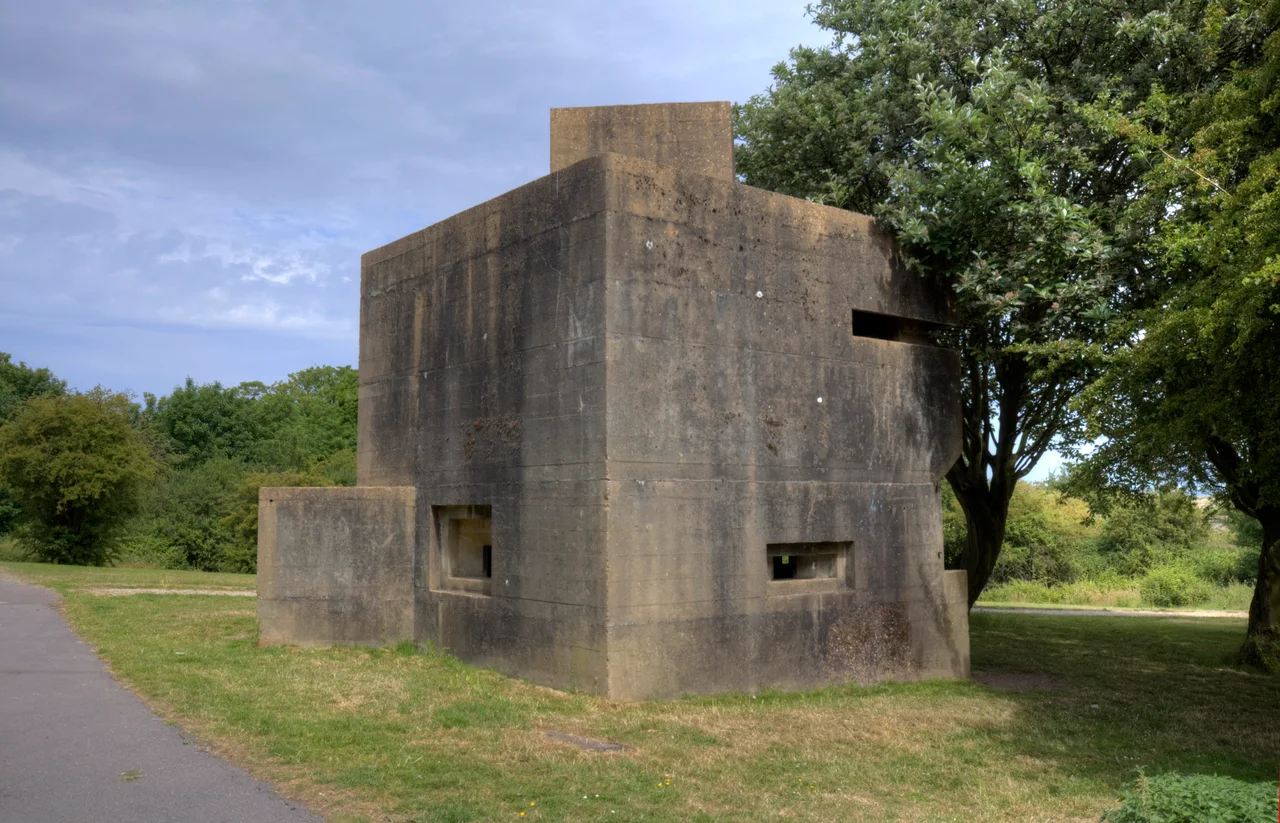
Between the world wars Coalhouse was reduced to care and maintenance status. The Second World War brought it back. In July 1941 the fort received two 5.5-inch guns that had been removed from HMS Hood during a refit in April 1940 - the same Hood that would be sunk by the Bismarck in May 1941, taking 1,415 men with her. The Hood's guns at Coalhouse Fort had a range of 12,500 yards and were installed in two of the old 6-inch emplacements, camouflaged with netting under a steel shelter. Two remotely controlled searchlights swept the river at night. A radar tower a quarter-mile south covered the approaches to the minefield laid offshore. Outbound ships passed over submerged sensors checking that their hulls had been demagnetised - if the German magnetic mines could still detect them, they would be recalled for further degaussing. An anti-aircraft battery 1,100 metres northwest defended the eastern approaches to London. Coalhouse was bombed more than once. The fort survived the war. Its military career did not.
From Shoe Storage to Batman Begins
Decommissioned in 1949, the fort was leased to Bata Shoes - the famous shoe factory just up the road in East Tilbury - and used as a storage facility. For a while it housed demobilised servicemen and their families. In 1959 the parade ground served as a coal store during a miners' strike. Thurrock Urban District Council bought the fort in 1962 and turned the surrounding land into a riverside park; the fort itself fell into disrepair. From 1985 to 2020 the Coalhouse Fort Project, a volunteer heritage charity, ran restoration and open days, gradually returning sections of the building to viewable condition. The BBC television series Restoration featured the fort. In 2005, Warner Bros. used Coalhouse as a filming location for the opening scenes of Batman Begins - Bruce Wayne's flight from his demons, in real terms, was filmed in a Victorian artillery fort built to defend the Thames against the French. The filming fee helped pay for £200,000 of gatehouse repairs in 2009-11. The project closed in 2020, considering its work essentially done. The Two Forts Way footpath now runs four miles between Coalhouse Fort and the older Tilbury Fort - a walking history of how five centuries of Englishmen with guns have looked at the same stretch of river and seen the same problem.
From the Air
Coalhouse Fort stands at 51.46°N, 0.43°E on Coalhouse Point on the north bank of the River Thames near East Tilbury, Essex. The fort is highly visible from the air: a distinctive D-shaped Victorian artillery fort facing the river, surrounded by parkland and marshes, with the Bata shoe factory complex visible to the northwest. London Southend Airport (EGMC) is 12 miles northeast; London City (EGLC) is 20 miles west. Best viewed from 1,500-3,000 feet to see the fort's plan against the river.
Nearby Stories
- Waltham Abbey Royal Gunpowder Mills 1.6 km away
- Bethlem Royal Hospital 4.4 km away
- Sissinghurst Castle Garden 5.6 km away
- Chelmsford 6.5 km away
- Herne Bay Pier 6.7 km away
- Operation Stack 7.1 km away
- St Osyth's Priory 13 km away
- Plymouth Brethren 24 km away