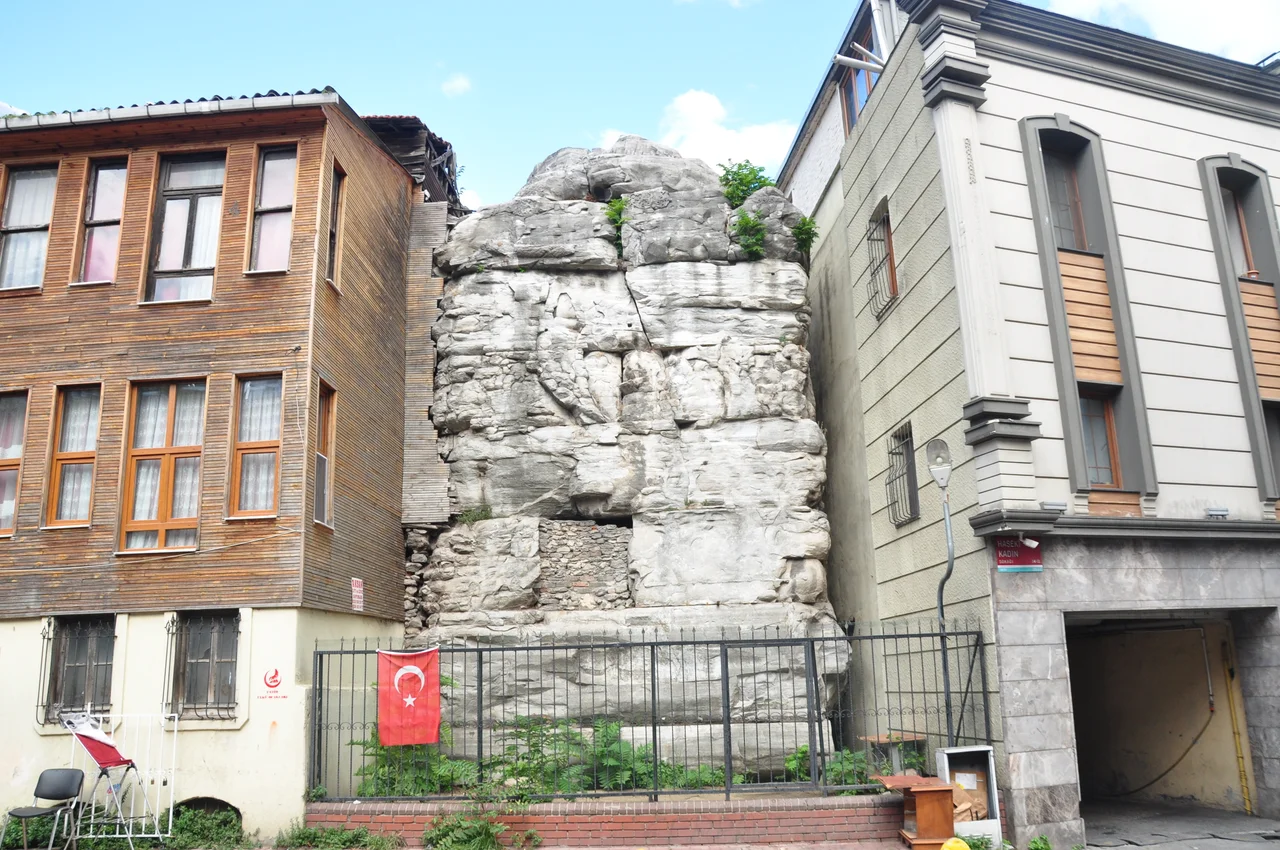

Column of Arcadius
There is a stump in the Cerrahpaşa neighborhood of Istanbul. It sits behind a fence, surrounded by apartment buildings, conspicuously out of place — a squat remnant of carved marble rising perhaps three meters from a patch of ground that feels far too ordinary for what it used to support. What it used to support was a column roughly fifty meters tall, crowned with a colossal bronze statue of the emperor Arcadius, its marble shaft wound with a spiraling frieze of carved reliefs depicting victory, conquest, and imperial majesty. That column was one of the great monuments of the late Roman world. The stump is what the earthquake of 1719 left behind.
The Seventh Hill and Its Forum
The column stood on the Xerolophos — 'dry hill' in Greek — the Seventh Hill of Constantinople, which Arcadius chose as the site of his own forum at the turn of the fifth century. The location mattered. Constantinople's hills, like Rome's, were civic stages, and a forum on the Seventh Hill staked a claim to the city's western quarter in the way that the Forum of Constantine dominated the city's center. Construction began after 401 AD, once Arcadius's generals had defeated the Gothic commander Gainas in the wars of 399 to 401. The column was the forum's centerpiece, meant to be seen from a distance, to remind anyone approaching from the land walls that the emperor's triumph was inscribed in marble on the city's horizon.
What the Reliefs Said
The column's shaft was wound with a spiraling frieze of carved reliefs — a technique borrowed from the columns of Trajan and Marcus Aurelius in Rome, then adapted for Arcadius's own purposes. The surviving drawings, made before the column's destruction, reveal a program of astonishing detail and deliberate political messaging. The lowest register showed bound barbarian captives and arms, standard Roman victory iconography. Above that, Victories inscribed shields, senators presented tribute alongside the personified figures of Constantinople and Rome wearing their civic crowns, and the two emperors — Arcadius in the east, his brother Honorius in the west — were depicted together in a joint triumph that, in fact, never occurred. The column showed what imperial unity should look like, not what it actually was. At the very top, airborne Victories held wreaths surrounding crosses, and the Sun and Moon drove their chariots across the stone sky. The whole program moved from earthly conquest to cosmic Christian order, a visual argument in marble for the legitimacy of the Theodosian dynasty.
The Scholar Who Climbed in Secret
During the Ottoman period, when the column still stood largely intact, a French humanist named Petrus Gyllius made his way up the interior spiral staircase — quietly, without official permission — and examined the structure from the inside and out. Gyllius was one of the great antiquarians of the sixteenth century, and his book De Topographia Constantinopoleos recorded what he found. He described the shaft as composed of 21 large marble blocks; of those 21, only the lowest course at the base survives today. The pedestal that Gyllius also measured was nearly eight meters tall with cornice moldings, its four faces carrying carved reliefs in four registers. Three small rooms occupied the interior of the pedestal, the first decorated with a cross-in-wreath niche. The spiral staircase rose through it all to a platform at the column's capital, where the statue stood against the sky.
A Triumph Depicted, A Triumph Invented
One of the more interesting historical details the Column of Arcadius preserved is the gap between the monument's claims and reality. The column was built to commemorate Arcadius's triumph over Gainas — a genuine military success. But the reliefs depicted both Arcadius and his brother Honorius as equal participants in a joint celebration. The two brothers had not celebrated a joint triumph. The Western Empire and the Eastern Empire were already diverging under separate courts with separate concerns. The column's sculptural program imagined a unity that propaganda required and politics had eroded. Later visitors who could read the reliefs were looking at an imperial fantasy in stone — which is, of course, what many triumphal monuments are, if you look at them carefully enough.
The Stump That Remains
The 1719 earthquake brought down the column itself. What survived was the lowest surviving portion of the base — one carved stone course, a torus decorated with an oak wreath bound with a floral fillet depicting theatrical masks and mythological hunt scenes involving lions, griffins, and birds. Above this, nothing. The bronze statue had already fallen in 740. The upper drums were gone. A stump endures in a city that built over and around it, the modern apartment blocks of Cerrahpaşa crowding in from every direction. It is one of those monuments that rewards patience and a willingness to seek out what does not advertise itself. Stand at the stump, look at the carved detail that remains, and the column rises in the imagination to something like its original scale — towering, carved from top to base, proclaiming in marble that empire is permanent, that victory is eternal. The earthquake disagreed.
From the Air
The Column of Arcadius stump lies at 41.0078°N, 28.9431°E in the Cerrahpaşa neighborhood of Istanbul's Fatih district, on the Seventh Hill of ancient Constantinople. From the air at 3,000 feet, the historic peninsula's hillscape is visible, with the Cerrahpaşa area identifiable by the large Cerrahpaşa Hospital complex nearby. The stump itself is too small to identify from altitude, but the Seventh Hill's elevated position is slightly perceptible in the terrain. Nearest major airport: LTFM (Istanbul Airport), approximately 35 km to the northwest. The Golden Horn inlet and the Bosphorus Strait provide excellent geographic orientation from any altitude above the city.
Nearby Stories
- Kocaeli Peninsula 7.6 km away
- Second Battle of Çatalca 11 km away
- Istanbul's Rural Outskirts 14 km away
- MV Struma 20 km away
- HMAS AE2 36 km away
- Bursa 66 km away
- Sangarius Bridge 71 km away
- Januarius MacGahan 101 km away