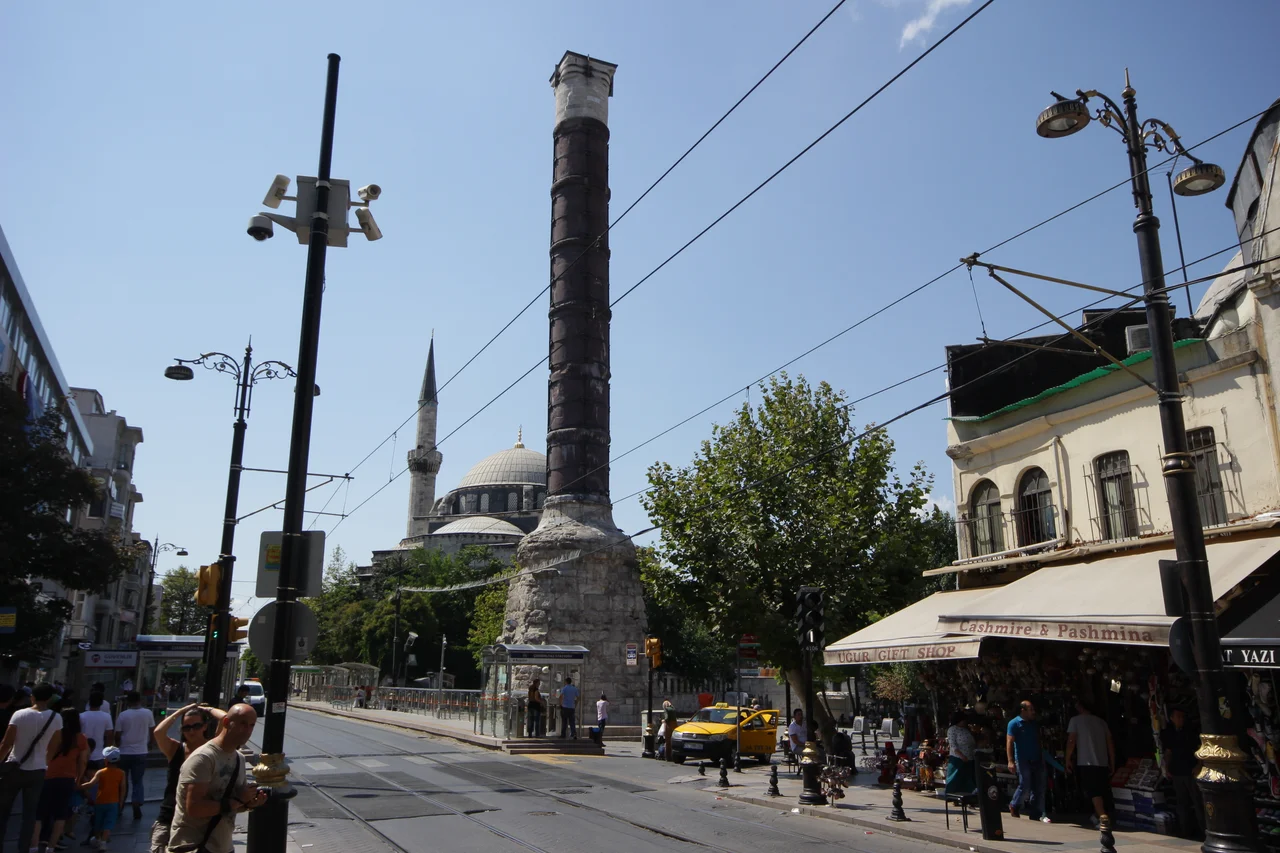

Column of Constantine
On May 11, 330 AD, Constantine the Great dedicated his new capital with ceremonies that were deliberately, almost uncomfortably, mixed. Christian prayers were offered. Pagan rites were performed. At the center of the Forum of Constantine, a column fifty meters tall — built from deep-red imperial porphyry, the stone that only emperors were permitted to use — received at its foot a collection of relics that tells you everything about how this emperor thought about power and legitimacy. There were fragments allegedly from the True Cross. There were relics associated with the loaves and fishes miracle. There was also, reportedly, the palladium of Rome: the ancient wooden statue of Pallas Athena said to have been brought from Troy and to protect the eternal city. Constantine was not replacing Rome. He was moving it.
The Stone That Only Emperors Could Use
Imperial porphyry — the dark reddish-purple stone quarried exclusively at Mons Porphyrites in Egypt — was one of antiquity's most controlled materials. Its use was reserved for imperial monuments and imperial burials; to build with it was to make a statement about divine sanction. Constantine built his column from porphyry drums stacked on top of one another, each joint originally hidden beneath sculpted bronze laurel wreaths. Monolithic columns were more prestigious — most Roman honorific columns were single shafts — but the scale Constantine intended made a single piece impractical. So he stacked the drums and covered the seams, and the resulting column stood nearly fifty meters tall, rivaling the Colosseum's height and approaching the Pantheon's internal dimension. His statue on top, likely of gilded bronze, wore a radiate crown — the symbol of the sun god Sol — and held an orb said to contain a fragment of the True Cross. The Christian emperor's statue looked like a pagan god. That was probably intentional.
The Heart of Nova Roma
The column stood at the center of the Forum of Constantine, an oval public square on the second-highest of the seven hills of what Constantine called Nova Roma — New Rome. It was midway along the Mese odos, the great colonnaded avenue that was Constantinople's main thoroughfare, running east toward Hagia Sophia, the Hippodrome, and the Great Palace, and west toward the Forum of Theodosius and eventually the land walls. In Constantine's own time, the forum held the original meeting place of the Byzantine Senate, which the emperor established there to give his new city instant institutional weight. The column was the axis around which the city's first public life revolved, visible from the streets in every direction, its gilded statue catching the light above the forum's colonnades.
Fourteen Centuries of Trouble
The column's history is a running inventory of damage and repair. Bronze reinforcements were added as early as 416 AD. Fire in the fifth and sixth centuries left scorch marks. In 1106, a violent storm toppled the imperial statue and knocked off the three uppermost column drums. Emperor Manuel I Komnenos (reigned 1143–1180) installed a cross in place of the statue and added an inscription: 'Faithful Manuel invigorated this holy work of art, which has been damaged by time.' The Fourth Crusade's sack of Constantinople in 1204 stripped away the bronze laurel wreaths that had covered the drum joints. The Ottoman conquest in 1453 removed the cross. Around 1515, Ottoman workmen added iron reinforcing hoops to the shaft — practical engineering that gave the column its Turkish name, Çemberlitaş, from çemberli (hooped) and taş (stone). A fire in 1779 destroyed the surrounding neighborhood and blackened the column so thoroughly that it acquired another name: the Burnt Column.
What Survived the Fire
The 1779 fire was among the worst in the column's long history, but the porphyry held. Porphyry is an exceptionally hard igneous rock, and the column's basic structure — its drums, its surviving height of 34.8 meters above present ground level — came through the fire intact, if darkened. Sultan Abdülhamid I had the masonry base added afterward, and the surrounding neighborhood was eventually rebuilt around the column. What lies below ground matters too: the original platform sits 2.5 meters beneath the present surface, and the pedestal it stood on is no longer visible. Restoration work has been intermittent since 1955, including repair of cracks in 1972. Since 1985, the column has been listed as part of the UNESCO World Heritage Site encompassing Istanbul's historic areas. It stands today beside the Çemberlitaş stop on the T1 tramline, which means tens of thousands of people ride past it daily without necessarily understanding what they are passing.
The Column Beside the Tram Stop
There is something both humbling and oddly fitting about the Column of Constantine's current situation. It rises from a busy intersection where Yeniçeriler Caddesi meets Divan Yolu — the two streets that roughly follow the path of the ancient Mese odos — and it competes for attention with storefronts, tourists, and the rattle of the T1 tram on its rails. Pigeons have colonized the iron hoops. The porphyry, after seventeen centuries of exposure, is so dark it barely reads as red anymore. But the column still stands on the line between what was and what is, exactly where Constantine placed it: at the intersection of the city's main roads, at the center of the forum that declared his capital open for business. The relics buried at its foot, if they were ever there, are still there. The palladium of Rome, the fragment of the True Cross — all of it sealed under a tram stop in Istanbul, waiting.
From the Air
The Column of Constantine (Çemberlitaş) stands at 41.0086°N, 28.9711°E on the Divan Yolu in Istanbul's Sultanahmet district, approximately 400 meters west of Hagia Sophia. From the air at 2,000 feet, the column is visible as a dark vertical shaft rising from the dense streetscape, easily located by following the Divan Yolu corridor westward from Sultanahmet Square. The surrounding neighborhood is one of Istanbul's most historically dense, with the Blue Mosque's minarets, the Grand Bazaar's rooftop, and Hagia Sophia's dome all within a short radius. Nearest major airport: LTFM (Istanbul Airport), approximately 35 km to the northwest on the European shore. The Bosphorus Strait and Sea of Marmara coastlines provide clear orientation from altitude.
Nearby Stories
- Kocaeli Peninsula 7.6 km away
- Second Battle of Çatalca 11 km away
- Istanbul's Rural Outskirts 14 km away
- MV Struma 20 km away
- HMAS AE2 36 km away
- Bursa 66 km away
- Sangarius Bridge 71 km away
- Januarius MacGahan 101 km away