
Column of Justinian
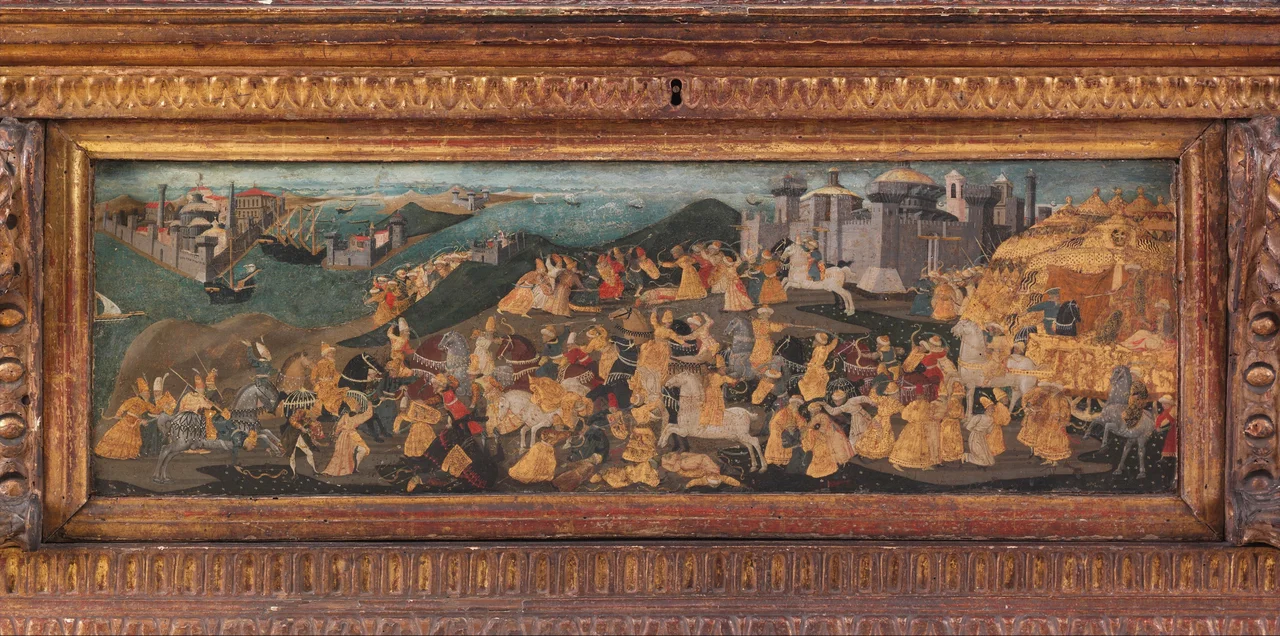
Sometime before 1433, three bronze figures vanished from the great square of Constantinople — statues of "pagan emperors" who had kneeled in submission before the column for centuries. Their disappearance went unrecorded. The column itself still stood: a shaft of brick clad in brass, rising some fifty meters above the Augustaeum — though the Florentine traveler Buondelmonti would later record it as seventy — topped by an emperor in the full theater of Roman triumph. But who that emperor was had already become a matter of myth. By the 15th century, Constantinopolitans believed the enormous bronze figure was Constantine the Great himself, founder of their city — not Justinian I, who had actually erected it in 543 to celebrate his military victories. The mix-up mattered, because when the globe slipped from the statue's outstretched hand sometime between 1422 and 1427, the citizens read it as prophecy. Their city, they felt certain, was about to fall.
The Emperor in Bronze
Justinian I raised the column in 543, at the height of his ambition, when his general Belisarius had reconquered North Africa and Italy and the empire seemed on the verge of reclaiming its ancient extent. The statue atop it was dressed in what the historian Procopius called "the dress of Achilles" — a muscle cuirass molded to the body, a helmet plumed with peacock feathers (the toupha), and a globus cruciger, the orb surmounted by a cross that symbolized Christian dominion over the world. The right hand stretched eastward, toward Persia, as if commanding it to submit. The column stood on a pedestal of seven marble steps in the Augustaeum, the great ceremonial square flanked by Hagia Sophia to the north and the entrance to the Great Palace to the south. Travelers approaching Constantinople by sea could pick it out against the skyline from a considerable distance.
There are hints, preserved in the 1430s drawing made by Giovanni Dario at the request of the antiquarian Cyriacus of Ancona, that the statue may not have been made for Justinian at all. Inscriptions on the base appear to reference Theodosius I or Theodosius II, raising the possibility that Justinian reused an earlier imperial monument and simply rechristened it. The recycling of prestigious statues was common practice in late antiquity; if true here, it would mean even Justinian's great column rested on a convenient fiction.
Acrobat and Rope
The Byzantine historian Nicephorus Gregoras recorded one of the more striking images from the column's long life: at some point, the peacock-feather helmet — the toupha — fell from the statue's head, and restoring it required an acrobat working on a rope slung from the roof of Hagia Sophia. The detail is easy to underestimate. It locates the column precisely in the urban fabric of the city, the column and the great church so close together that a rope could span between them, and it tells us something about the scale of what had been built. Seventy meters is not an architectural ornament. It is a skyline feature, a thing you navigate by, a thing you look up at from the streets below and feel the weight of.
Russian pilgrims visiting the city in the late Byzantine period described both the column and the three kneeling bronze figures arrayed before its base — enemy rulers rendered in permanent submission. Those figures were gone by 1433. The Florentine cartographer Cristoforo Buondelmonti, writing in the same era, confirmed the column's height at 70 meters. The French scholar Pierre Gilles, who lived in Constantinople in the 1540s, arrived too late — the column had been destroyed in the earthquake of 1509. He found only fragments lying in the storerooms of Topkapi Palace, waiting to be melted down and cast into cannons.
The Globe Falls
The object in the statue's left hand — the globus cruciger, the orb signifying Christian sovereignty over the world — had been the column's most potent symbol. When it fell from the statue's grip sometime in the 1420s, ordinary Constantinopolitans made a straightforward deduction: if the emperor drops the world, the world will be taken from him. The city they lived in had been shrinking for decades. The Byzantine Empire, once stretching across three continents, was by then reduced to Constantinople itself and a few outlying territories. The Ottoman Empire pressed from every direction. Mehmed II would breach the Theodosian Walls in 1453, not quite thirty years after the globe fell.
The column survived the conquest. It stood through the first decades of Ottoman rule, a relic of the old city's grandeur, until the earthquake of 1509 finished what war and time had not. Almost nothing remains above ground. The Augustaeum where it stood is buried beneath the streets near Hagia Sophia, and the fragments Pierre Gilles catalogued were melted long ago. What survives is the Cyriacus drawing, the travelers' descriptions, and the shape the column leaves in the records — a monument to victory that became, despite itself, a monument to loss.
Reading the Ruins
The Column of Justinian illustrates a recurring pattern in Constantinople's long history: monuments built to proclaim permanence outlasted by the meanings people gave them. The column was raised to celebrate military triumph. It was remembered as the image of a founder. Its fall was read as divine warning. Each generation encountered it fresh and rewrote what it meant.
Modern archaeology has recovered enough to establish the basic facts: the column's construction date, its location in the Augustaeum between Hagia Sophia and the Great Palace, its height and materials, the style of the statue. The 3D reconstruction produced by the Byzantium 1200 project gives a sense of how the whole ensemble looked. But the acrobat on the rope, the three kneeling figures, the globe slipping from an emperor's hand while citizens watched and drew conclusions — those details live only in manuscripts, in the observations of pilgrims and scholars who saw the thing while it still stood. They record not just a monument but a city's relationship with it, the way an object accumulates meaning across centuries until the earthquake comes and there is nothing left but the stone fragments and the stories.
From the Air
The Column of Justinian once stood at approximately 41.008°N, 28.979°E, in the Augustaeum square directly adjacent to Hagia Sophia in the historic peninsula of Istanbul. Flying over this area from LTFM (Istanbul Airport, 33 km northwest), approach the Bosphorus Strait and look for the distinctive dome of Hagia Sophia — the column's original site was just to its southwest, near the entrance of Topkapi Palace. Best viewed at 1,500–3,000 feet for a sense of the dense urban fabric of the old Byzantine city center. The Sea of Marmara is visible to the south, the Golden Horn to the north. Optimal visibility in clear mornings when the domes and minarets cast long shadows across the First Hill.
Nearby Stories
- Kocaeli Peninsula 7.6 km away
- Second Battle of Çatalca 11 km away
- Istanbul's Rural Outskirts 14 km away
- MV Struma 20 km away
- HMAS AE2 36 km away
- Bursa 66 km away
- Sangarius Bridge 71 km away
- Januarius MacGahan 101 km away