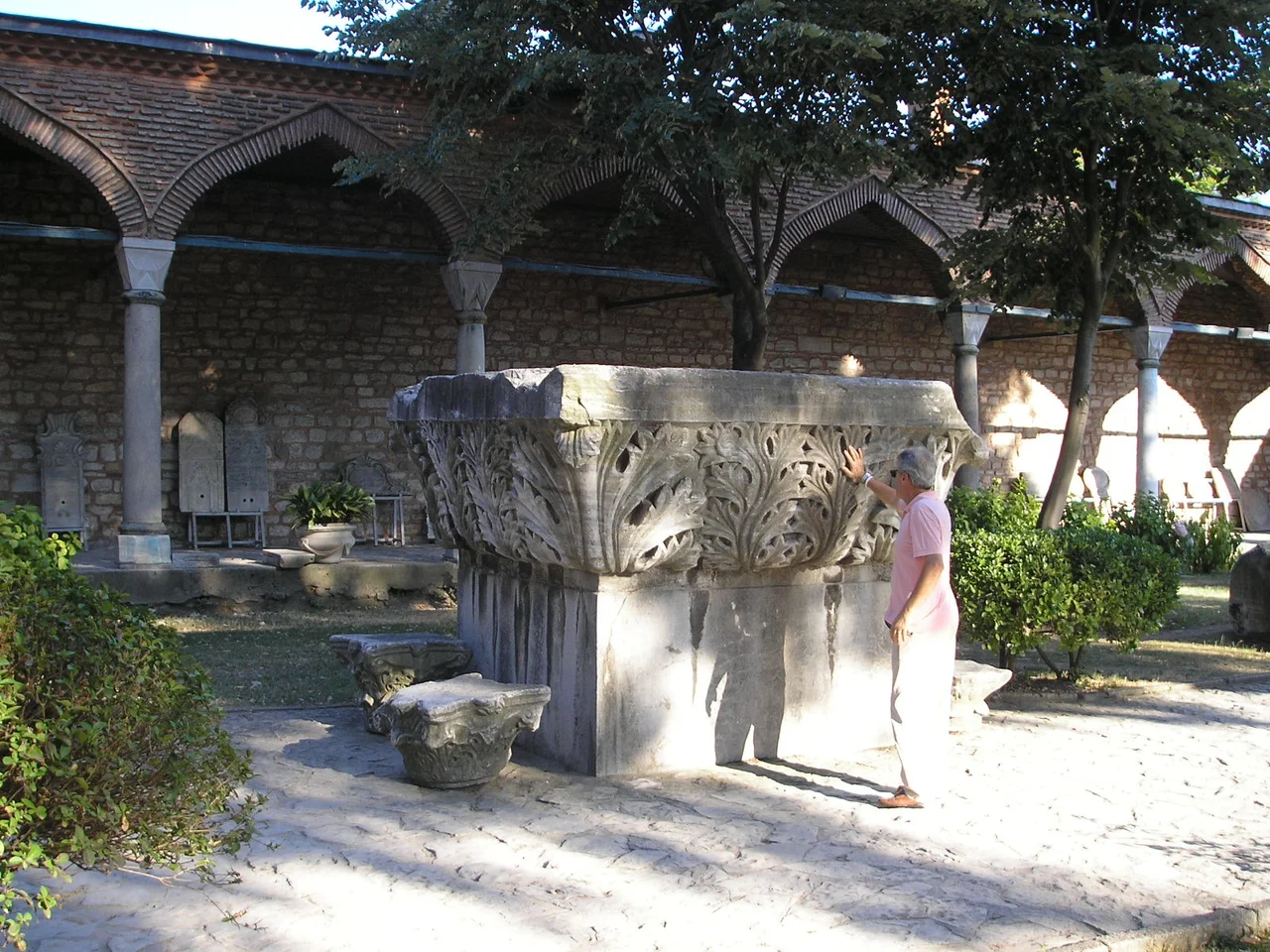

Column of Leo
A complete marble drum sits in the second courtyard of Topkapi Palace, inscribed on its upper face with a single Greek letter: Η. In the Greek numeral system, Η means eight. The drum was the eighth piece of a column shaft, the topmost drum before the capital, and it waited in that courtyard for archaeologists to recognize what it was. The column it once belonged to had stood in the Forum of Leo, the last forum ever built in a Roman capital city — and it had been gone for so long that its very location was disputed. Reconstructing it, from that drum and a handful of other fragments, took until 1986.
The Last Roman Forum
Leo I ruled the eastern empire from 457 to 474, the first emperor crowned by the Patriarch of Constantinople — a shift in the ceremonial legitimation of power, even if the real choice had been made by the powerful general Aspar, who selected Leo and presented him to the senate. His forum, the Forum of Leo, was built somewhere on what had been the ancient acropolis of Byzantium, on the hill overlooking the Bosphorus. Its exact position was recorded only obliquely: a 15th-century Latin translation of a work by Manuel Chrysoloras placed it "on the hill of Byzantium, to the right of the temple of Peace." That temple of Peace was Hagia Irene, and the "hill" was the old pre-Constantinian city center. Modern scholars have concluded that the most likely site of the forum is the second courtyard of Topkapi Palace — the very place where the column's fragments were later found.
The forum was the last of its kind. After Leo, no emperor would build another forum in a Roman capital. What made this one distinctive beyond timing is uncertain; most of its buildings are lost. Archaeological excavations in the Topkapi courtyards have found the remains of a basilica with a narthex and a polygonal apse, possibly built in 471 as part of the original forum complex and perhaps the same church of Saints Peter and Paul that the emperor Justin II had rebuilt a century later.
Marble and Wreaths
From the surviving fragments, Byzantinist Urs Peschlow published a meticulous reconstruction of the Column of Leo in 1986. The column would have stood between 21 and 26 meters tall without its statue — not as tall as some of Constantinople's great columns, but substantial. The shaft was made up of eight marble drums, each one encircled by a carved laurel wreath that concealed the joins between sections. In the center of each wreath, a medallion bore a Christian symbol related to the Chi Rho, linking imperial display to Christian identity as had become standard practice by the 5th century.
The Corinthian capital atop the shaft was more than two meters high and nearly three meters broad. Most strikingly, human face protomes — stylized face masks — projected from each side of the capital, between the volutes where a floral ornament would normally sit. This unusual feature finds its closest parallel in the Column of Marcian, erected just a few years earlier in the same city, suggesting the same workshop or at least the same design vocabulary. The column was dedicated either by Leo's sister Euphemia or by his wife Verina, depending on which Byzantine source you consult. No dedicatory inscription survives to settle the question.
The Colossus That May Have Traveled
At the top of the column stood a bronze statue of the emperor. It is gone now — but where it went is one of the more intriguing open questions in Byzantine archaeology. Standing in the city of Barletta in southern Italy is an enormous bronze figure known as the Colossus of Barletta: a much-restored Late Antique statue of an emperor in military armor, roughly 5 meters tall. Its origins have been debated for centuries. Peschlow argued in his 1986 reconstruction that the proportions of the Colossus match the scale of the Column of Leo's reconstructed summit closely enough to make the identification plausible. If correct, the statue may have been removed from Constantinople — possibly during the Latin occupation following the Fourth Crusade of 1204 — and eventually deposited in Italy, where it remained.
The identification is not universally accepted. The statue could belong to any number of lost monuments. But the possibility gives the fragments in Topkapi a strange resonance: the drum marked Η, sitting quietly in a palace courtyard, and perhaps, across the Adriatic, an enormous bronze emperor standing in the Italian sun — separated by a thousand years and a thousand miles from the city where they once belonged together.
What Remains
The fragments visible today in the second courtyard of Topkapi Palace — the capital, the impost block above it, a complete drum, parts of a second drum, and the statue's pedestal — are modest things when seen in isolation. The column's socle, pedestal base, and most of its shaft are lost. The statue itself is gone or traveling. But the surviving pieces are precise enough to tell the story of how the whole was put together: the dowel holes where drums were pinned, the concave upper face of the eighth drum designed to cradle the capital above it, the four dowel holes in the impost block waiting for the plinth that would carry the statue.
The Forum of Leo, the last Roman forum, has been a palace courtyard for six centuries. The column that once rose from it is a reconstruction in a scholarly journal. But the marble drum inscribed Η is still there, among the tourists and the pigeons of Topkapi, carrying its quiet annotation: this was the eighth piece, and it was the top.
From the Air
The Column of Leo's site is within the Topkapi Palace complex at approximately 41.013°N, 28.985°E, on the First Hill of Istanbul overlooking the Bosphorus. From LTFM (Istanbul Airport, 33 km northwest), follow the Sea of Marmara coastline eastward; the Topkapi promontory juts into the meeting point of the Bosphorus, the Golden Horn, and the Sea of Marmara. Approaching at 2,000–3,000 feet, the palace grounds are unmistakable — a walled complex on the very tip of the historic peninsula. The Hagia Sophia dome is visible just southwest of the palace walls. Best viewed in morning light when the Bosphorus shimmers and the palace gardens are in shadow.
Nearby Stories
- Kocaeli Peninsula 7.6 km away
- Second Battle of Çatalca 11 km away
- Istanbul's Rural Outskirts 14 km away
- MV Struma 20 km away
- HMAS AE2 36 km away
- Bursa 66 km away
- Sangarius Bridge 71 km away
- Januarius MacGahan 101 km away