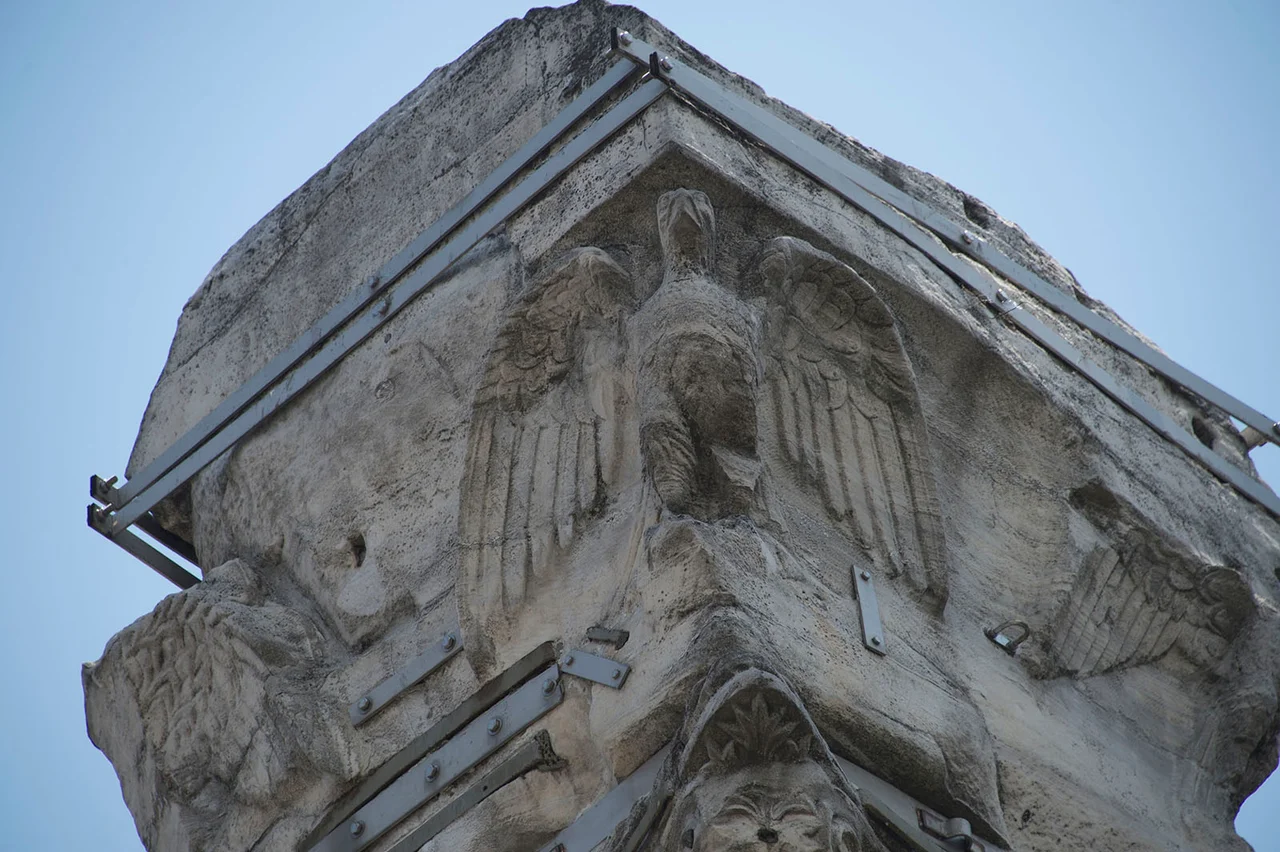

Column of Marcian
Nobody called it the Column of Marcian for long. After the Ottomans took Constantinople in 1453, the statue of the emperor vanished from the top — the bronze was too valuable to leave in place — and the column was left with just its shaft and the decorations on its base. Those decorations included two carved genii, winged spirit figures supporting a globe, and it was the genii that Ottomans noticed and remembered. The word for girl in Turkish is kız. The word for stone is taş. The column became Kıztaşı: the Maiden's Column, named for figures that weren't maidens at all but for the way they looked to people who had no reason to know what they originally meant. It still stands in the Fatih district of Istanbul. It is the only honorific column from Constantinople's Roman era that remains upright.
Egyptian Granite for a New Emperor
The Column of Marcian was carved from red-grey granite quarried in Egypt, transported across the Mediterranean, and erected in Constantinople sometime between 450 and 452 — during the brief window when the city's urban prefect Tatianus held authority and Emperor Marcian was newly on the throne. The column follows a tradition that reached back to Trajan's column in Rome and Marcus Aurelius's column in Rome: a freestanding honorific shaft topped by a statue of the emperor, planted in the urban landscape as a statement of power and continuity.
The base is encased in four slabs of white marble. Three faces carry the IX monogram — a Christian symbol combining the Greek letters iota and chi — set within carved medallions. The fourth face shows the two genii supporting a globe. Atop the shaft sits a Corinthian capital decorated with carved aquilae, the Roman eagles that had been military and imperial symbols for centuries. The whole ensemble was oriented deliberately: the base aligns northwest to southeast, while the capital aligns north to south, a subtle rotation evidently designed so that the statue of Marcian could face toward the nearby Church of the Holy Apostles, the burial church of the emperors. Even the orientation of a man's image in bronze was a theological statement.
What the Latin Says
On the northern face of the base, a Latin dedicatory inscription survives — damaged, but legible:
[PR]INCIPIS HANC STATUAM MARCIANI CERNE TORUMQUE / [PRAE]FECTUS VOVIT QUOD TATIANUS OPUS
Behold this statue of the princeps Marcian and its base, a work dedicated by the prefect Tatianus.
The lettering was originally filled with bronze — the inlay has long since been removed, leaving only the carved grooves — but the message remains clear enough. The column was not Marcian's own commission; it was a gift from the prefect, the senior administrator of the city, offered as an act of loyalty and self-promotion in one. That the column is not documented in any late Roman or Byzantine literary source is striking given how thoroughly other monuments were described. Its history has to be pieced together entirely from what the stone itself says, where it stands, and how it compares to other structures that can be dated more precisely.
Kıztaşı
The transformation of a Roman imperial column into the Maiden's Column captures something true about how cities metabolize their own pasts. The people who renamed it weren't ignorant of history in any simple sense; they were living in a city whose layers they inherited all at once, without guidebooks, and they made sense of what they saw using the vocabulary they had. Two winged figures supporting a globe, their drapery flowing, their forms ambiguously human — if you had never encountered a Roman genius figure before, you might see maidens. The name stuck. It stuck so thoroughly that it is still the column's most common informal name in Istanbul today.
Marcian himself has largely faded from popular memory. He ruled from 450 to 457, consolidated the eastern empire after the chaos of Attila's invasions, and presided over the Council of Chalcedon in 451, one of the defining theological councils of early Christianity. His name survives in stone on the northern face of the base he probably never saw erected. His statue is gone. What remains is the granite shaft, the marble base with its genii, and a Turkish nickname born of misrecognition — more durable, in its way, than the bronze image of the emperor himself.
The Sole Survivor
Constantinople was once forested with honorific columns. The Column of Constantine, the Column of Arcadius, the Column of Theodosius, the Column of Justinian — one by one, earthquake, fire, iconoclasm, conquest, and the Ottoman cannon-foundries took them down. The Column of Marcian is the only one still standing at anything close to its original height, in the Fatih district, tucked into a residential neighborhood well away from the tourist routes that thread between Hagia Sophia and the bazaars.
It is easy to walk past without fully registering what you're seeing: a single tall column on a marble base in a small square, surrounded by the city's ordinary life. That ordinariness is part of the point. The column was always embedded in the urban fabric, not isolated on a pedestal in a museum. It has been here, in something like this relationship with the streets around it, for more than fifteen centuries. The genii still hold their globe. The eagles still spread their wings on the capital above. And the name on the base, if you look for it, still says: behold.
From the Air
The Column of Marcian stands at approximately 41.016°N, 28.950°E in the Fatih district of Istanbul, about 2.5 kilometers west of Hagia Sophia on the Third Hill of the historic peninsula. From LTFM (Istanbul Airport, 35 km northwest), the historic peninsula is the tongue of land where the Bosphorus meets the Sea of Marmara. At 2,000–3,000 feet, the district's grid of streets and the distinctive silhouettes of Ottoman mosques are visible; the column itself is too slender to identify from altitude, but its neighborhood sits just south of the Vefa district. Look for the dome of the Şehzade Mosque as a reference point — the column is a few hundred meters to the northeast.
Nearby Stories
- Kocaeli Peninsula 7.6 km away
- Second Battle of Çatalca 11 km away
- Istanbul's Rural Outskirts 14 km away
- MV Struma 20 km away
- HMAS AE2 36 km away
- Bursa 66 km away
- Sangarius Bridge 71 km away
- Januarius MacGahan 101 km away