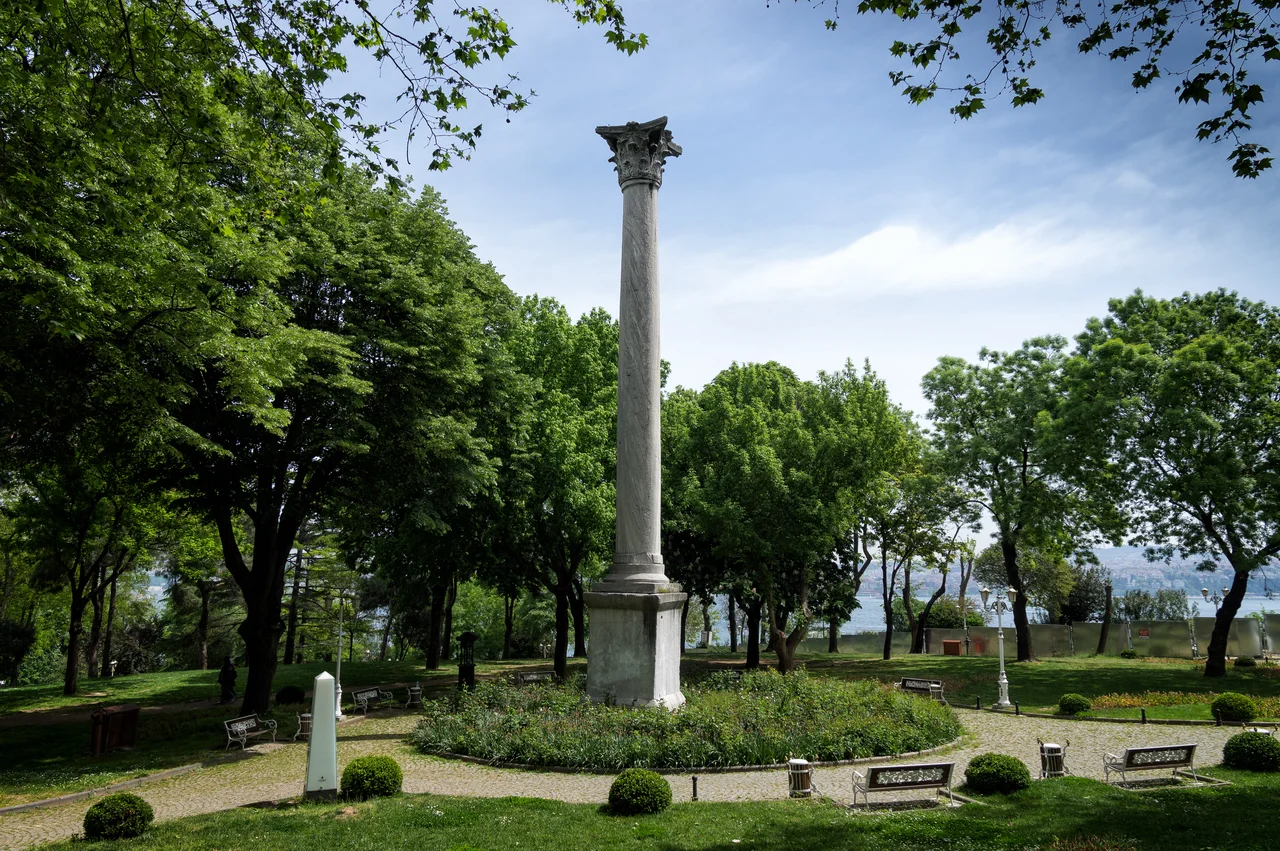

Column of the Goths
Before there was Constantinople, there was Byzantium. And before there was the Column of the Goths, there may have been an earlier inscription on the same stone — whatever it said, it was chiseled away and replaced with the words that survive. The column stands now in Gülhane Park, in the shadow of the old Topkapi Palace walls, 18.5 meters of Proconnesian marble topped with a Corinthian capital. It is the oldest freestanding Roman monument still upright in Istanbul, which means it predates the city as most people know it. Constantine the Great refounded this city in 330 and called it New Rome. The column was probably already here.
FORTVNAE REDVCI OB DEVICTOS GOTHOS
The Latin inscription at the base of the column names the occasion: "To Fortuna, who returns by reason of victory over the Goths." Fortuna Redux — Fortuna who brings men home safely — was a Roman goddess of the return from battle, an appropriate deity to invoke after a military campaign. The Goths who were defeated were among the waves of Germanic peoples who began pressing into Roman territory in the 3rd century AD, raiding across the Danube and into Thrace and Anatolia before Roman armies pushed them back.
Exactly which Roman victory the inscription commemorates is uncertain. Scholars date the column to the third or fourth century AD, a range that spans multiple Gothic incursions and Roman counterattacks. The earlier inscription that the dedicatory text replaced — now lost, its content unrecoverable — suggests the column may have a history extending even before the Gothic victory it currently celebrates. Byzantium, the city that stood on this site before Constantinople, had its own monuments and its own civic life. The column may have served an entirely different commemorative purpose before someone decided that the Goths' defeat was the story worth telling.
Proconnesian Marble
The column is carved from Proconnesian marble, quarried on the island of Proconnesus in the Sea of Marmara — what is today the Turkish island of Marmara Adası. Proconnesian marble was one of the most widely used building materials in the ancient Mediterranean world: pale, bluish-white, fine-grained, easy to work and abundant enough to be exported throughout the Roman Empire. The great quarries on Proconnesus supplied marble for buildings from Rome to Alexandria, and the column's material places it firmly within the normal supply chains of Roman imperial construction.
At 18.5 meters, the column is shorter than the great imperial columns of central Constantinople — Justinian's at 70 meters, Marcian's somewhat taller. But the Column of the Goths was not built to dominate a cityscape. It stands in what was probably a secondary area of the old Byzantium, possibly at the edge of the ancient city's acropolis overlooking the Bosphorus. The marble pillar is unfluted, plain along its shaft, with its ornament concentrated in the Corinthian capital above. The simplicity is part of its character — this is a soldier's monument, not a philosopher's.
A Park Through Many Empires
The land where the column stands has been, at different times, part of the outer gardens of the Byzantine imperial palaces, part of the outer gardens of Topkapi Palace after the Ottoman conquest, and since the late 19th century, Gülhane Park — "the rose house garden," one of Istanbul's oldest public parks. The park was opened to the public in 1912, transforming what had been palace grounds into a space for ordinary Istanbulites.
The column has witnessed the succession of empires from its spot in the garden without commentary. Romans, Byzantines, Ottoman Turks, and the citizens of the Turkish Republic have all walked past it. The inscription grew harder to read as the centuries passed — it is now, according to visitors, virtually illegible without prior knowledge of what it says. But the column endures, marble that has outlasted every political order that claimed this city, standing in a park where children play and pigeons settle on the Corinthian capital, in the shadow of walls that themselves have been rebuilt a dozen times.
Older Than the City
What makes the Column of the Goths genuinely unusual among Istanbul's Roman remains is the implication of its age. If the column dates to the third century or early fourth century, it was erected before Constantine chose this site for his new capital. It was already standing when Constantine arrived, already part of the landscape of a provincial city, already carrying its story about Fortuna and the defeated Goths.
Constantine's decision to build Constantinople here was partly strategic — the peninsula's natural defenses, its control of the Bosphorus, its position between Europe and Asia — and partly political: starting fresh, away from the entrenched senatorial families of Rome, in a city he could fill with his own monuments. But he built on top of something. Byzantium already had its streets, its acropolis, its harbor, its temples, and its columns. The Column of the Goths represents what was here before the city became what it became. It is a reminder that the story started before 330, and that the marble has been standing here, reading its inscription to the sky, longer than the name Constantinople has existed at all.
From the Air
The Column of the Goths stands at approximately 41.015°N, 28.985°E within Gülhane Park, just outside the walls of Topkapi Palace on the Bosphorus-facing slope of the First Hill of Istanbul. From LTFM (Istanbul Airport, 33 km northwest), the historic peninsula is the narrow land mass where the Bosphorus meets the Sea of Marmara and the Golden Horn. At 1,500–2,500 feet, Gülhane Park is the green area immediately north of Topkapi's outer walls, sloping toward the Bosphorus waterfront. The column itself is a slender marker within the park's trees, best appreciated on the ground, but the surrounding landscape — the walled promontory, the water on three sides, the domes of Hagia Sophia visible above the tree line — makes this one of the most dramatically situated ancient monuments in Europe.
Nearby Stories
- Kocaeli Peninsula 7.6 km away
- Second Battle of Çatalca 11 km away
- Istanbul's Rural Outskirts 14 km away
- MV Struma 20 km away
- HMAS AE2 36 km away
- Bursa 66 km away
- Sangarius Bridge 71 km away
- Januarius MacGahan 101 km away