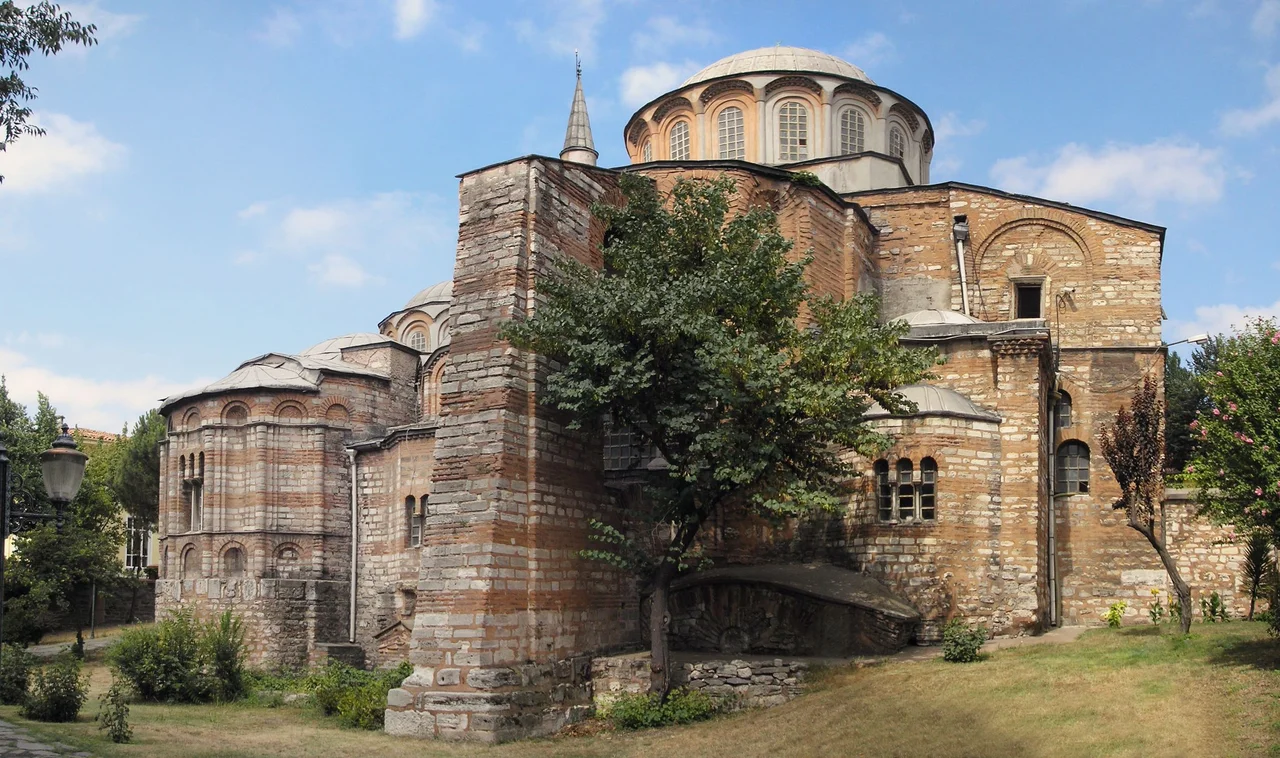

Constantinople
The name had to be said in full. Not just "the city" — though that is what the Greeks called it, and what Istanbul still means in Turkish, from the Greek phrase eis tin Polin, "into the city." In Old Norse the Vikings called it Miklagarðr, the great city. In Arabic, Rūmiyyat al-Kubra — the Great City of the Romans. In Persian, Takht-e Rum — the Throne of the Romans. In Slavic languages, Tsargrad — the City of the Emperor. Every civilization that encountered it reached for the most emphatic name it could find, and still felt it hadn't quite captured what they meant. Constantinople was founded in 324 on the site of an older Greek city called Byzantium, consecrated as capital of the Roman Empire on 11 May 330, and it would remain the capital of successive empires — Roman, Byzantine, Latin, Ottoman — until the sultanate was abolished in 1922. Eleven centuries of continuous imperial rule from a single city. Nothing else in world history quite compares.
Constantine's Wager
The emperor Constantine I knew Rome was the wrong capital. It was too far from the frontiers — from the Danube to the north and the Euphrates to the east — and it was too full of entrenched senatorial families who complicated governance. Rome had been the seat of Roman power for over a thousand years, and moving the capital seemed unthinkable. Constantine thought it anyway. He identified the site of the ancient Greek city of Byzantium, a compact peninsula where Europe and Asia nearly touched, where the Bosphorus Strait narrowed enough that whoever held the crossing controlled the trade between the Black Sea and the Mediterranean. The geography was a gift that no rival city could replicate.
He built fast. Constantinople was constructed over roughly six years and ceremonially consecrated on 11 May 330, though construction continued for decades afterward. Constantine divided the expanded city into fourteen regions, mirroring Rome. He promised householders imperial land grants to attract private builders. From 18 May 332, he arranged free food distributions — 80,000 rations a day from 117 distribution points — to draw population. Columns, marbles, doors, and tiles came wholesale from temples across the empire. The greatest Greek and Roman artworks were shipped in to fill the squares and colonnades. He built it as an act of will, and it worked.
The Heart of a Thousand-Year Empire
From the mid-5th century to the early 13th century, Constantinople was the largest and wealthiest city in Europe. Its Theodosian Walls — a double line of fortifications 18 meters tall, built between 413 and 414, fronted by a moat — were simply impregnable to any army that lacked artillery. Huns, Avars, Bulgars, Arabs, Vikings, and Russians all pressed against those walls and turned back. The city survived sieges in 626 by a combined Persian and Avar force, and two Arab sieges in 674–678 and 717–718, partly through the deployment of Greek fire, an incendiary compound that could burn on water and destroy entire fleets.
Inside the walls, the city accumulated the treasures of the ancient world. The Imperial Library held more than 100,000 manuscript volumes at its height — the largest collection in Europe, preserving texts by Greek and Latin authors that had already been lost to the chaos that consumed the western half of the empire. The Hippodrome seated more than 80,000 spectators and served not just as a sporting venue but as the city's political theater, the place where crowds acclaimed emperors and demanded the removal of ministers. Hagia Sophia, completed under Justinian I in 537, was for nearly a thousand years the largest enclosed space in the Christian world. Justinian, present at its dedication, reportedly exclaimed: "O Solomon, I have outdone thee."
The Wound That Would Not Heal
On 12 April 1204, the armies of the Fourth Crusade broke through Constantinople's sea walls. What followed was three days of methodical destruction. The crusaders, who had ostensibly set out to reclaim Jerusalem, instead looted the richest Christian city in the world. Bronze statues that had stood in the Hippodrome for centuries were pulled down and melted for coinage. Manuscripts were scattered. The relics of the city's most sacred churches were seized and dispersed to cathedrals across western Europe. Steven Runciman, the historian of the Crusades, wrote that the sack of Constantinople was "unparalleled in history."
The Latin Empire that replaced Byzantine rule lasted only until 1261, when the Byzantine emperor Michael VIII Palaiologos recaptured the city. But Constantinople never fully recovered. The population that had numbered in the hundreds of thousands in the city's prime had fallen to perhaps 35,000 by 1261. Trade that had once flowed through Constantinople now found other routes. Civil wars, plague — the Black Death arrived in 1347 — and relentless Ottoman pressure over the following two centuries ground the empire down until by the early 15th century the Byzantine Empire consisted of little more than Constantinople itself, a city and its immediate surroundings, an island of the old world surrounded by a rising tide.
29 May 1453
The siege lasted seven weeks. Mehmed II, the Ottoman sultan, was twenty-one years old. He had commissioned a Hungarian gunsmith named Urban to build a cannon powerful enough to breach the Theodosian Walls — walls that had held for nearly a thousand years — and the cannon worked. On 29 May 1453, Ottoman forces poured through the breaches. The last Byzantine emperor, Constantine XI Palaiologos, reportedly died fighting somewhere in the chaos of the final assault. His body was never conclusively identified.
Approximately 33,000 people were captured by the Ottomans in the immediate aftermath. Mehmed did not destroy the city; he wanted to rule it, to make it his. He ordered Muslims, Christians, and Jews to resettle the depleted city, requiring thousands of households to relocate there from other parts of the Ottoman Empire. He commissioned new mosques, repaired the walls, and built a new palace — Topkapi — on the acropolis where Byzantium's ancient city had first stood. The Church of the Holy Apostles, the burial place of Byzantine emperors since Constantine, was demolished to make way for the tomb of Mehmed himself. But Hagia Sophia was not demolished. It was converted to a mosque. The dome that Justinian's architects had hung in the air over a Byzantine nave now sheltered Friday prayers. The city remained, transformed.
What Was Saved
When Constantinople fell, scholars and monks fled westward, carrying manuscripts with them. The texts they brought — Greek philosophy, mathematics, science, literature that had been preserved in the city's libraries while much of western Europe lost the means to copy or read them — flooded into Italy and contributed to a reopening of classical thought that was already underway. The connection is not simple or direct, but it is real: Constantinople's fall accelerated the dispersal of ancient knowledge into the hands of people who were ready to use it. The Renaissance that followed owed more to this city than the standard accounts of European history usually acknowledge.
The city itself went on. As Istanbul, it became the capital of an Ottoman Empire that would last until 1922, and then the largest city of the Turkish Republic. In 1930, the name was officially changed to Istanbul in most international usage, though the Greek Orthodox Patriarchate still maintains the title of Ecumenical Patriarch of Constantinople, and in Greece the city is still called Konstantinoúpoli, or simply "the City." The Bosphorus still carries the trade between two seas. Hagia Sophia is still the building it was in 537 — altered, converted, reconverted, the subject of every kind of political argument — but still standing, still legible, still the dome that Justinian said had outdone Solomon. Some things about this city refuse to end.
From the Air
Constantinople — modern Istanbul — sits at approximately 41.01°N, 28.97°E at the crossing of the Bosphorus Strait, where Europe and Asia are separated by less than a kilometer. Flying from LTFM (Istanbul Airport, 35 km northwest on the European shore), the approach over the Sea of Marmara reveals the historic peninsula as a narrow triangle of land: the Bosphorus to the northeast, the Golden Horn inlet to the north, and the Marmara to the south. At 3,000–5,000 feet, the silhouette of Hagia Sophia's dome, the minarets of the Blue Mosque, and the walled promontory of Topkapi Palace are all visible as distinct landmarks against the water. The Theodosian Walls run across the western end of the peninsula, visible as a double line of masonry. Crossing the Bosphorus at altitude, with Europe visible to the left and Asia to the right, gives a spatial understanding of why this location dominated Mediterranean and Asian trade for two millennia. Best observed in early morning or late afternoon when the light picks out the dome and minarets and the Bosphorus glitters between two continents.
Nearby Stories
- Kocaeli Peninsula 7.6 km away
- Second Battle of Çatalca 11 km away
- Istanbul's Rural Outskirts 14 km away
- MV Struma 20 km away
- HMAS AE2 36 km away
- Bursa 66 km away
- Sangarius Bridge 71 km away
- Januarius MacGahan 101 km away