
Crimea Memorial Church
Sultan Abdülmecid gave the land. The British Empire paid for the building. The architect who won the competition was fired before a stone was laid. The church that eventually rose in Galata between 1864 and 1868 memorializes soldiers who died fighting — in part — to preserve the Ottoman Empire from Russian expansion. It now shelters displaced people in its crypt. Few buildings in Istanbul carry more compressed irony, or more genuine grace.
A War Remembered on Enemy Ground
The Crimean War of 1853 to 1856 pitted Britain and France alongside the Ottomans against Russia, a coalition strange enough that it required a monument to make sense of it. The idea of building a memorial church in Istanbul was first raised in 1856, the year the war ended. A competition was held, and the young architect William Burges submitted the winning design. But Burges never built it. In-fighting among the committee members — and concerns about the supposedly 'un-English' character of his design — led to his removal in 1863. George Edmund Street, who would later design London's Royal Courts of Justice, replaced him. Street's Victorian Gothic church was constructed between 1864 and 1868 on land that an Ottoman sultan had donated to a foreign power as an act of diplomatic grace. It stands today on a steep Beyoğlu street in Galata, its pointed arches and dressed stone a piece of England inserted into the Istanbul skyline.
What the Organ Loft Holds
Inside, the building carries its history in layers. The organ was made in England in 1911 by W. Hill & Son, the same firm that built organs for York Minster, Ely, Worcester, and Manchester cathedrals. Its pipes have filled the nave for over a century. The wrought iron staircase was brought from London. But what the organ loft contains is more unusual than the instrument itself: regimental flags from the Crimean War hang there alongside two flags from the British military headquarters in occupied Istanbul after the First World War, and the ensign from the battleship that carried Mehmed VI — the last Ottoman sultan — into exile in 1922. The church's facade bears colourful modern interpretations of biblical stories by the artist Erica Beard. The building accumulates layers of British-Ottoman history with every decade it survives.
Gallipoli and the Saints Who Look Like Neighbors
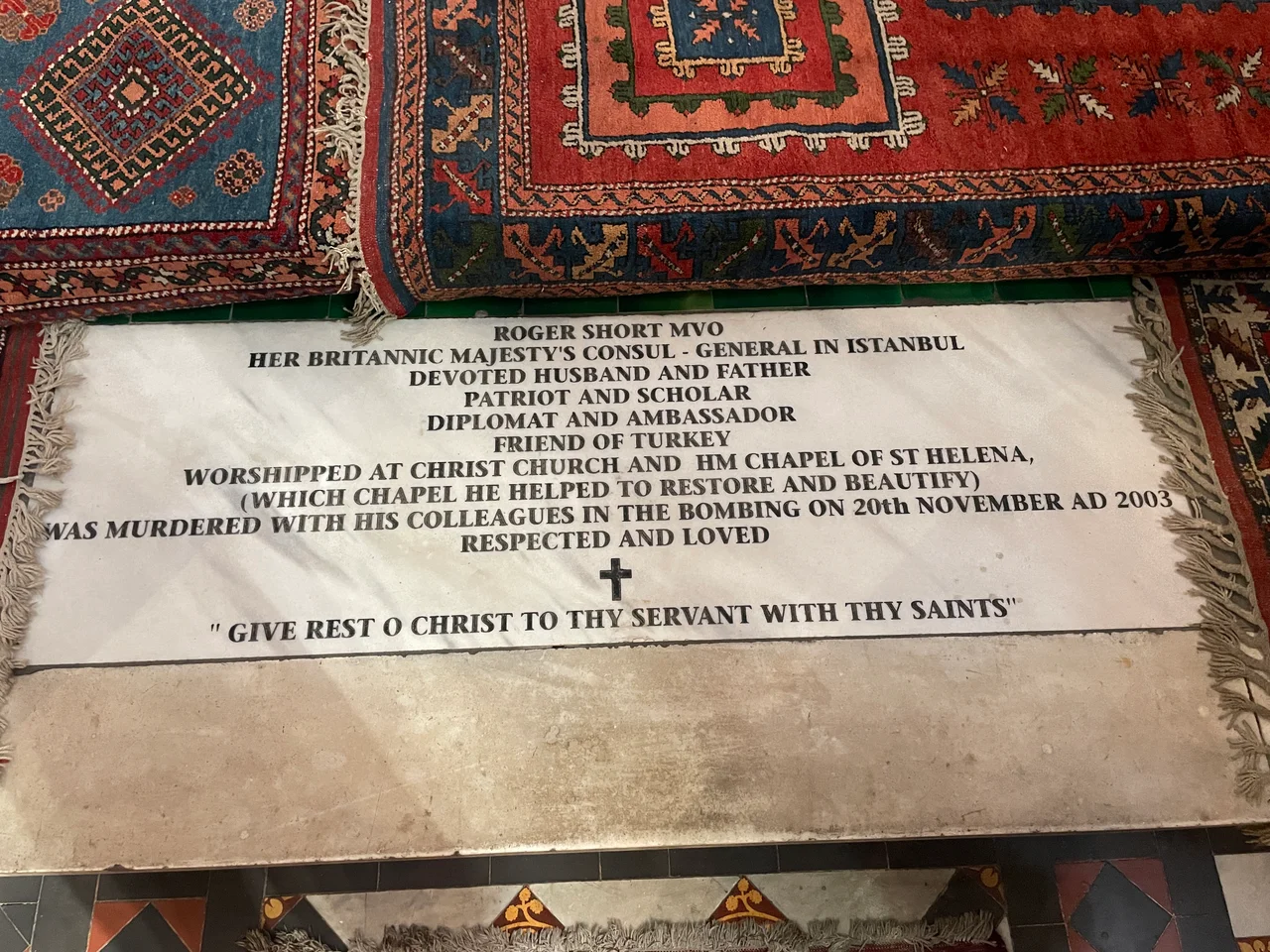
A wooden rood screen erected in 1923 connects the nave to the chancel, installed as a memorial to those who died in the Gallipoli campaign — a different war, a different catastrophe, the same landscape. Between 1995 and 2005, the Scottish artist Mungo McCosh painted it with images of saints and other figures, setting them against the Istanbul skyline. The faces of the saints were modelled on members of the congregation, which means that a first-century martyr stares back at you wearing the features of a twentieth-century parishioner. In one corner, the Christ child holds a simit — the sesame-crusted bread ring sold on every Istanbul street corner — a gesture of deliberate rootedness in the city the church calls home. The chancel also holds a quieter memorial: a plaque to Roger Short, Britain's Consul-General, killed in the 2003 bombing that destroyed the entrance to the British Consulate nearby.
Closed, Restored, Reopened
By 1978, the congregation had dwindled to the point where the church closed. It sat empty until an unlikely group made its restoration possible. Sri Lankan refugees who had fled to Istanbul following the Iraqi invasion of Kuwait in 1990 carried out much of the repair work. The church reopened in September 1991. Since then, the crypt beneath it has operated as St George's Hostel, the church's center for work with refugees and migrants. The hostel has housed more than two thousand homeless people over the years, with a particular focus on Christians who have fled Pakistan. The same building that was constructed to honor soldiers of a nineteenth-century imperial war now spends its weeks providing beds and meals to people caught in the displacements of the twenty-first century.
Open Doors on Sundays
Every Sunday at 11 a.m., the main liturgy is open to all comers. One resident priest serves the three Anglican churches in Istanbul: Christ Church in Galata, All Saints in Moda on the Asian shore, and St Helena's at the British Consulate. The congregation is international and ecumenical in practice, drawing diplomats, expats, long-term residents, and visitors who find their way up the steep Beyoğlu street on a Sunday morning. The building is not always easy to find and not always easy to reach — Galata's streets are steep and irregular — but once inside, the quality of stillness is noticeable. Istanbul presses in on every side. Within the nave, Victorian Gothic stone and the faint smell of candles hold the city at a small distance.
From the Air
Christ Church Galata stands in the Beyoğlu district at approximately 41.027°N, 28.977°E, on a hillside rising steeply from the Golden Horn toward Taksim Square. From the air at 2,000–3,000 feet, the church's Gothic tower is visible amid the dense rooftop texture of Beyoğlu, roughly 500 meters southwest of the Galata Tower. The nearest airport is LTFM (Istanbul Airport) on the European side, approximately 35 km to the northwest. Flying southward along the Golden Horn, the dome of the Süleymaniye Mosque dominates the skyline to the south; Galata Tower marks the ridge; and Christ Church sits just below the ridgeline in the urban fabric between them. Clear days allow the Bosphorus to be visible to the east.
Nearby Stories
- Kocaeli Peninsula 7.6 km away
- Second Battle of Çatalca 11 km away
- Istanbul's Rural Outskirts 14 km away
- MV Struma 20 km away
- HMAS AE2 36 km away
- Bursa 66 km away
- Sangarius Bridge 71 km away
- Januarius MacGahan 101 km away