
Cromwell Museum
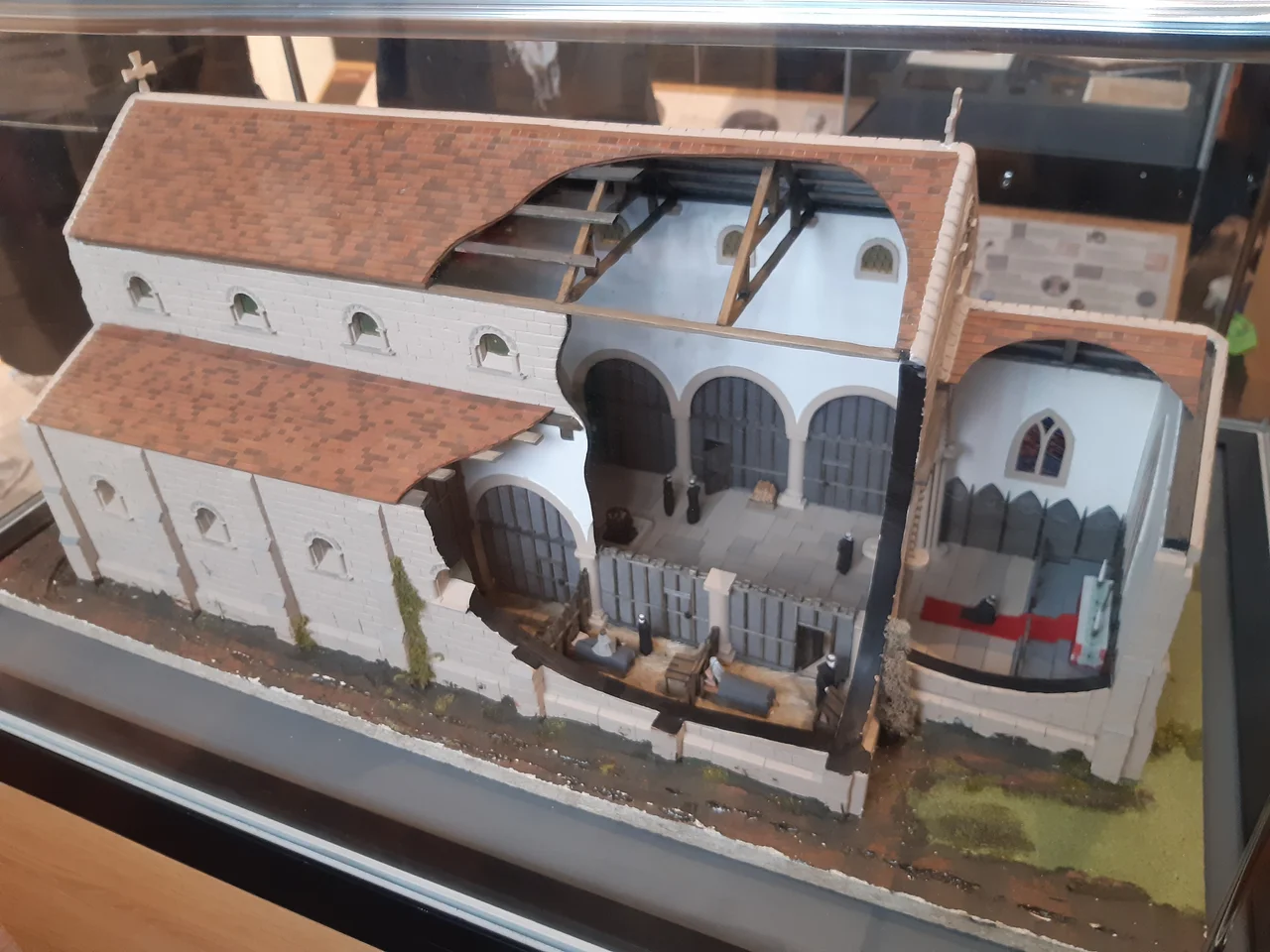
Step inside the Cromwell Museum and you are standing in a classroom. The same vaulted hall where a young Oliver Cromwell parsed his Latin verbs in the 1610s, where the diarist Samuel Pepys would later carve his name into a desk, now houses around 610 objects devoted to the man who cut off a king's head and ruled England without one. Huntingdon's grammar school occupied this building from the 16th century until 1896, and the masonry tells a longer story still. Strip away the brick skin added in later centuries - as restorers did in 1878 - and you find a blocked Romanesque doorway from the 12th-century Hospital of St John the Baptist. Schoolroom, hospital, museum: the walls have absorbed almost nine hundred years of Huntingdon's life.
The Spital and the Schoolboy
The oldest fabric here dates to between 1170 and 1190, when an Augustinian hospital known as the Spital cared for the sick and the destitute on the High Street. After the Reformation gutted such institutions, the town corporation took the building and turned it into a free grammar school - which is where Oliver Cromwell, born in Huntingdon in 1599, learned the rhetoric and theology he would later wield against bishops and kings. Pepys passed through the same desks decades later. By 1863 the medieval hall was crumbling; in 1878 the architect Robert Hutchinson restored it for £900, paid for by the playwright Dion Boucicault in memory of his son, killed two years earlier in the Abbots Ripton rail accident. The building survives today as five decorative arches on a west front, two surviving bays of a vanished nave, and a bellcote pointing at the Cambridgeshire sky.
What the Lord Protector Left Behind
The collection - founded in 1962 and judged the finest body of Cromwelliana in the United Kingdom - is the kind of thing that makes historians whisper. There are portraits painted from life and death masks cast within hours of his passing in 1658. There is his hat, his pocket watch, items of 17th-century military equipment on loan from the Royal Armouries, and a copy of the Lord Protector medal struck by the engraver Thomas Simon. About 70 percent of the objects belong to the museum outright; the rest arrive on loan from descendants of Henry Cromwell, his fourth son, and from the Museum of London. Threaded through the cases is the Tangye Collection - assembled by the Victorian engineer Richard Tangye, whose admiration for Cromwell was unfashionable enough to be a kind of devotion.
A Reputation That Will Not Settle
How do you curate a man whose name still divides a country? Cromwell ended monarchy, reformed Parliament, sheltered Jews who had been expelled from England for centuries, and presided over a brutal Irish campaign whose memory still inflames opinion in Drogheda and Wexford. The museum does not look away. It presents the regicide, the Protectorate, the dissolution of Parliament, the slaughter, alongside the Bible-reading farmer who never wanted to be king. Pilgrims of one persuasion arrive expecting a hero; pilgrims of another arrive ready to condemn. The collection invites both to slow down and look at what the man actually wore, signed, fought with, prayed over.
Saved Twice
The museum has been threatened more than once. In 2013, Cambridgeshire County Council proposed closing it as a budget measure, citing a saving of £20,000 a year. The town pushed back, hard. Letters were written, petitions signed, the BBC dispatched cameras. On 1 April 2016 management passed from the council to a charitable trust dedicated specifically to Cromwell's legacy. The building that had been hospital, then schoolroom, then museum had survived its latest threat - rescued, fittingly, by the same kind of stubborn civic feeling that produced its most famous pupil in the first place.
From the Air
The Cromwell Museum sits on Huntingdon High Street at 52.3307N, 0.1844W, roughly in the centre of the small Cambridgeshire town. The building's bellcote and surviving Romanesque masonry are best appreciated from low pattern altitude (1,500-2,500 ft AGL) over the town. Nearest airfields are RAF Wyton (EGUY) two miles north-east, RAF Alconbury (EGWZ, now decommissioned) five miles north-west, and Cambridge Airport (EGSC) about 20 miles south-east. Conington (EGSF) lies eight miles north. The River Great Ouse curls past Huntingdon to the south and is the most reliable visual landmark from the air.
Nearby Stories
- Red Bull Racing 1.3 km away
- Flag Fen 2 km away
- Denver Windmill 3.1 km away
- Uppingham School 3.6 km away
- Sywell Aviation Museum 5.8 km away
- Newmarket, Suffolk 6.8 km away
- Letchworth 6.9 km away
- Castle Hedingham 18 km away