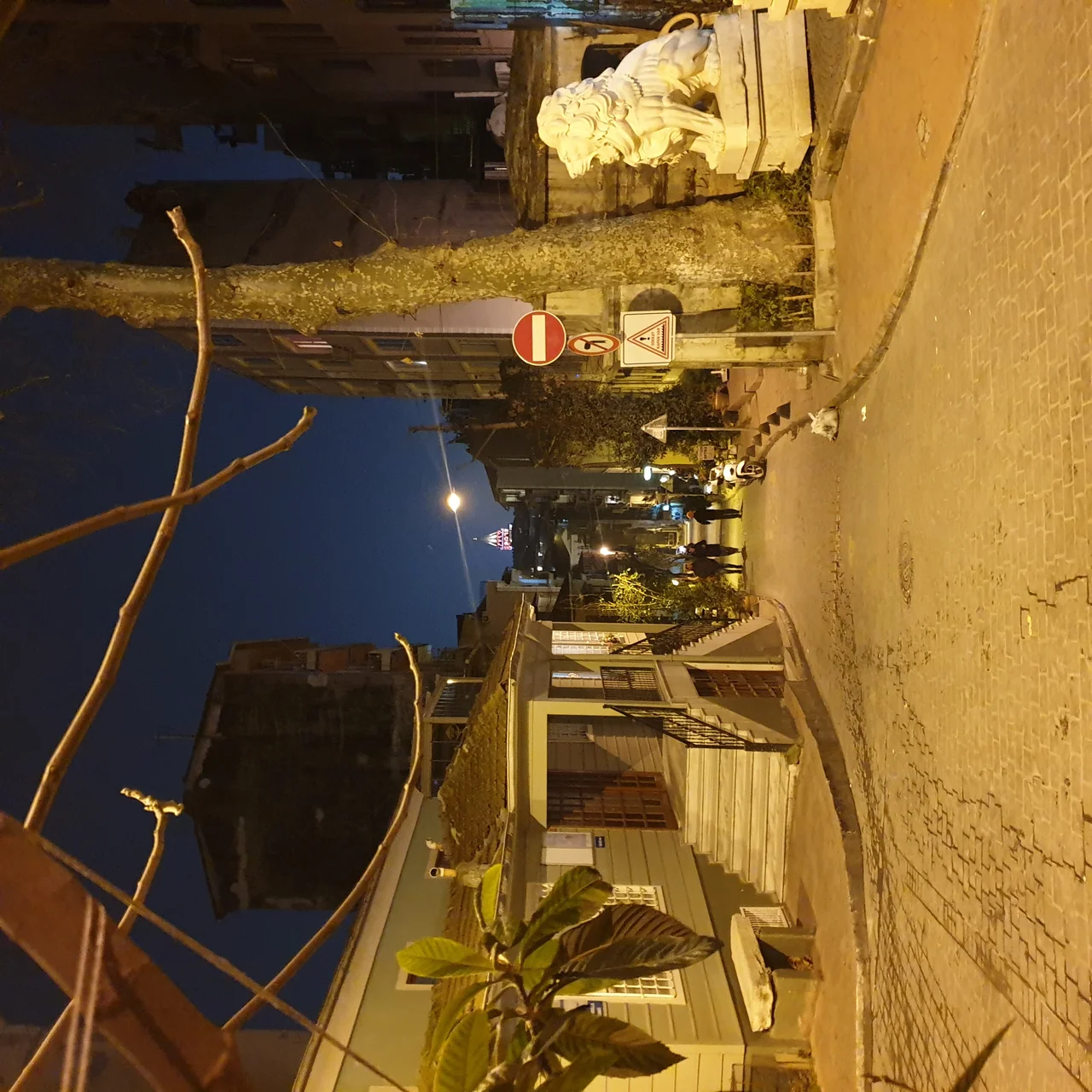

Çukurcuma
The name means Friday Valley in Turkish — a reference, tradition holds, to the day in 1453 when Sultan Mehmed the Conqueror paused in this hollow between hills to offer the first Friday prayer after his conquest of Constantinople. Whether or not the story is true, Çukurcuma has been accumulating things worth remembering ever since. Its streets are lined with antique shops where the inventories of old Istanbul wash up: ottomans, lamps, ceramics, photographs of people whose names have been forgotten. It is the kind of neighborhood where the past is not stored in museums but left out on the pavement for sale.
A Valley Between Hills
Çukurcuma lies in Beyoğlu, tucked into a valley southeast of İstiklal Caddesi and not far from Galatasaray Square, between the neighborhoods of Tomtom and Cihangir. The main street is Çukurcuma Caddesi. The buildings are mostly nineteenth century, stone and plaster in the European style that characterized Ottoman Beyoğlu, with some twentieth-century insertions. The district was never the grandest part of Pera — it was always a little downhill from the main commercial axis, slightly out of the way, the kind of place where artists and second-hand dealers naturally settle. Today its character is European in flavor and unhurried in pace, full of antique shops, small cafés, and the occasional gallery. The Guardian named it one of the five best places to live in the world in 2012. That designation caused some locals to roll their eyes, but it was not wrong about the quality of the streets.
Five Centuries of Layers
Çukurcuma was not settled in the Byzantine period — the area was outside the main residential zone of Constantinople. Its history properly begins with the Ottoman city. The Muhittin Molla Fenari Mosque, said to date from Mehmed the Conqueror's reign, was substantially rebuilt between 1541 and 1547 to a design by the master Ottoman architect Mimar Sinan. By the nineteenth century, the district had become a genuinely mixed neighborhood: ethnic Turks alongside Armenians, Greeks, and Western Europeans, each community establishing schools and hospitals and consular offices. The Liceo Italiano Galileo Galilei opened in 1882 alongside the already-established Greek Zografeion Lyceum. The Greek Consulate General still occupies a building in the neighborhood. That cosmopolitan texture did not survive the twentieth century intact. The Istanbul pogrom of 1955 — days of organized violence against the city's Greek and Armenian communities — hit Çukurcuma hard. Almost all the remaining Turkish Greeks and Armenians left afterward, a departure that transformed the neighborhood as surely as any earthquake.
Pamuk's Friday Valley
In 2008, the novelist Orhan Pamuk — who had won the Nobel Prize in Literature two years earlier — published The Museum of Innocence, a novel set largely in Çukurcuma. The book follows a wealthy Istanbul man who fills a house with objects connected to the woman he loved and lost: ticket stubs, cigarette butts, a thousand earrings, salt shakers, combs. It is a novel about Istanbul's upper-middle-class life in the 1970s and about the compulsive nature of memory, and Çukurcuma's antique shops — places where other people's memories accumulate for sale — gave it exactly the right setting. Then, in 2012, Pamuk did something unusual: he opened an actual Museum of Innocence in a wooden house on one of the neighborhood's back streets, displaying the objects described in the novel. The museum was recognized as European Museum of the Year in 2014. Fiction and fact collapsed into each other in a way that Çukurcuma, with its layered past, seemed designed to accommodate.
Antiques, Cafés, and the Art of Looking
Walking Çukurcuma today means navigating a neighborhood that has been simultaneously discovered and somehow not overrun. The antique shops still function as antique shops — places where you can spend an hour opening drawers and examining Soviet cameras and brass fittings from old Bosphorus ferries — rather than as boutiques selling artfully rusted things at inflated prices. The cafés have the unhurried quality of places where people actually sit and read. Cats appear on most windowsills. The steep streets and irregular topography keep the neighborhood slightly inconvenient to reach, which has protected it from the homogenization that has flattened other Istanbul districts. Çukurcuma remains what it has been for most of its history: a place where things accumulate, where the past is not organized but present, and where looking carefully at what's on the shelves rewards the effort.
From the Air
Çukurcuma occupies a valley in Beyoğlu at approximately 41.031°N, 28.980°E, on the European side of Istanbul. From the air at 2,000 feet, the neighborhood is visible as a dense urban fabric just southwest of the Galata Tower — which stands at the ridgeline above — and northeast of the Golden Horn. The valley character is legible from altitude: streets running down toward lower ground, buildings packed into the slope. The nearest airport is LTFM (Istanbul Airport) approximately 30 km to the northwest. On clear days, flying over this area reveals the full geometry of European Istanbul: the Golden Horn cutting inland, the Bosphorus to the east, and the minarets of Süleymaniye marking the old city beyond the water.
Nearby Stories
- Kocaeli Peninsula 7.6 km away
- Second Battle of Çatalca 11 km away
- Istanbul's Rural Outskirts 14 km away
- MV Struma 20 km away
- HMAS AE2 36 km away
- Bursa 66 km away
- Sangarius Bridge 71 km away
- Januarius MacGahan 101 km away