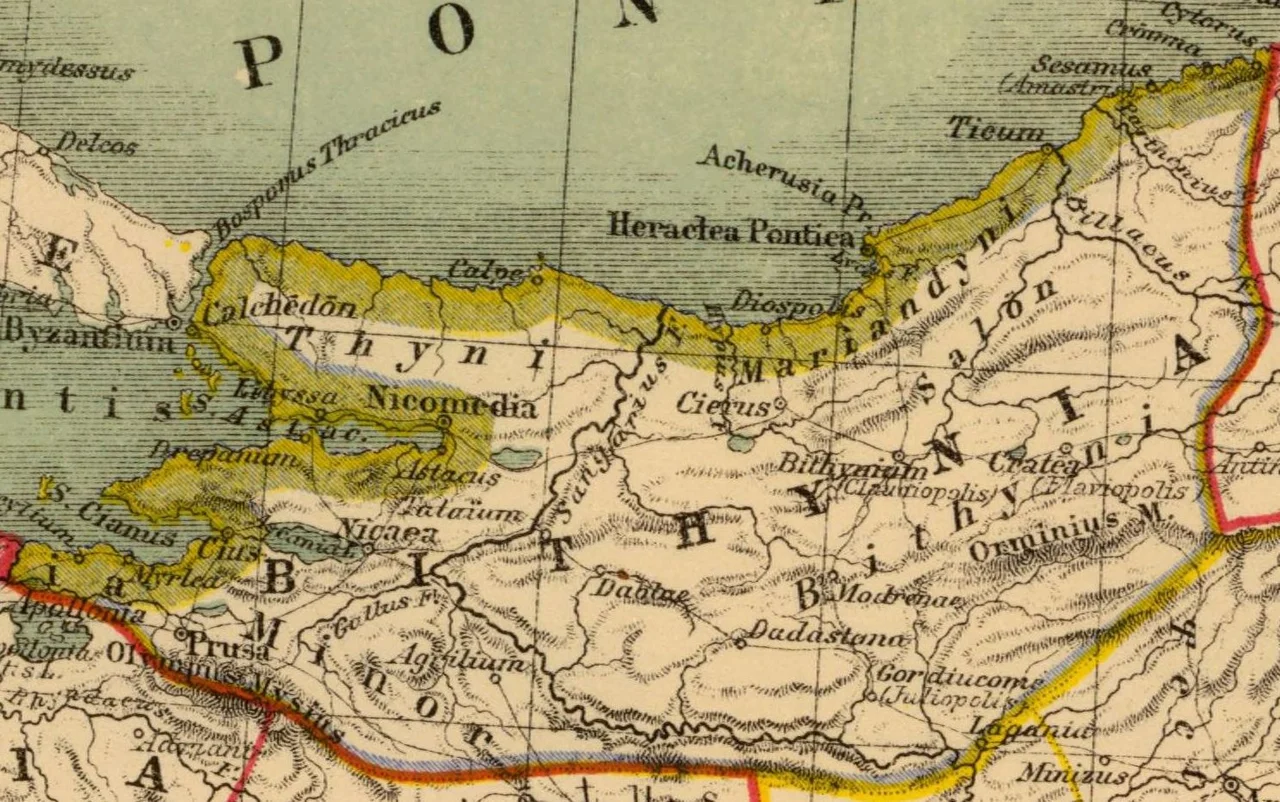

Damalis
At the place where the Bosphorus narrows most tightly between Europe and Asia, the ancients gave the Asian headland the name of a young cow. Damalis means heifer in Greek, and the name itself comes with two explanations — one divine, one human — that the ancient world offered as alternatives without feeling the need to choose between them. Both versions end with a bronze cow erected on a promontory above the strait, and both say something true about why humans mark the places where two worlds meet.
The Myth and the Strait
According to Greek mythology, Io was a priestess of Hera whom Zeus transformed into a white heifer — some say to hide his infatuation, some say as punishment, the sources are not fully in agreement. Pursued by the gadfly Hera sent to torment her, Io wandered across the ancient world in bovine form, crossing into Asia at the narrowing of the strait that would bear the mark of her crossing. The Greeks called that crossing point Bosporos — literally ox-ford, or cow-crossing — and the headland on the Asian side was said to be where Io finally set foot on land again. People erected a bronze cow there to mark the spot. The historian Polybius knew the town that grew near it as Bous, the simple Greek word for cow. The place held the shape of the myth in its name for centuries.
The General's Wife
Arrian, the second-century Greek historian, quoted an older source — Eustathius — with a different account. The name Damalis, he wrote, came not from a goddess but from a woman: the wife of the Athenian general Chares of Athens. Chares was an active military commander in the fourth century BC, and his fleet was stationed near Byzantium during the period when Macedon and the Greek city-states were contending for control of the region. His wife accompanied him on campaign — not unusual in the ancient world, where generals' households traveled with armies. She died while the fleet was at anchor near the Asian shore of the Bosphorus. She was buried on the headland, and a monument in the shape of a cow was placed above her grave. The name of the place, on this account, is her memorial. Damalis: the heifer. The wife who followed her husband to the edge of the known world and did not return.
Where Damalis Stood
The ancient settlement of Damalis stood near Chrysopolis, the town that would eventually become modern Üsküdar, on the Asian shore of the Bosphorus. The headland it occupied sits at approximately 41.025°N, 29.011°E, where the strait is narrow enough that in some lights you can read the expressions on the faces of people on the opposite shore. The location was strategically significant for millennia — the crossing point that connected the Greek cities of Europe with the coasts of Bithynia and Anatolia beyond. Byzantine Constantinople depended on controlling it. The Ottomans fortified both shores. The headland itself has been absorbed into the urban fabric of Üsküdar, its ancient features buried under centuries of development, but the geography that made it meaningful — the narrowing water, the continental divide — remains exactly as it was when someone first placed a bronze cow above the crossing.
Names That Outlast Their Reasons
What is most striking about Damalis is how the name persisted. Ancient place names survive through layers of conquest and linguistic change when they attach themselves to something that doesn't move: a river, a mountain, a coastline. The headland above the Bosphorus crossing was always going to be named by whoever held the strait, and whoever held the strait was always going to need to name this specific piece of land. Whether the name came from a myth about Io or a tomb for Chares's wife, it kept the shape of a cow in its syllables. Polybius, writing in the second century BC, already found it ancient. Arrian, writing later, offered the human explanation as an alternative. Both knew the same place. The strait that Io crossed still carries her story in its modern name, and the Asian shore still carries the word for heifer in the old records. Some names are simply too useful to lose.
From the Air
The ancient headland of Damalis lies near the Üsküdar district of Istanbul on the Asian shore of the Bosphorus, at approximately 41.025°N, 29.011°E. This is the Asian side of Istanbul, making the nearest major airport LTFJ (Sabiha Gökçen International), approximately 20 km to the southeast. Flying at 2,000–3,000 feet over the Bosphorus here, the narrowing of the strait is clearly visible — this is one of the tightest constrictions of the channel between the Black Sea and the Sea of Marmara. The Asian shore of Üsküdar rises sharply from the water, and the European shore with its Ottoman mosques and palaces is close enough that the relationship between the two sides is immediately legible from altitude. The Maiden's Tower (Kız Kulesi) sits on a small islet just offshore, marking the entrance to the narrows.
Nearby Stories
- Kocaeli Peninsula 7.6 km away
- Second Battle of Çatalca 11 km away
- Istanbul's Rural Outskirts 14 km away
- MV Struma 20 km away
- HMAS AE2 36 km away
- Bursa 66 km away
- Sangarius Bridge 71 km away
- Januarius MacGahan 101 km away