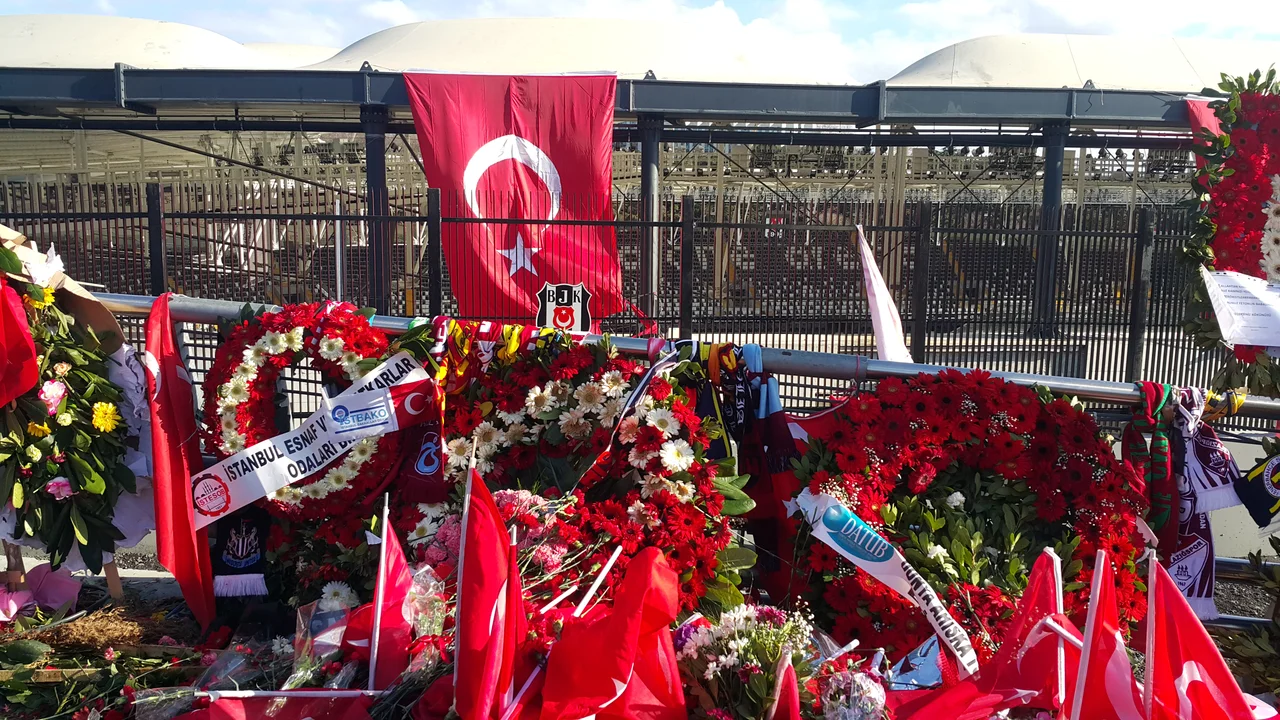

December 2016 Istanbul Bombings
On the night of 10 December 2016, families in the Beşiktaş district of Istanbul were still clearing the streets after a football match when two bombs detonated within seconds of each other outside the Vodafone Park stadium. Forty-eight people died. Among them were 39 police officers — men and women who had spent the evening managing crowd safety for an ordinary league match and who were resting at their posts when the attack came. The hillside park beside the stadium, known until then as Free Hill, was renamed Martyrs' Hill two days later. It is now the 10 December Martyrs Park. This is a place of mourning, and this story is told in that spirit.
The Evening Before
A Süper Lig match between Beşiktaş JK and Bursaspor had ended at the Vodafone Park stadium roughly an hour and a half before the bombs went off. The crowd had dispersed. Supporters had filtered through the exits and into the night streets of Beşiktaş, heading for buses and ferries and the underground. What remained near the stadium, in the exit area used by visiting Bursaspor supporters, were groups of riot police — the officers who had spent hours ensuring the crowd's safe departure. They were the intended targets. The attack was designed not to catch spectators but to kill the officers left behind when the stadium emptied. Bursaspor confirmed afterward that none of its supporters had been harmed.
Two Bombs, Forty-Eight Dead
The first device was a car bomb detonated in front of the stadium. It contained approximately 300 kilograms of explosives packed with iron pellets, designed to maximize casualties among the police group nearby. Seconds later, a suicide bomber detonated a second device in Maçka Park, adjacent to the stadium. The sound of the blasts carried across the Bosphorus — witnesses in Üsküdar, on the Asian side of the strait, reported hearing the explosions. When the dead were counted, 48 people had been killed: 39 police officers, seven civilians, and the two attackers. More than 150 others were wounded. Among the officers who died were Adem Oğuz, Adem Serin, Ali Aksoy, Durmuş Öcal, Hasan Bilgin, İlker Uylaş, Kadir Yıldırım, Mehmet Atıcı, Metin Düzgün, Mustafa Öztürk, Yasin İke, Süleyman Sorkut, Okan Doğan, Soner İdil, Mehmet Zengin, Oğuzhan Duyar, and Hamdi Dikmen. They were officers doing their jobs on an ordinary Saturday night.
Responsibility and Aftermath
The Kurdistan Freedom Hawks — known by the Turkish acronym TAK, an organization regarded as a radical offshoot of the Kurdistan Workers' Party — claimed responsibility for the attack. In their statement, TAK said their members had carried out the bombing and described the police as deliberate targets, framing the attack as retaliation for Turkish military operations in Kurdish regions and for the continued imprisonment of PKK leader Abdullah Öcalan. The Turkish government imposed a temporary broadcast ban on coverage except for officially released information. President Recep Tayyip Erdoğan confirmed deaths in a statement issued just after midnight, calling the aim of the attack the maximization of casualties. By December 12, 235 people had been detained in anti-terrorism raids. The day after the bombings was declared a national day of mourning.
A Hill Renamed
The slope northwest of the stadium where the second bomb detonated had been called Beleştepe — Free Hill — because in the years before the Vodafone Park was built, the elevated ground gave people a free view over the old stadium's walls. Two days after the attack, the Beşiktaş municipal council voted to rename it Şehitler Tepesi: Martyrs' Hill. The area was subsequently commemorated as the 10 December Martyrs Park. Renaming is one of the oldest ways that societies mark loss — an acknowledgment that ordinary geography has been changed by what happened on it, that the place needs a new name to carry new meaning. The hillside where police officers died doing their jobs is now a park named for them, and the name will be there long after the events that made it necessary have moved from memory into history.
The Officers Remembered
The 39 officers who died in Beşiktaş on 10 December 2016 were not soldiers at war or officials making consequential decisions. They were people assigned to manage a Saturday evening football crowd — traffic and barriers and patient hours of waiting. They came from different parts of Turkey. They had families. Some were young. When the attack came, they were standing in the positions their duties required. What is worth remembering, beyond the political and diplomatic aftermath that follows every mass casualty event, is that reality: ordinary people in uniform, at work, at the moment the bombs went off. Turkey observed its national day of mourning the following day. The name of the park in Beşiktaş keeps the date.
From the Air
The Vodafone Park stadium and the adjacent 10 December Martyrs Park sit in the Beşiktaş district of Istanbul at approximately 41.042°N, 28.994°E, on the European shore of the Bosphorus, directly below the Çırağan Palace. The nearest airport is LTFM (Istanbul Airport) approximately 30 km to the northwest. Flying at 2,000–3,000 feet along the Bosphorus from the north, the stadium is clearly visible on the waterfront — a modern oval structure built close to the water's edge, with the hillside park rising to its northwest. The Bosphorus Bridge (now the 15 July Martyrs Bridge) spans the strait roughly 2 km to the south. The shoreline here is densely built, with Ottoman palaces and modern development alternating along the water.
Nearby Stories
- Kocaeli Peninsula 7.6 km away
- Second Battle of Çatalca 11 km away
- Istanbul's Rural Outskirts 14 km away
- MV Struma 20 km away
- HMAS AE2 36 km away
- Bursa 66 km away
- Sangarius Bridge 71 km away
- Januarius MacGahan 101 km away