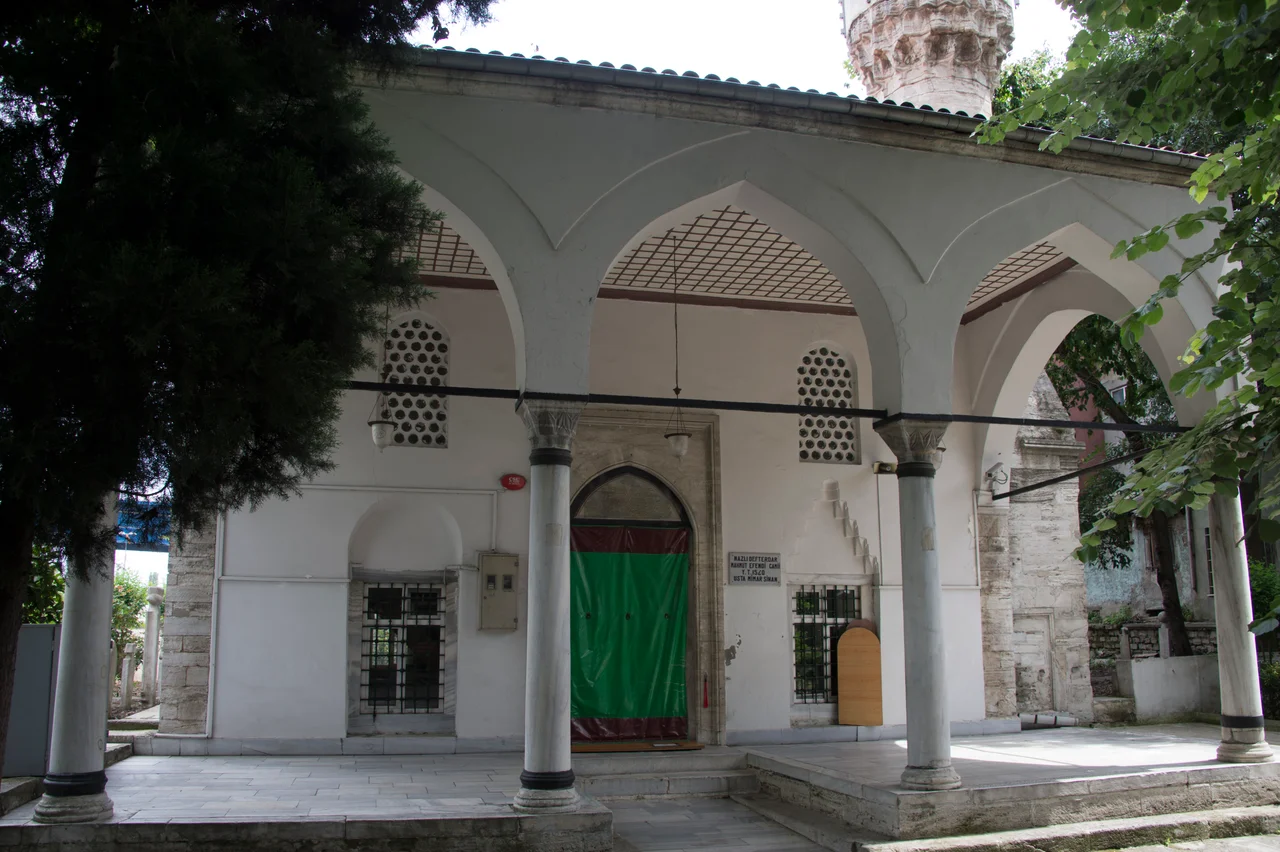

Defterdar Mosque
Every mosque in Istanbul raises a crescent toward the sky. Every mosque, that is, except one. On the dome of the Defterdar Mosque in Eyüp, where a crescent should be, there stands instead an inkpot and a pen — the tools of a bureaucrat, cast in metal, gleaming above the Golden Horn. The man who put them there, Nazlı Mahmut Efendi, was the Ottoman Empire's chief finance secretary, known by the title *defterdar* — literally 'keeper of the register.' He died in 1546, but his professional identity outlasted him by nearly five centuries, perched above a building that the greatest architect of the Ottoman world agreed to design.
The Keeper of the Register
The word *defterdar* has a satisfying literalness to it: *defter* means notebook or register, and the suffix *-dar* means doer or keeper. In the Ottoman imperial bureaucracy, the defterdar held the finances of an empire that stretched from the Adriatic to the Persian Gulf. Nazlı Mahmut Efendi occupied that post in the first half of the sixteenth century, accumulating enough wealth and influence to do what powerful Ottoman men did with their resources — commission a mosque. That mosque would carry his professional title as its name. It would stand in Eyüp, the sacred district on the upper Golden Horn named for Abu Ayyub al-Ansari, a companion of the Prophet Muhammad whose tomb draws pilgrims to this day. To place a mosque here was to stake a claim in the most revered neighborhood in Istanbul.
Sinan Builds for the Bureaucrat
Mimar Sinan was already the most consequential architect in Ottoman history when Mahmut Efendi approached him. Sinan designed over three hundred structures during his career — mosques, bridges, caravanserais, hans — including the Süleymaniye Mosque in Istanbul and the Selimiye Mosque in Edirne, which many consider his masterpiece. Against that backdrop, the Defterdar Mosque is a modest commission: a single-domed neighborhood mosque built in 1542, compact and elegant rather than grand. Sinan brought the same precision to small projects that he applied to imperial ones. The result is a building that sits comfortably in its surroundings, its proportions considered, its stone surfaces calm. What makes it singular is not its scale but its finial — that inkpot and pen rising from the apex of the dome, an assertion of the patron's identity so confident it borders on eccentric.
Storm and Renewal
For nearly four and a half centuries, the original inkpot and pen stood on the dome. Then a storm in 1997 broke them. The loss was more than aesthetic; it severed a material connection to the man who had insisted on this unusual symbol in the first place. Istanbul is a city accustomed to losing things — to earthquakes, fires, conquests, and the slow erasure of time. But it is also a city that rebuilds. Ten years after the storm, on 30 May 2007, new versions of the inkpot and pen were assembled on top of the dome. The date was not random: May 29 is the anniversary of the Ottoman conquest of Constantinople in 1453, and commemorations fill the city at the end of May. The restoration of the mosque's distinctive crown slipped quietly into that season of remembrance.
Eyüp's Sacred Ground
The Defterdar Mosque does not stand alone in Eyüp. The district is dense with history — the Eyüp Sultan Mosque, the tomb of Abu Ayyub al-Ansari, a hillside cemetery where Ottoman statesmen and poets are buried, and the Pierre Loti café perched above it all with views of the Golden Horn below. Eyüp has always been a place of meaning rather than mere commerce. Walking through its streets, you pass vendors selling prayer beads and incense, mothers pushing prams past tomb railings, pigeons settling on the domes of hans. The Defterdar Mosque inhabits this neighborhood as it always has — not as a tourist attraction but as a working place of worship. The inkpot and pen on its dome go mostly unremarked by those who pass beneath them daily, a private joke between a 16th-century finance minister and the sky.
A Monument to Professional Pride
Commissioning a mosque was an act of piety in the Ottoman world, but it was also an act of self-presentation. The patron's name attached to the building, a form of immortality available to the devout and the wealthy alike. Nazlı Mahmut Efendi chose to make his identity explicit in a way that most patrons did not. He did not simply attach his name to a building; he placed his professional emblem on top of it. That choice tells us something about the man — his sense of humor, perhaps, or his pride in the craft of accounting, or simply his desire to stand apart. Sinan, who built for sultans and viziers and admirals, built this too: a mosque for a man who kept the books of an empire, and who wanted the world to know it.
From the Air
The Defterdar Mosque sits at 41.042°N, 28.9376°E in Eyüp, on the upper European shore of the Golden Horn. Flying into Istanbul Airport (LTFM) on an approach from the west, the Golden Horn is visible as a narrow inlet cutting inland from the Bosphorus. At 2,000–3,000 feet, the domed skyline of Eyüp becomes distinguishable. The mosque is a small, single-domed structure in a dense residential and religious neighborhood; the distinctive inkpot-and-pen finial is not visible from altitude, but the Eyüp Sultan Mosque complex nearby serves as a reference landmark. LTFM is approximately 25 km to the northwest.
Nearby Stories
- Kocaeli Peninsula 7.6 km away
- Second Battle of Çatalca 11 km away
- Istanbul's Rural Outskirts 14 km away
- MV Struma 20 km away
- HMAS AE2 36 km away
- Bursa 66 km away
- Sangarius Bridge 71 km away
- Januarius MacGahan 101 km away