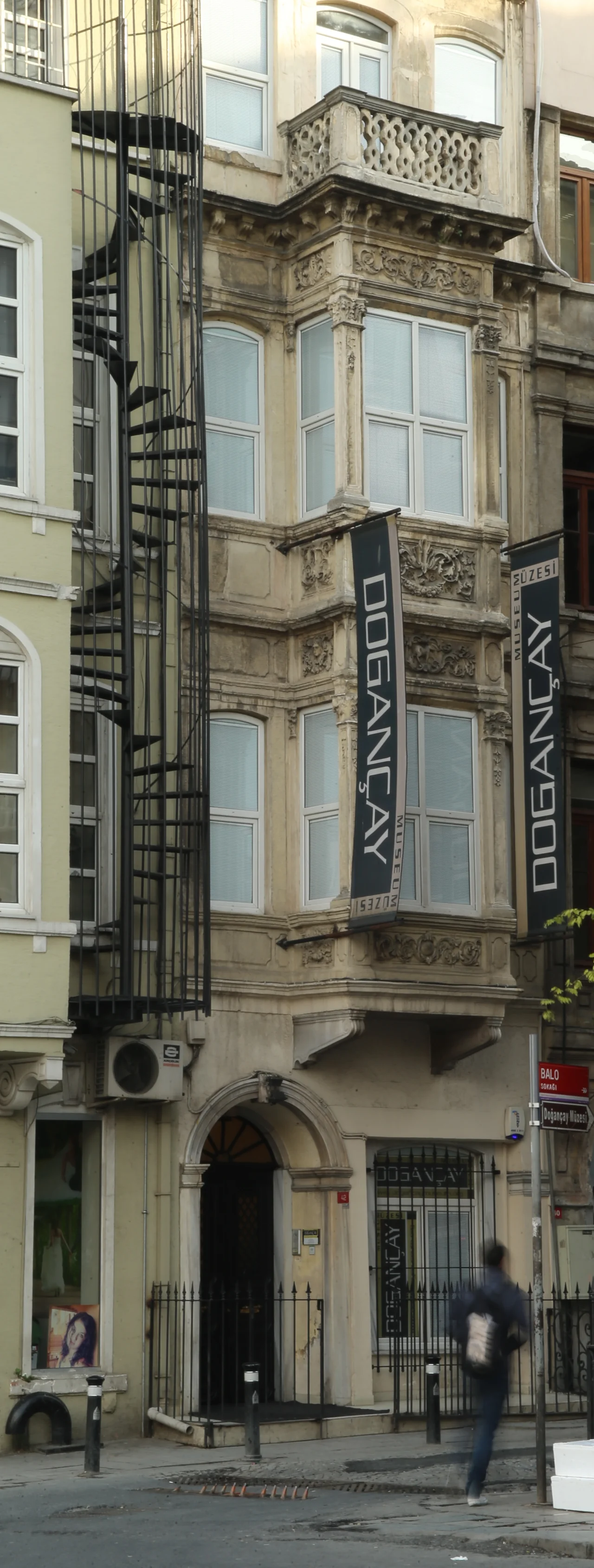

Doğançay Museum
Burhan Doğançay spent his life looking at walls — the battered, poster-plastered, graffiti-streaked walls of cities from New York to Paris to Istanbul — and finding in them a record of human longing and disregard that paint on canvas could not capture alone. When he bought a crumbling five-story building in Beyoğlu in 1999, the walls were the point. Four years of renovation later, those walls became the frame for Turkey's first museum dedicated to a single artist, a place where Doğançay's obsession with urban surfaces finally had a home worthy of the obsession itself.
The Artist Who Listened to Walls
Burhan Doğançay was born in Istanbul in 1929, the son of Adil Doğançay, a well-regarded Turkish painter known for impressionist landscapes and still lifes who also worked as a military cartographer. He studied law and economics, worked as a diplomat, and then — in his thirties — gave it all up for art. He eventually settled in New York, where the walls of the city became his subjects. Peeling posters, layered paint, the shadows that ropes and wires throw across brick: he documented these in photographs and translated them into canvases, prints, tapestries, and sculptures across a career spanning more than five decades. His series multiplied — the Ribbons Series, the Cones Series, the GREGO Series, named after a New York graffiti artist who became a kind of alter ego — each one finding new formal possibilities in the texture of surfaces that most people walk past without looking.
A Building Rescued from Disrepair
The building at the heart of the museum had a history of its own before Doğançay arrived. Built roughly 150 years ago, it had once been the elegant home of a Greek family — one of the countless fine buildings of Beyoğlu that had fallen into neglect over the decades. When Doğançay purchased it in 1999, it was, by the museum's own account, in a state of complete disrepair. He saw it anyway as what it could become. A four-year renovation brought the structure back to its former architectural dignity while fitting the interior to the exacting demands of a museum: climate control, proper lighting, gallery walls strong enough to hold large-format works. Even the elevator car was put to use, displaying photographs from Doğançay's 'Ironworkers Project.' Nothing was wasted.
Five Floors of a Life's Work
The museum opened to the public in 2004 and spread Doğançay's output across five floors. The ground floor eases visitors in with an Aubusson tapestry from the Ribbons Series — one of fourteen produced at L'Atelier Raymond Picaud in France — alongside photographs and lithographs. A tearoom on this level serves tea each afternoon, a detail that softens the transition from the street noise of Beyoğlu to the quieter attention the art demands. The first floor holds the Cones and Ribbons Series from the early 1970s, a period when Doğançay moved away from realistic renderings of grimy walls toward a more abstract language of shadow, light, and dimension. The second floor extends the wall-inspired series. The third floor holds a surprise: a floor devoted to Adil Doğançay's impressionist paintings, giving the museum the feel of a family archive as much as an artist's monument. Over a hundred works in total are on display.
A Foundation Carries On
Burhan Doğançay died in January 2013 at the age of eighty-three. His obituary in the New York Times noted that he had created more than five thousand works over his career. Since 2010, the museum had already been operating under the auspices of the Burhan-Angela Doğançay Foundation for Art and Culture. After his death, the foundation made a deliberate decision: it stopped collecting new works and turned its full attention to presenting what it already owned. That choice transformed the museum into something like a completed sentence — a full stop at the end of a long and prolific artistic life. The foundation also runs educational programs and an annual elementary school art competition in cooperation with the Greater Istanbul Municipality, drawing roughly seven thousand students from fifteen hundred schools each year.
Stepping Off the Street
Beyoğlu moves fast. The district's main artery, İstiklal Caddesi, is one of the busiest pedestrian streets in Europe, and the surrounding lanes are dense with cafes, shops, galleries, and the ordinary urgency of a city of millions. The Doğançay Museum stands inside all of this, yet visitors describe the moment of entering it as an abrupt shift — the noise drops, the pace slows, and the walls that Doğançay spent a lifetime interrogating suddenly surround you, holding his answers. That the building itself once had a history of abandonment and renewal gives it a faint resonance with the subject matter on its walls: the human marks left on surfaces, and what those marks mean after the people who made them are gone.
From the Air
The Doğançay Museum is located at 41.0358°N, 28.9784°E in the Beyoğlu district of Istanbul, on the European side of the city. Flying into Istanbul Airport (LTFM) from the northwest, the Beyoğlu hillside rises north of the Golden Horn, with the distinctive Galata Tower serving as a visual anchor for the neighborhood. The museum itself is not distinguishable from altitude, but the Galata Tower — roughly 500 meters to the south — marks the broader district. LTFM is approximately 20 km to the northwest. Best viewing is at 1,500–2,500 feet on approach over the European side, when the grid of Beyoğlu's streets comes into resolution.
Nearby Stories
- Kocaeli Peninsula 7.6 km away
- Second Battle of Çatalca 11 km away
- Istanbul's Rural Outskirts 14 km away
- MV Struma 20 km away
- HMAS AE2 36 km away
- Bursa 66 km away
- Sangarius Bridge 71 km away
- Januarius MacGahan 101 km away