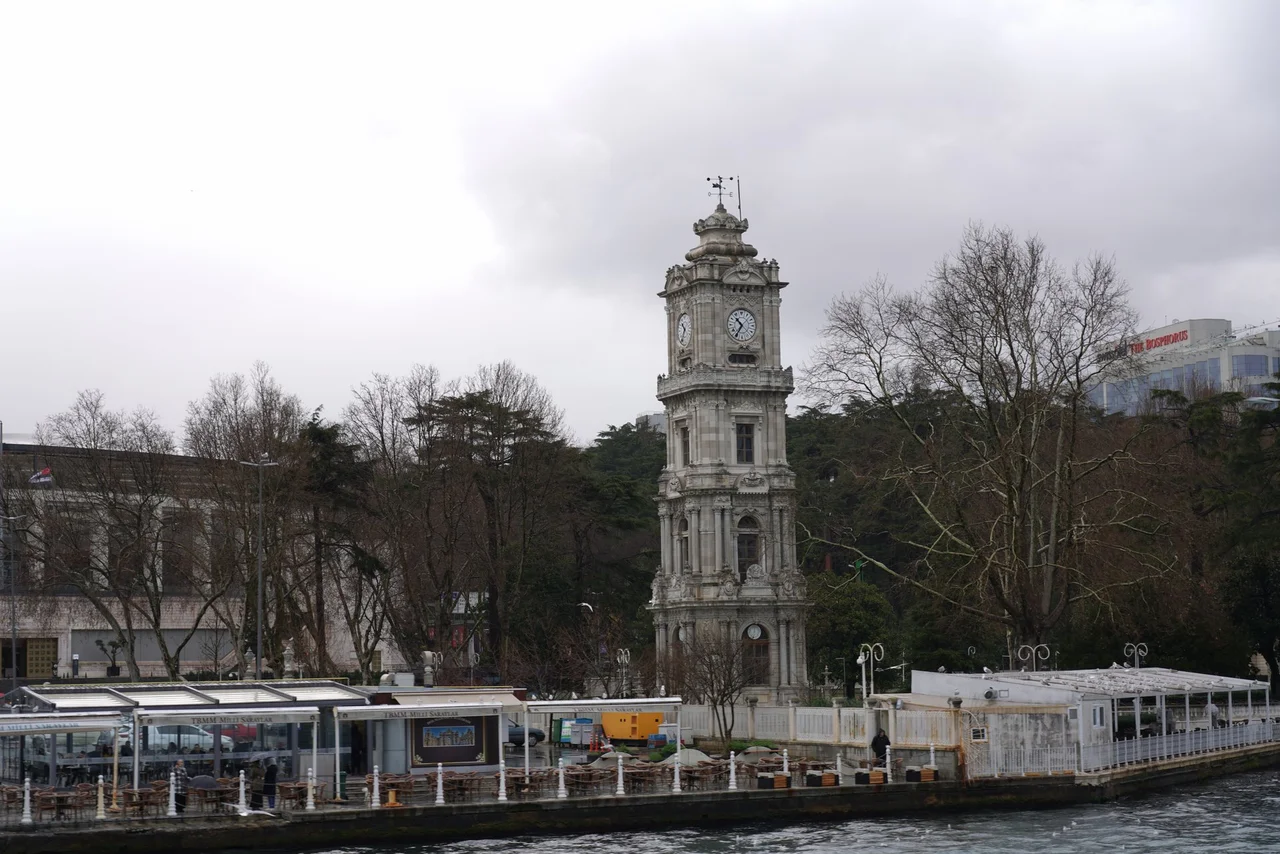

Dolmabahçe Clock Tower
Time in the Ottoman Empire was not simply a practical matter. It was a statement of authority, a demonstration that the sultan's reach extended even to the hours of the day. When Abdülhamid II ordered the construction of a clock tower beside Dolmabahçe Palace between 1890 and 1895, he was participating in a practice that sultans across the empire had taken up in the nineteenth century — planting ornate timepieces in public squares, at palace gates, beside mosques — so that the synchronized rhythms of modern life would carry the imperial stamp. The tower on the Bosphorus waterfront became one of the finest examples of this impulse.
The Sultan Who Commissioned It
Abdülhamid II reigned from 1876 to 1909, a long and contested tenure during which the Ottoman Empire navigated the pressures of modernization, European encroachment, and internal reform. He was deeply interested in technology — he used photography, maintained an extensive personal library, and built a telegraph network that kept him informed of events across the empire. He was also deeply suspicious of political threats, governing much of his reign under emergency powers after suspending the constitution. The clock tower belongs to his more confident phase, the 1890s, when he was still asserting Ottoman architectural ambition on a waterfront that Europe could see from across the Bosphorus.
A Tower Designed for the Waterfront
The tower was designed by Sarkis Balyan, a member of the Armenian Balyan family that had served as court architects to the Ottoman sultans for several generations. Sarkis Balyan was responsible for numerous buildings in the Ottoman neo-baroque style — a vocabulary that blended European baroque ornament with Ottoman sensibilities, producing buildings that were simultaneously legible to Western eyes and distinctly Turkish in their setting. The clock tower stands four stories tall on a square footprint, reaching 27 meters. It occupies a position in front of the Treasury Gate of Dolmabahçe Palace, on a small square directly along the European waterfront of the Bosphorus, next to Dolmabahçe Mosque. From the water, it reads as a confident vertical punctuation in the long horizontal sweep of the palace facade.
French Craft, German Hands
The mechanics inside the tower came from Paris. The clock was manufactured by the house of Jean-Paul Garnier, a French clockmaker of considerable reputation in the nineteenth century. Garnier's clocks were known for their precision and craftsmanship, and the commission for a tower clock visible from the water would have been a prestigious one. The installation was carried out by the court clock master Johann Mayer, whose German name reflects the cosmopolitan composition of the Ottoman court in this period — European craftsmen, Greek architects, Armenian designers, and Ottoman patrons producing buildings and objects that drew on the whole Mediterranean world. The clock's face displays Eastern Arabic numerals, the numerals traditional to Ottoman timekeeping, in a highly stylized form. Two opposing sides of the tower bear the sultan's tughra, the elaborate calligraphic signature of Abdülhamid II, which served as the imperial seal on official documents and objects of state.
Old Mechanism, New Current
The original clock was mechanical, wound by hand and regulated by springs and gears. It kept time in this way for eighty-four years. In 1979, it was converted partly to electrical operation, a practical concession to maintenance that altered the mechanism without changing the face, the case, or the position in the landscape. Clock towers across the Ottoman world underwent similar modernizations in the twentieth century. The electrical conversion is almost invisible from the outside — visitors who stand in the square below and look up still see the Garnier face, the Eastern numerals, the Balyan stonework, the tughra. The passage of time is marked in a tower that has itself been modified by time, as the city around it has been modified by layers of history that no single century could contain.
Along the Palace Shore
The clock tower is best understood not in isolation but as part of the ensemble it was built to complement. Dolmabahçe Palace, completed in 1856, was the first European-style palace built by the Ottomans on the Bosphorus, a deliberate signal to the great powers of Europe that the empire was modern, lavish, and here to stay. The palace stretched nearly 600 meters along the waterfront. The clock tower punctuated its northern end, marking the Treasury Gate, providing orientation for visitors arriving by boat. Together, the palace and the tower created one of the most theatrical architectural sequences on the European shore — a vision of Ottoman power composed for an audience looking in from the sea.
From the Air
The Dolmabahçe Clock Tower stands at 41.0376°N, 28.9964°E on the European shore of the Bosphorus, immediately adjacent to Dolmabahçe Palace. From the air, the straight, formal waterfront of the palace is one of the most recognizable features on the European side of Istanbul. At 1,500–2,500 feet on a westbound approach toward Istanbul Airport (LTFM, approximately 20 km to the northwest), the Bosphorus waterfront is laid out clearly, with the palace's long cream-white facade and the smaller clock tower visible at its northern end. The Bosphorus itself — roughly 700 meters wide at this point — provides a vivid boundary between the European and Asian shores. The Beylerbeyi Palace on the Asian side sits directly across the water.
Nearby Stories
- Kocaeli Peninsula 7.6 km away
- Second Battle of Çatalca 11 km away
- Istanbul's Rural Outskirts 14 km away
- MV Struma 20 km away
- HMAS AE2 36 km away
- Bursa 66 km away
- Sangarius Bridge 71 km away
- Januarius MacGahan 101 km away