
El-Kurru
Before there were pyramids at El-Kurru, there were mounds of rubble piled over rock-cut pits - the oldest royal graves, the father of Piye among them, buried under circular cairns of gravel and stone. Then, gradually, the tombs grew walls. Then chapels. Then, over the course of a few generations, the Kushite kings began building steep-sided pyramids over their dead. By the time Piye's descendants ruled Egypt as its 25th Dynasty, they would be laid to rest here, at the desert edge of the Nile, under monuments patterned after the pharaohs they had conquered but smaller, steeper, unmistakably their own.
From Tumulus to Pyramid
The earliest burials at El-Kurru - Tumuli 1 through 6, and tomb Ku.19 - look nothing like pyramids. They are Nubian-style tumuli: a pit cut into the bedrock, the body placed inside, then a circular mound of rubble heaped over the top. Tumulus 1, dated to 860-840 BC, may be the grave of Piye's father, whose name has been lost. The next generation added offering chapels. The generation after that shifted from circular to square plans. By the time Piye himself - the Kushite king who marched north and seized Egypt around 744 BC - was buried at El-Kurru, the architecture had fully evolved into small steep pyramids with offering chapels on their east sides. Nubian pyramids, scholars stress, are not imitations of Egyptian ones; they are their own tradition, evolving on their own ground.
The Black Pharaohs' First Home
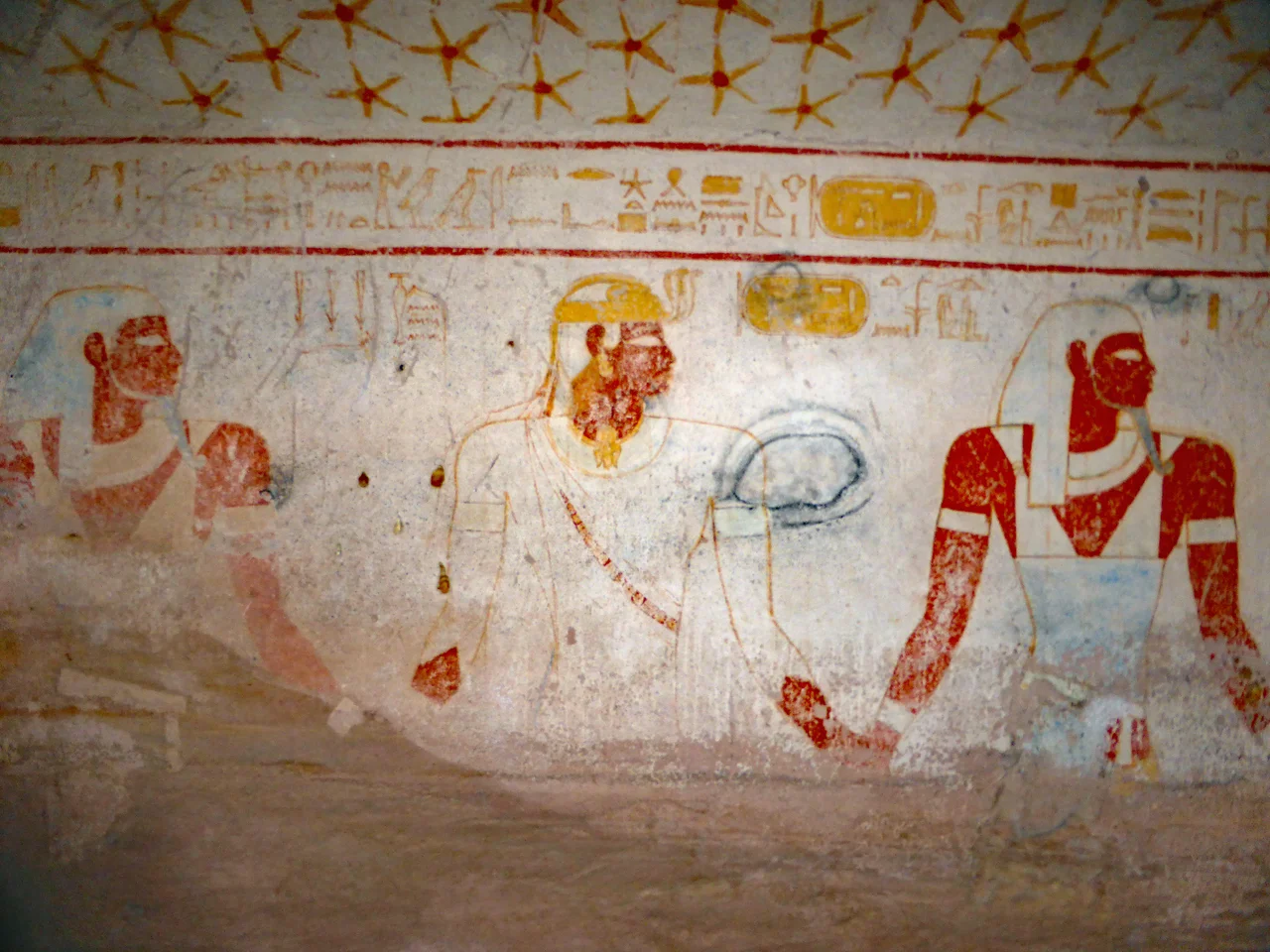
The last king of Egypt's 25th Dynasty, Tantamani, was buried at El-Kurru around 650 BC. The burial chamber of his tomb still holds one of the finest surviving examples of Kushite royal painting - a vaulted room with painted figures watching the king into the afterlife. His was the closing chapter of El-Kurru's main use as a royal cemetery. After Tantamani, the Napatan kings chose Nuri, across the Nile, for their burials. But El-Kurru was never entirely abandoned. In the mid-fourth century BC, a king whose name we do not know returned and built his tomb, and his queen's, here at the old cemetery. The draw of the ancestors was strong. Generations later still, Christian Nubians came and scratched graffiti into the stone of pyramid Ku.1 - monograms, crosses, and perhaps most hauntingly, a multitude of boats, perhaps commemorating some kind of river procession long lost to memory.
Reisner's Map, Rewritten
George Reisner excavated El-Kurru in 1918 and 1919, and after his death his assistant Dows Dunham saw the work through - publishing the excavation report in 1950, a quarter century later. Reisner's chronology placed the cemetery's start at 860 BC. Later scholars, including Timothy Kendall, have more or less agreed, though the start date has slid to 850-830 BC with better dating methods. In 2013 the site came alive again. Under the direction of Dr. Geoff Emberling of the Kelsey Museum and Dr. Rachael J. Dann of the University of Copenhagen, in collaboration with Sudan's National Council for Antiquities and Museums and funded in part by the Qatar Sudan Archaeological Project, the International Kurru Archaeological Project has reopened excavations. New finds include a medieval fortification, a settlement, and a cemetery - centuries of use stacked on top of the Napatan royal necropolis.
The Cemetery That Started a Dynasty
El-Kurru sits on the east bank of the Nile near the modern town of Karima, about 400 kilometers north of Khartoum, within sight of the sacred mountain Jebel Barkal. From the air the pyramids are small - nothing like the colossal tombs at Giza - but they cluster in a tight group against the tan of the desert, their chapels still marked, some intact enough to enter. Below ground, the burial chambers step down into rock-cut shafts, reached by stairways carved from the bedrock. Tantamani's chamber, painted and still bright in places, is one of the most striking surviving examples of Kushite royal art. A World Heritage Site since 2003, El-Kurru is where the Nubian pyramids began - a royal experiment that would, at Meroe, eventually produce more pyramids than all of Egypt.
From the Air
Coordinates 18.41°N, 31.77°E, on the east bank of the Nile near Karima, Sudan. Part of the UNESCO-listed Gebel Barkal and the Sites of the Napatan Region. Nearest airport is Dongola (HSDN) about 130 km north. Recommended viewing altitude 5,000-8,000 feet to see the cluster of small steep pyramids and their relationship to Jebel Barkal just downstream.
Nearby Stories
- Merowe Dam 25 km away
- Dar al-Manasir 40 km away
- Northern Sudan 45 km away
- Banganarti 58 km away
- R12 (cemetery) 97 km away
- Pyramids of Meroë 198 km away
- Northern State (Sudan) 205 km away
- Nubian pyramids 218 km away