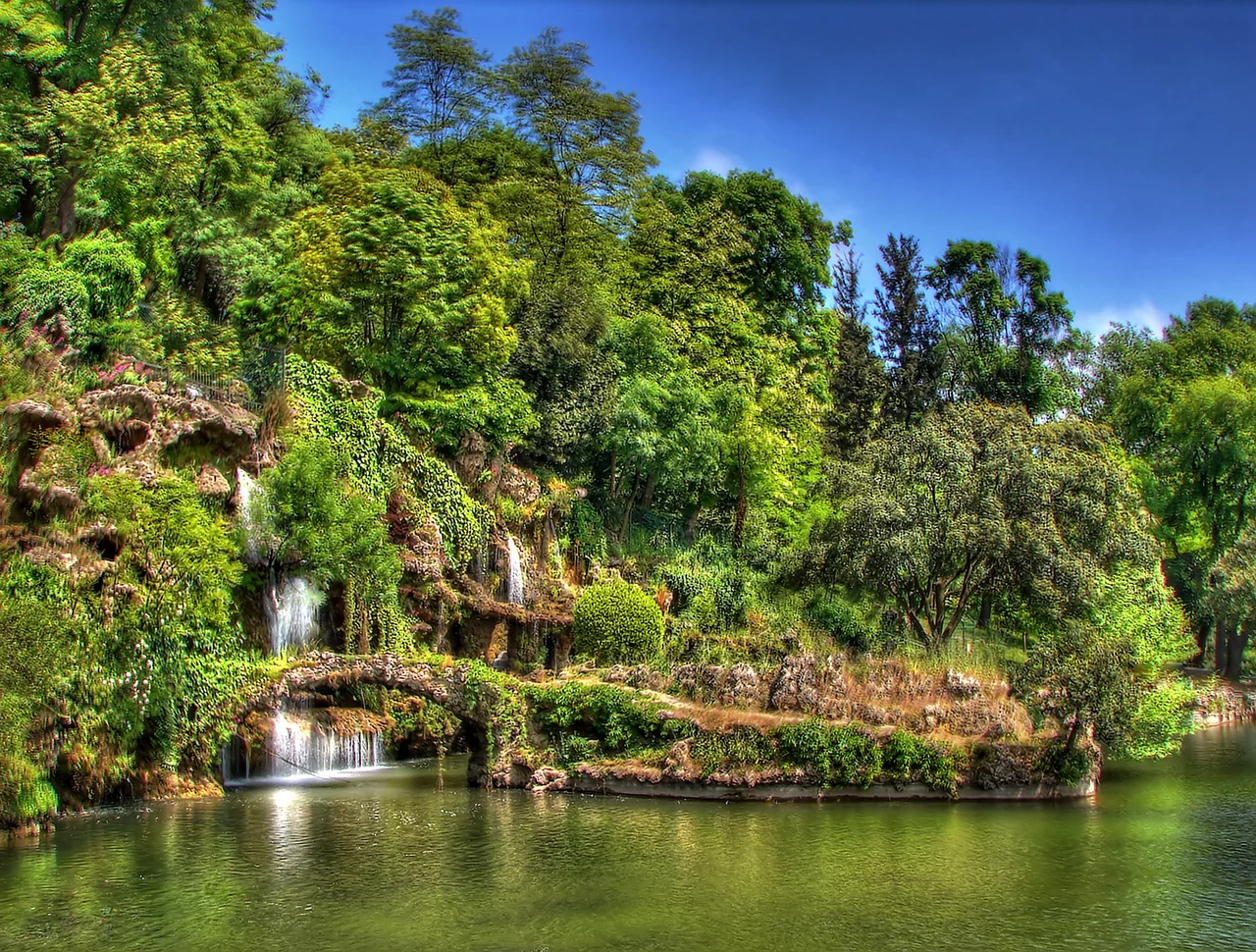

Emirgan Park
Every April, the slopes above the Bosphorus turn improbable colors. Scarlet, cream, violet, deep burgundy — millions of tulip bulbs planted across 117 acres come into bloom at roughly the same time, and Istanbul treats it as an event. Emirgan Park, the 17th-century estate on the European shore north of the city center, becomes the centerpiece of the annual Tulip Festival: the hillside terraces crowded with families, the three Ottoman pavilions framed in blossoms, the water visible below through the new leaves of stone pines and Lebanon cedars. Emirgan did not invent the tulip — no one did — but the Ottoman court gave it its European name and its reputation for extravagance, and this park still carries some of that inherited drama.
From Cypress Forest to Safavid Gift
Before anyone planted tulips here, the hillside above what is now Emirgan was a cypress forest. The Byzantines called it Kyparades — Cypress Forest — and left it largely undisturbed. In the Ottoman period, the land was granted to a court official, Nişancı Feridun Bey, a Lord Chancellor who gave his name to the 'Feridun Bey Park.' Then, in the 17th century, the estate changed hands in an unusual way. Sultan Murad IV (who reigned from 1623 to 1640) presented it to Emir Gûne Han, a Safavid Persian commander who had surrendered his besieged castle to the Ottomans without resistance and then followed the sultan back to Constantinople. The estate was renamed 'Emirgûne' in his honor — a name that gradually corrupted, through common usage, into 'Emirgan.'
The Three Pavilions
The most distinctive architectural features of Emirgan Park are its three pavilions — the Yellow, Pink, and White — each built by Khedive Ismail Pasha, the Ottoman viceroy of Egypt who owned the estate in the 19th century. The Yellow Pavilion is the grandest: a two-story mansion of 400 square meters, with a salon encircled by many smaller rooms, reflecting the layout of the traditional Ottoman house. Court architect Sarkis Balyan did the interior decoration — oil-painted flower figures on the ceilings, elaborate carvings on the facades, opulent color throughout. The Pink Pavilion, named for the cranesbill-flower pink of its exterior, is a simpler two-story Ottoman house, its elegance concentrated in its proportions and ornamentation rather than its scale. Together the three pavilions anchor a park that is genuinely and usably public: jogging tracks, picnic tables, two decorative ponds, and more than 120 plant species across the terraced hillside.
How a Park Becomes a City's
Emirgan's path from private estate to public park is a story of Istanbul in the 20th century. After the heirs of Khedive Ismail Pasha sold the estate in the 1930s, it passed to Satvet Lütfi Tozan, a wealthy Turkish businessman. In the 1940s, Tozan donated the grounds — pavilions and all — to the City of Istanbul, during the tenure of Governor and Mayor Lütfi Kırdar. The Metropolitan Municipality of Istanbul has administered it ever since. The Yellow Pavilion has operated since 1997 as a café and event venue run by Beltur, the municipality's tourism company. The arrangement has given the park a sustainable income stream while preserving its public character. On weekends, the entire hillside fills with families from across the city.
The Arboretum Above the Strait
Emirgan is more than a tulip setting. The park's tree collection reads like a botanic garden catalog: Stone Pine, Turkish pine, Aleppo Pine, Maritime Pine, Japanese Cedar, Norway Spruce, Blue Spruce, Atlas Cedar, Lebanon Cedar, Himalayan Cedar, Coast Redwood, Maidenhair tree, and Camphor tree, among many others — more than 120 species across 117 acres. Some of these trees are old enough to have been here when the park was still a private estate. The hillside drops toward the Bosphorus, so from certain points in the park the view through the tree canopy opens onto the strait, with the Asian shore visible across the water. On clear mornings, before the city fully wakes, it is possible to understand why sultans and their guests once considered this hillside worth owning.
From the Air
Emirgan Park sits at approximately 41.108°N, 29.053°E on the European shore of the Bosphorus, in the Sarıyer district north of central Istanbul. Flying into Istanbul Airport (LTFM), the Bosphorus is the primary navigation landmark — the park occupies a distinctive hillside stretch of the European shore roughly 15 km north of the Galata Bridge. At 2,000–3,000 feet, the terraced green hillside of the park is visible against the developed shoreline. The Fatih Sultan Mehmet Bridge (Second Bosphorus Bridge) is visible to the south and provides a useful position reference. Winds from the Black Sea funnel down the Bosphorus strait; plan approaches accordingly.
Nearby Stories
- Kocaeli Peninsula 7.6 km away
- Second Battle of Çatalca 11 km away
- Istanbul's Rural Outskirts 14 km away
- MV Struma 20 km away
- HMAS AE2 36 km away
- Bursa 66 km away
- Sangarius Bridge 71 km away
- Januarius MacGahan 101 km away