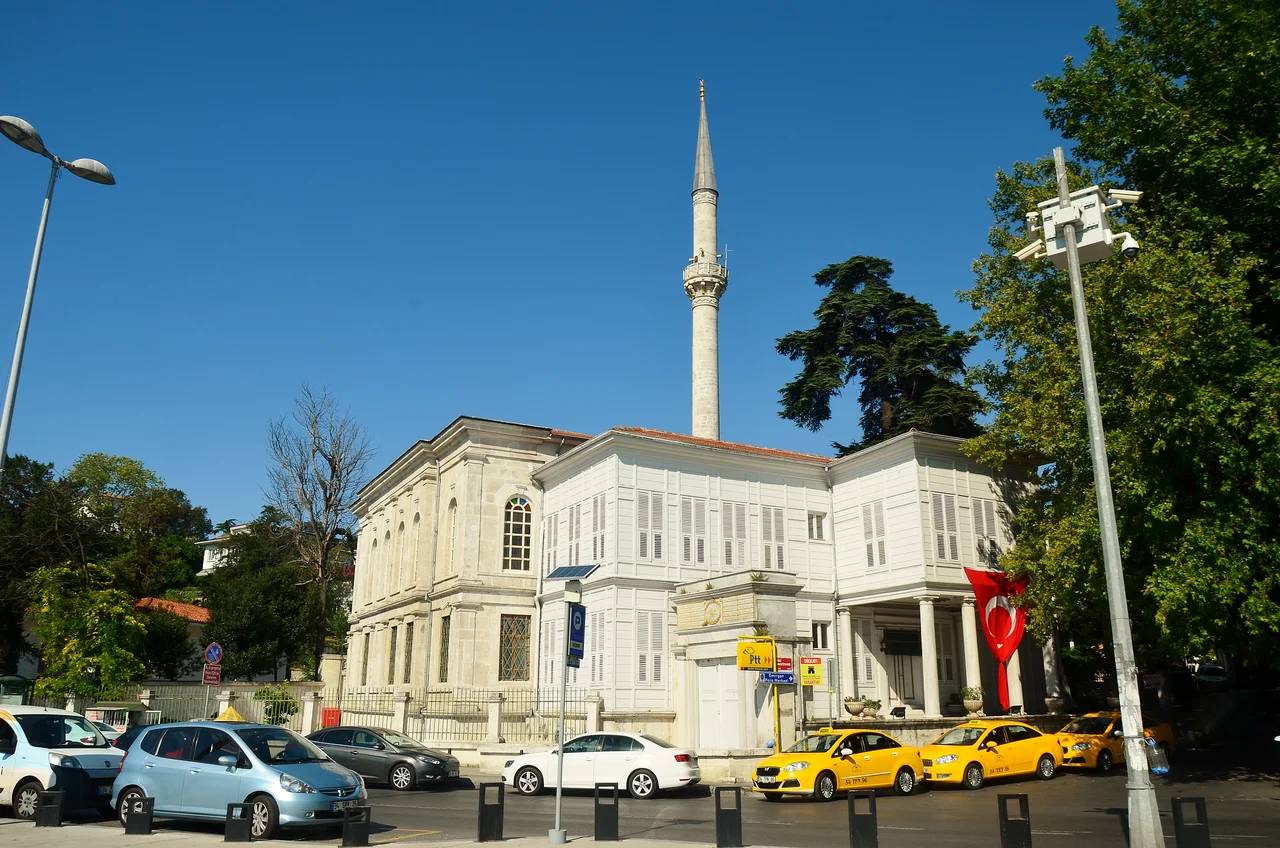

Emirgan
The tea gardens of Emirgan fill up by mid-morning. Locals settle into chairs around the plane-tree-shaded square, ferries pass on the Bosphorus below, and the waterside mosque — built in 1838, its minaret reflected in the strait — anchors one end of the main promenade. Emirgan is a neighborhood that knows what it is: a middle-class Bosphorus village, leafy and somewhat removed from the intensity of central Istanbul, holding a remarkable cluster of historic buildings in a relaxed residential setting. Its population of about 8,000 shares this stretch of European shoreline with a world-class private museum, the oldest surviving waterside mansion on the European Bosphorus coast, and a hilltop park that draws hundreds of thousands of visitors every April.
A Name from a Surrender
The name Emirgan comes from Emir Gûne Han — a Safavid Persian commander who, in the 17th century, surrendered his besieged castle to Ottoman Sultan Murad IV without resistance and then accompanied the sultan back to Constantinople. As a reward, or perhaps as a mark of distinction, the sultan gave Emir Gûne Han an estate on the Bosphorus shore. The area was already known as Feridun Bey Park, after an earlier Ottoman court official. With the new ownership, it became 'Emirgûne,' a compound of the commander's title and name. Over the following centuries, the name softened through everyday use into Emirgan. The neighborhood's identity was thus set by the act of a commander who chose not to fight — and by the sultan who deemed that worth rewarding.
The Oldest Yalı on the European Shore
Tucked along the inland side of the coast road — pushed there when the road was built in 1940, having once stood right at the water's edge — the Şerifler Yalı is the oldest surviving waterside mansion on the European side of the Bosphorus. Built sometime in the 18th century, it belonged at one point to Hüseyin, the Şerif of Mecca, from whom it takes its name. The mansion probably stands on the site of a 17th-century structure built for Emir Gûne Han himself — the same figure who gave the neighborhood its name. The yalı now houses offices for historic conservation bodies including the Historic Towns Union, and is not open to the public. The building carries its age well: a wooden facade, the proportions of the traditional Ottoman waterside house, and the quiet authority of something that has outlasted most of the things that surrounded it.
Art on the Bosphorus: The Sakıp Sabancı Museum
Emirgan's most prominent cultural institution stands in a peaceful garden on the Bosphorus shore. The Sakıp Sabancı Museum — originally the Sabancı family's summer residence, bequeathed to Sabancı University in 1998 and opened as a museum in 2002 — is now one of Istanbul's most respected cultural institutions. Its permanent collections cover Ottoman calligraphy, antique furniture, and fine art, with rotating exhibitions that have included major international shows. The museum has mounted retrospectives drawing on work ranging from Pablo Picasso through to Abdülmecid II, the last caliph of the Ottoman Empire, who was also a serious painter. The house itself — a 19th-century mansion on the water — is as much of the experience as the art inside it.
Mosque and Square: Daily Life on the Shore
The Hamid Evvel Mosque, completed in 1838, sits directly beside what is now Emirgan's main square — a plane-tree-shaded open space where the tea gardens cluster and where the neighborhood comes together on evenings and weekends. Across the square from the mosque stands the original timekeeper's cottage, added in 1844, which now operates as a café. The pairing — mosque and timekeeper, prayer and time — is a distinctly Ottoman piece of civic design. Ferries still call at the Emirgan pier, connecting the neighborhood to the city center and to the Asian shore. The north-to-south current of the Bosphorus is visible from the pier, the water moving with particular purpose through the narrowing of the strait.
From the Air
Emirgan sits at approximately 41.104°N, 29.052°E on the western shore of the Bosphorus, in the Sarıyer district of Istanbul. Flying into Istanbul Airport (LTFM) from the northwest, the Bosphorus shoreline runs northeast-southwest below, and Emirgan is identifiable as a wooded hillside village about 12 km north of the Galata Bridge. The Fatih Sultan Mehmet Bridge (Second Bosphorus Bridge) is the primary landmark to the south; Emirgan village occupies the European shore roughly 4–5 km north of the bridge. Recommended viewing altitude is 2,000–3,000 feet for the best detail on the yalıs and waterfront. Black Sea outflows create variable winds along the strait.
Nearby Stories
- Kocaeli Peninsula 7.6 km away
- Second Battle of Çatalca 11 km away
- Istanbul's Rural Outskirts 14 km away
- MV Struma 20 km away
- HMAS AE2 36 km away
- Bursa 66 km away
- Sangarius Bridge 71 km away
- Januarius MacGahan 101 km away