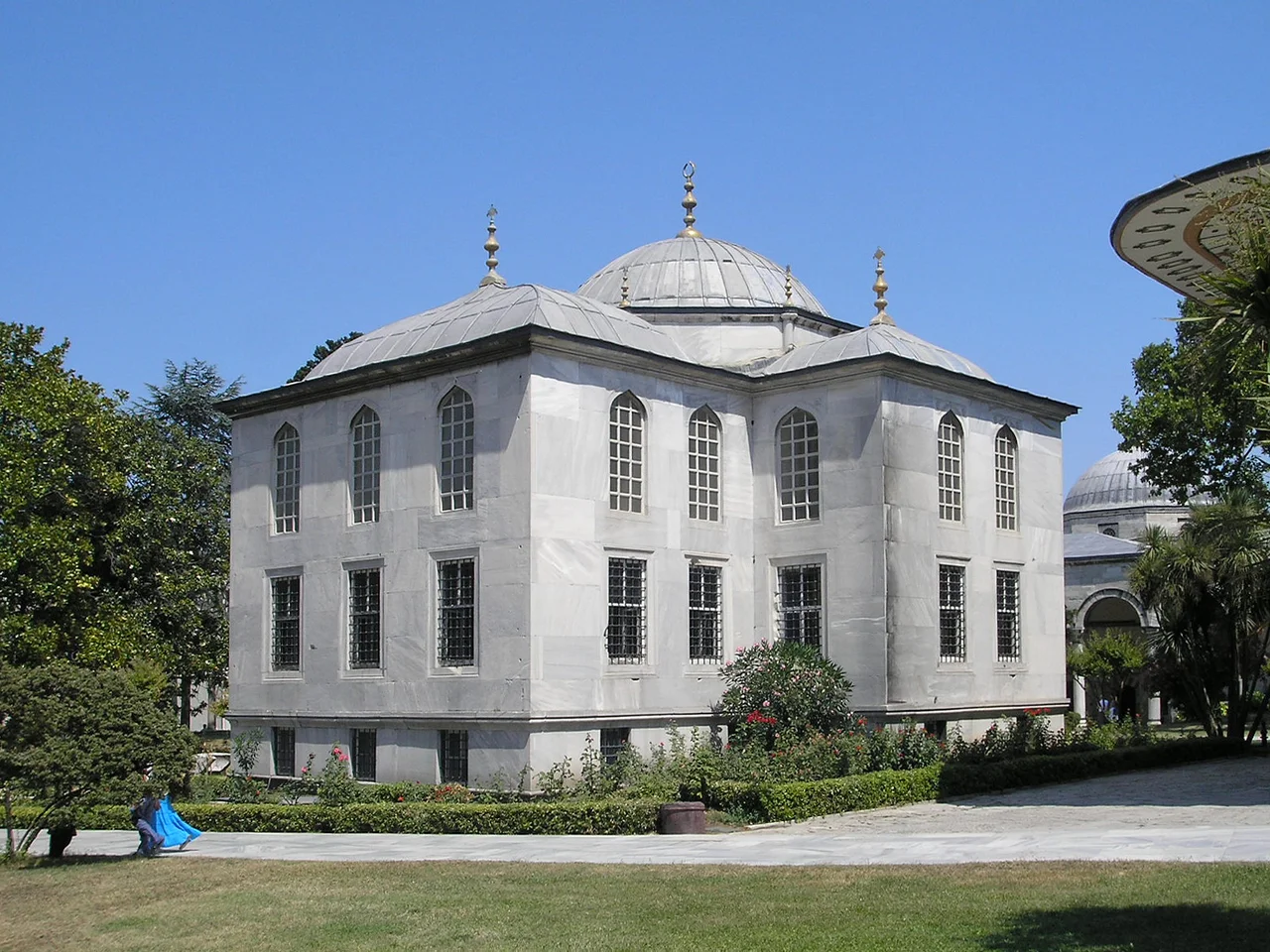

Enderun School
Picture the moment: a boy, perhaps eight or ten years old, somewhere in the Balkans or Anatolia, selected by Ottoman officials and taken from his family. He may never see his parents again. The officials have assessed him — his health, his intelligence, his aptitude — and deemed him suitable for something the empire considers an honor. He will be converted to Islam, educated in multiple languages, trained in science and music and swordsmanship, and placed inside the Topkapı Palace itself. Over the following years he will live within palace walls, advancing through seven grades of a school unlike any other in the 15th-century world. Some graduates rose to become grand viziers — the empire's most powerful officials, second only to the sultan. That path was real. So was the separation from everyone the boy had known.
The Devşirme: What the Levy Actually Was
The devşirme — the word means 'collection' or 'levy' — was a periodic system by which Ottoman officials took boys from Christian families, primarily in the Balkans and Anatolia, for imperial service. The boys were predominantly from rural communities; Orthodox Christian families were the main source, with Armenians and Jews generally exempted. Officials selected boys roughly between the ages of eight and eighteen, with emphasis on physical health, intelligence, and apparent ability. Upon selection, the boys were converted to Islam, separated from their families, and entered into Ottoman state service. This was not a choice. Families could not refuse — though some tried, and some parents reportedly offered bribes to have their sons included, knowing that the palace school offered a pathway that village life did not. Both responses were real, and neither cancels the other. The devşirme was a forced system that operated for centuries; the opportunities it created did not change the fact that it began with children taken from their homes.
Inside the Third Courtyard
The Enderun School — the name comes from 'Enderûn,' the 'Inner Service' of the palace — occupied the third courtyard of Topkapı, the most restricted and ceremonially significant space in the Ottoman imperial compound. The courtyard was surrounded by the Imperial Treasury, the Pavilion of the Holy Mantle, and the Palace School buildings themselves. Within the school, students moved through seven halls or grades, each with twelve teachers. They wore uniforms that indicated their level of achievement. The physical environment was rich by any standard of the era: a library, a mosque, music conservatories, dormitories, baths. The boys who reached the palace school had already passed through preparatory schools outside the palace walls; only the strongest candidates entered the inner tier of the Enderun system.
A Curriculum Designed to Produce Statesmen
The Enderun curriculum was comprehensive in ways that would have been recognizable as humanist in Renaissance Europe. Students studied Islamic sciences alongside Arabic, Turkish, and Persian. They received instruction in mathematics, astronomy, medicine, and geography. History, law, palace protocol, and administrative practice were taught alongside vocational arts — calligraphy, painting, music. Physical training, including weapons and close combat, ran alongside the academic coursework. A graduate was expected to speak and write at least three languages fluently, to have mastered a craft or art, to understand current scientific thinking, and to be able to command troops in the field. The sultan needed people who could run an empire, and the Enderun was the machine for producing them. It was also, for the boys inside it, simply their world — the only world most of them would know for years.
Çıkma: The Exit, and What Came After
The graduation ceremony at the Enderun School was called çıkma — literally 'exiting.' The word itself captures something of the experience: the graduates were those who had exited. They left palace service to enter functional state roles, transferring out every two to seven years, or following the accession of a new sultan. Assignment depended on merit. Graduates who excelled were placed in government or scholarly positions; those who did not advance were assigned to the military. The school's merit system was specific: carefully graded rewards and corresponding punishments structured advancement at every stage. Some graduates rose to extraordinary heights. Ibrahim Pasha, Sokollu Mehmed Pasha, and others who governed the empire at its most powerful came through this system. Their careers were real achievements. They were also built on a foundation they did not choose.
The School in the Palace, the Palace Today
The Enderun School operated within Topkapı for centuries, from the era of Mehmet II — who formalized and expanded the institution his father Murat II had established — through to the late Ottoman period. The school was formally closed in the 19th century as the empire modernized its administrative and military structures. Today the third courtyard of Topkapı Palace is open to visitors as part of the museum complex that occupies the palace. The Enderun Library still stands — a quiet, elegant building in the courtyard — and visitors walk past the spaces where boys from the Balkans and Anatolia once studied, competed for advancement, and grew up inside the walls of the most powerful court in the eastern Mediterranean world. The stones remember the institution. What they cannot hold is the texture of those individual lives — the boys who left villages and families and became, in the palace school's telling, something the empire needed them to be.
From the Air
The Enderun School's former location within Topkapı Palace sits at approximately 41.012°N, 28.985°E on Istanbul's historical peninsula, at the tip of the Sarayburnu promontory where the Golden Horn meets the Bosphorus and the Sea of Marmara. Flying into Istanbul Airport (LTFM) from the northwest, the Topkapı Palace complex is visible on the peninsula's easternmost point — its distinctive tree-lined courtyards and rooflines recognizable from several thousand feet. Recommended viewing altitude is 2,000–3,000 feet for detail on the palace grounds. The Hagia Sophia and Blue Mosque domes are nearby landmarks to the southwest, providing strong orientation reference. The confluence of the three bodies of water at Sarayburnu is one of Istanbul's most recognizable geographic features from the air.
Nearby Stories
- Kocaeli Peninsula 7.6 km away
- Second Battle of Çatalca 11 km away
- Istanbul's Rural Outskirts 14 km away
- MV Struma 20 km away
- HMAS AE2 36 km away
- Bursa 66 km away
- Sangarius Bridge 71 km away
- Januarius MacGahan 101 km away