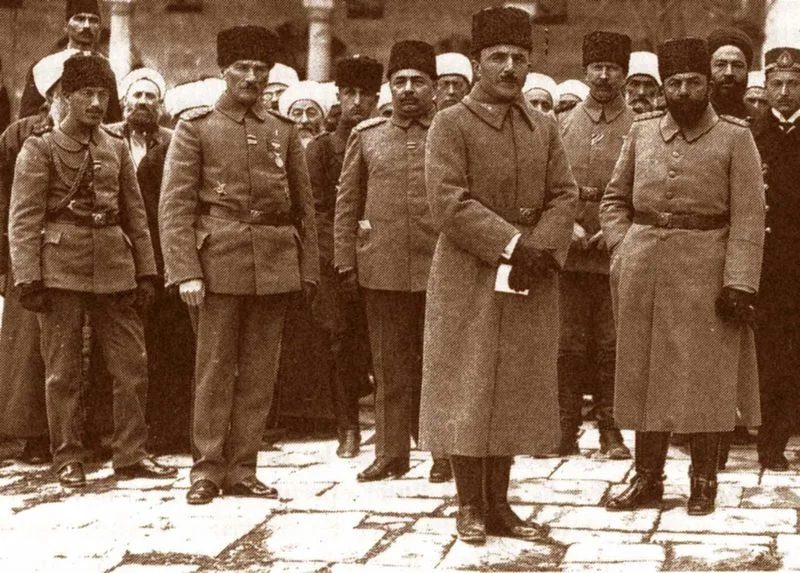
_with_Enver_Pasha.jpg)
Enver Pasha
His remains came home in 1996, reinterred at the Abide-i Hürriyet cemetery in Şişli, Istanbul — a man who had fled the city in the darkness of November 1918 as a fugitive, convicted in absentia of war crimes, and who had spent his last years chasing an empire of his own imagination across Central Asia. Ismail Enver, known to history as Enver Pasha, was born in Istanbul in 1881. By the time he was thirty, he was a hero of the 1908 Young Turk Revolution. By the time he was thirty-five, his decisions had helped drag the Ottoman Empire into a world war it could not survive — and his orders had set in motion a genocide.
The Officer Who Rode to Power
Enver rose quickly through the Ottoman military, distinguishing himself during the suppression of revolts in Macedonia and earning a reputation as dashing, ambitious, and fiercely nationalist. The 1908 Young Turk Revolution — led by the Committee of Union and Progress, known as the CUP or the Unionists — transformed Ottoman politics, and Enver became one of its celebrated faces. A 1911 posting to Libya, where he organized guerrilla resistance to Italian invasion, added to his fame. He returned from that war with a hero's swagger. By 1913 he had helped orchestrate the Raid on the Sublime Porte, a coup that brought the CUP to near-total power. He was made Minister of War in 1914. He was thirty-two years old, married to an Ottoman princess, and convinced he was destined to restore the empire's greatness. His confidence outran his judgment — a pattern that would prove fatal to hundreds of thousands of people who had nothing to do with his ambitions.
The War He Chose and the Soldiers He Lost
Enver pushed hard for an Ottoman alliance with Germany, and in late October 1914 he maneuvered the empire into World War I by secretly authorizing the Ottoman Navy to shell Russian ports in the Black Sea, an act of war done without cabinet approval. The empire was now committed to a conflict it was structurally unprepared to fight. Enver's military command produced disasters of almost unimaginable scale. In December 1914 and January 1915, he personally led the Ottoman Third Army into a winter offensive against Russian forces at Sarıkamış in the Caucasus. The campaign was based on strategic overconfidence and logistical fantasy. Ottoman soldiers advanced through mountain passes in temperatures well below freezing, without adequate winter clothing, food, or supply lines. Of roughly 90,000 men who began the campaign, somewhere between 60,000 and 75,000 died — the vast majority not from enemy fire but from frostbite, starvation, and disease. It was one of the worst military disasters in modern history. Enver blamed the defeat partly on Armenians — a charge historians have found to be false and politically motivated.
The Genocide
In 1915, Enver Pasha — alongside fellow triumvirate members Talaat Pasha and Cemal Pasha — was a principal organizer of the deportation and mass killing of the Ottoman Armenian population. The deportations began in April 1915. Armenian men were typically executed first; women, children, and the elderly were marched into the Syrian desert. Massacre, starvation, and exposure killed the great majority. Scholars estimate that between 600,000 and 1.5 million Armenians died. The International Association of Genocide Scholars and most historians classify these events as genocide. Enver, as Minister of War, controlled the military apparatus through which much of the killing was carried out, including the Special Organization — paramilitary units specifically deployed against the Armenian population. The Armenians who died were real people: farmers, merchants, teachers, priests, women who had children, children who had names. Their communities, centuries old, were erased.
Flight, Fantasy, and a Final War
Germany's defeat in 1918 meant the Ottoman Empire's defeat too. Enver and the other architects of the war crimes fled Istanbul by German submarine in November 1918. In absentia, Ottoman courts-martial convicted him of war crimes and sentenced him to death. He drifted through Europe — Berlin, Moscow — searching for leverage and allies, dreaming of a pan-Turkic state that would stretch from Istanbul to Central Asia. He contacted Bolshevik leaders, then turned against them. In 1921 he went to Central Asia, where Soviet forces were suppressing the Basmachi resistance movement. Enver switched sides and joined the Basmachi. On 4 August 1922, near the village of Ab-i-Derya close to Dushanbe, a Red Army cavalry brigade launched a surprise attack. Enver was killed — either charging the attackers on horseback, or ambushed in a village four days later, depending on whose account you read. He was forty years old. The pan-Turkic empire he had imagined never existed for a single day.
A Contested Grave in Şişli
Turkey's relationship with Enver Pasha remains tangled. In 1996, his remains were exhumed from Tajikistan and reinterred at the Abide-i Hürriyet — the Monument of Liberty — cemetery in Şişli, Istanbul, on the 74th anniversary of his death. The ceremony was attended by senior officials. His legacy is inseparable from his catastrophic choices: the war entry, Sarıkamış, the genocide. Atatürk — who replaced Enver as the dominant figure in Turkish nationalism — considered him dangerous and blocked his attempts to return during the War of Independence. The historical record is clear about what Enver Pasha did. What remains contested is what Turkey chooses to do with that record.
From the Air
Enver Pasha's Istanbul connections center on Şişli, where his remains rest at the Abide-i Hürriyet cemetery at approximately 41.068°N, 28.982°E. The cemetery sits a few kilometers north of the historic peninsula. Flying into Istanbul from the west, LTFM (Istanbul Airport) is the nearest major international airport, located northwest of the city at approximately 41.275°N, 28.752°E. At cruise altitude, the Bosphorus strait separating European and Asian Istanbul is clearly visible, as is the Golden Horn inlet cutting into the European shore. The area of Şişli is part of the modern European city north of the old walled peninsula — a district of apartment blocks and boulevards that replaced the cosmopolitan neighborhoods of the late Ottoman era in which Enver rose to power.
Nearby Stories
- Kocaeli Peninsula 7.6 km away
- Second Battle of Çatalca 11 km away
- Istanbul's Rural Outskirts 14 km away
- MV Struma 20 km away
- HMAS AE2 36 km away
- Bursa 66 km away
- Sangarius Bridge 71 km away
- Januarius MacGahan 101 km away