
Ertuğrul Tekke Mosque
Sultan Abdülhamid II was not, by most accounts, a sociable man. He governed from behind the walls of Yıldız Palace, afraid of assassination, suspicious of nearly everyone, and famously reluctant to leave his compound. Yet this same sultan built one of Istanbul's most intimate religious complexes just outside his palace gates — a place specifically designed to welcome visitors from across the Islamic world whom he himself rarely met face to face. That place was the Ertuğrul Tekke Mosque, completed in 1887 in the Yıldız neighborhood of Beşiktaş, and it tells you something about the contradictions at the heart of the late Ottoman Empire.
A Sultan's Diplomatic Mosque
Abdülhamid II built the Ertuğrul Tekke complex for a specific purpose: to reinforce Ottoman claims to the Islamic Caliphate at a moment when the empire was losing territory on every frontier. The sultan's strategy was to cultivate religious prestige abroad when political power was slipping away at home. He invited sheikhs and Islamic scholars from across the Muslim world to Istanbul and needed somewhere to house and honor them. The külliye — the Ottoman term for a mosque complex with supporting buildings — he constructed included not just a mosque but a tekke (a Sufi lodge), a guesthouse, a library, and a fountain. The complex was dedicated to Sheikh Hamza Zafir al-Madani, a Libyan Sufi from the Shadhiliyya order and founder of its Medeni branch, who had become an important ally in Abdülhamid's pan-Islamic project. The mosque was named not for the sheikh, however, but for Ertuğrul Gazi — the father of Osman I, founder of the Ottoman dynasty itself — connecting the sultan's religious diplomacy to the deep roots of Ottoman legitimacy.
Wood, Marble, and Art Nouveau
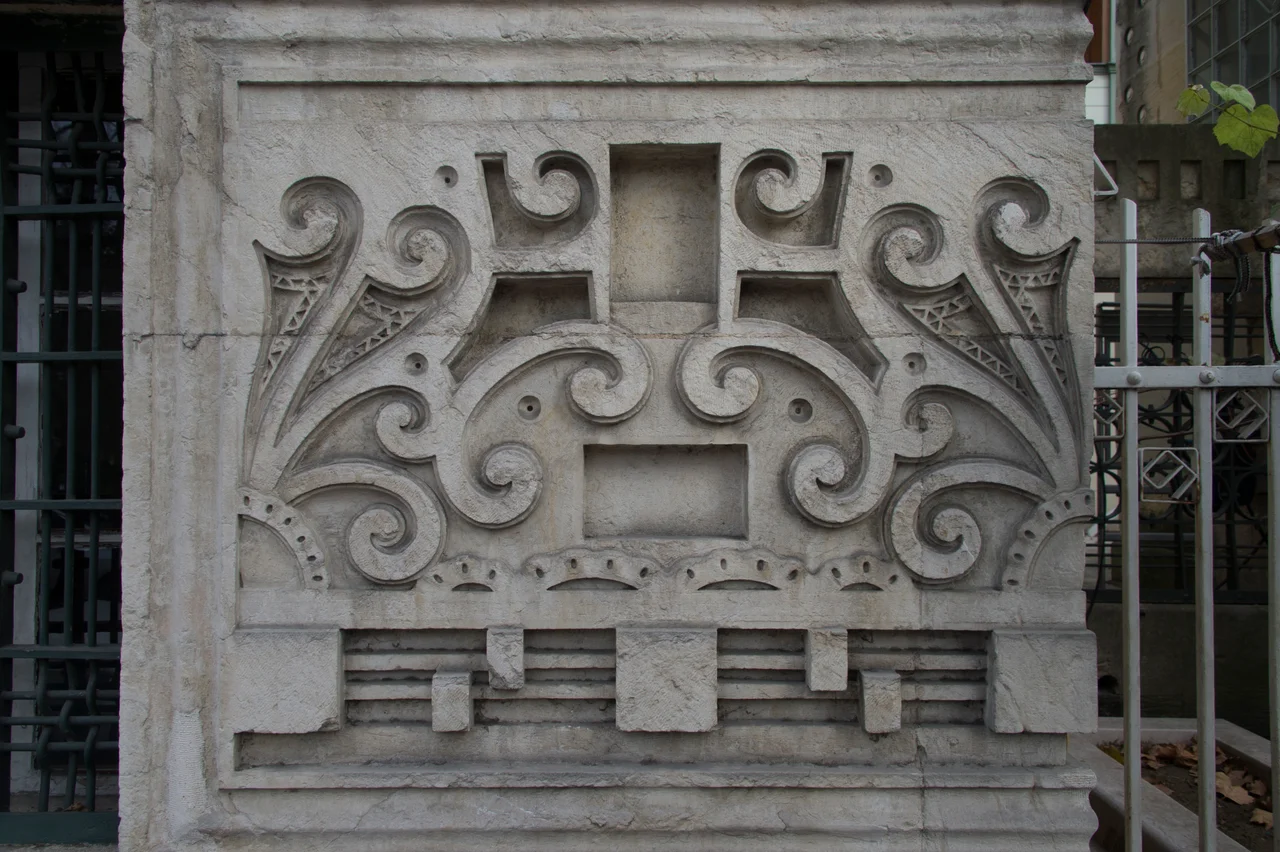
The complex is architecturally layered, and the layers tell the story of its history. The mosque and guesthouses are built of wood in the classical style of the late Ottoman period — elegant, modest, domestic in scale, set among gardens on the hillside above Beşiktaş. Then Sheikh Hamza Zafir died in 1903, and Abdülhamid commissioned a türbe, a mausoleum, to be built beside the mosque. The architect he chose was Raimondo D'Aronco, an Italian who had become the sultan's court architect after surviving the 1894 Istanbul earthquake. D'Aronco designed the türbe — and the library and fountain added in the same expansion — in the Art Nouveau style then sweeping Europe. The result is an unusual pairing: classical Ottoman wooden buildings alongside curved stone and tile in the European modernist idiom. Both the sheikh's two brothers, Muhammed Zafir Efendi and Beşir Zafir Efendi, who continued leading the tekke after his death, are also buried in the türbe.
Closure, School, Restoration
When the Turkish Republic abolished the tekkes in 1925 as part of Atatürk's secularization program, the Ertuğrul complex closed. The mosque fell silent. The two guesthouse buildings were repurposed as a primary school — Şair Nedim Primary School — for several decades, filling with children instead of visiting scholars. By 1960, extensive wear had forced even that use to stop, and all the buildings were shuttered. Restoration came eventually: between 1969 and 1973, the General Directorate for Foundations of the Republic of Turkey rebuilt the mosque and reopened it to worshippers. A more thorough restoration followed between 2008 and 2010, and on 21 May 2010, President Abdullah Gül formally reopened the mosque and türbe to the public. The two guesthouses remain in a ruined state, their purpose long outlasted by the republic that replaced the empire.
Hillside Quiet Above Beşiktaş
Today the Ertuğrul Tekke Mosque occupies a quiet corner of the Yıldız hillside, not far from Yıldız Palace and its wooded park. The area retains something of its late Ottoman character — a neighborhood of embassies, old villas, and winding streets above the bustle of the Bosphorus waterfront below. The complex is easy to miss if you don't know to look for it: there are no minarets soaring above the skyline, no grand forecourt. What you find instead is a wooden mosque gate, a shaded garden, the grave of a Libyan Sufi scholar, and the memory of a sultan who believed that soft religious power might save what armies could not.
From the Air
The Ertuğrul Tekke Mosque sits at approximately 41.046°N, 29.009°E in the Yıldız neighborhood of Beşiktaş, on the European shore of the Bosphorus. At low altitude approaching from the west, the Bosphorus Bridge (15 July Martyrs Bridge) is visible about 1 kilometer to the south, and the dense woodlands of Yıldız Park are immediately adjacent. The nearest major airport is LTFM (Istanbul Airport), approximately 35 kilometers northwest of the site. At cruise altitude, the narrow strait of the Bosphorus separating Europe from Asia is clearly visible below, with Beşiktaş district on the western shore. Recommended viewing altitude for the neighborhood is around 1,500 feet on approach to the Bosphorus.
Nearby Stories
- Kocaeli Peninsula 7.6 km away
- Second Battle of Çatalca 11 km away
- Istanbul's Rural Outskirts 14 km away
- MV Struma 20 km away
- HMAS AE2 36 km away
- Bursa 66 km away
- Sangarius Bridge 71 km away
- Januarius MacGahan 101 km away