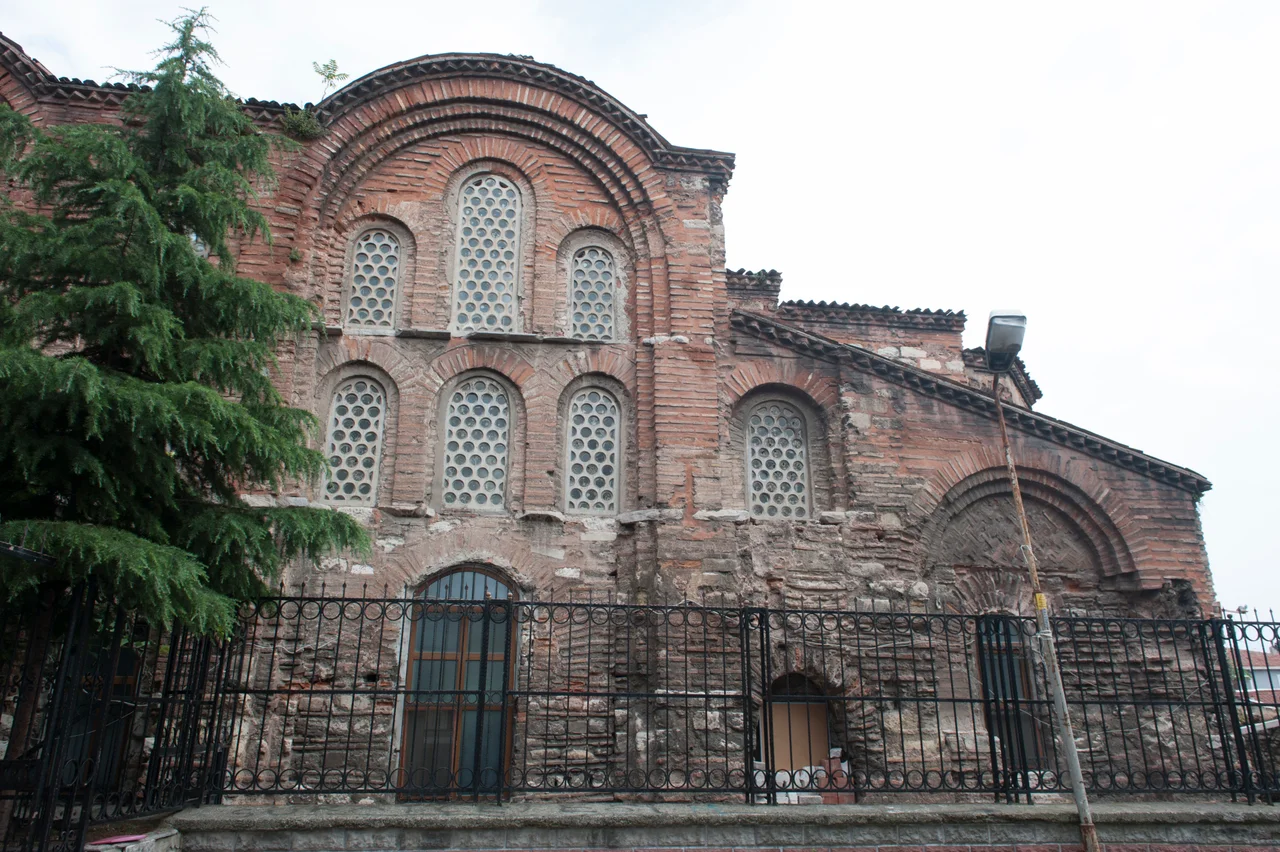

Eski Imaret Mosque
The name translates, bluntly, as Old Soup Kitchen Mosque. It is not the most romantic name for a building nearly a thousand years old, but it is an honest one — a memory, encoded in Turkish, of the days just after 1453 when the church's attached monastic buildings fed workers constructing the nearby Fatih Mosque. Before it became a soup kitchen's neighbor, it was a Byzantine convent. Before that, it was a hilltop refuge for an empress. The Eski Imaret Mosque, in the Zeyrek neighborhood of Istanbul's Fatih district, has outlasted the empire that built it, the crusade that occupied it, the conquest that converted it, and the fires that consumed nearly everything around it. It is the only documented 11th-century church in Istanbul that survives intact.
A Hilltop Built by an Empress-Mother
Sometime before 1087, Anna Dalassena — the formidably capable mother of Byzantine Emperor Alexius I Comnenus — built a convent on the summit of the fourth of Constantinople's seven hills. Following imperial custom, she retired there at the end of her life. The convent was dedicated to Christos Pantepoptes, meaning 'Christ the All-Seeing' — a name that suited a hilltop church with commanding views over the city below. The Pantepoptes (as scholars call it) was a middle Byzantine structure of the cross-in-square type: a central dome rising over four vaulted crossarms, an inner and outer narthex to the west, a sanctuary to the east. A U-shaped gallery ran over the narthex and the two western bays — likely built, historians suggest, for the private use of the empress herself. The exterior was decorated with sunbursts, meanders, basket-wave patterns, and cloisonné motifs — the latter unusual in Constantinople but characteristic of Greek architectural tradition of the period.
A Vantage Point for Two Conquests
The church's hilltop position made it strategically useful in ways its founders had not intended. On April 12, 1204, when the Fourth Crusade's forces attacked Constantinople, Emperor Alexios V Doukas Mourtzouphlos set up his command post near the monastery. From here, he watched the Venetian fleet commanded by Doge Enrico Dandolo deploy for the assault. The attack succeeded. Alexios V fled, abandoning his purple tent on the spot — Baldwin of Flanders spent that victorious night inside it. During the Latin occupation of Constantinople that followed (1204–1261), the building was used as a Roman Catholic church. Then, in 1453, Mehmed II's Ottoman forces took the city. The Pantepoptes church became a mosque almost immediately. Its monastic buildings were converted into a zaviye, a medrese, and an imaret — a public soup kitchen — to support the construction and staffing of the Fatih Mosque nearby. That last function gave the building the name it carries to this day.
What Survived, and What Didn't
Fires consumed the monastery complex over the centuries; the last traces of the monastic buildings disappeared roughly a hundred years ago. The church structure itself survived, though not without alteration. Ottoman builders flattened the undulating Byzantine roofline under a single flat roof. The original interior decoration is gone — only some marble moldings, cornices, and doorframes remain from the Byzantine period. A 1970 restoration rebuilt the multi-level roofline that the Ottomans had obscured. The brick construction technique is unusual and distinctive: alternate courses of bricks are set back from the wall face in a deep mortar bed, with mortar layers roughly three times thicker than the brick layers. The roof tiles are also unique among Istanbul's religious buildings, which are otherwise covered with lead. As of 2024, restoration work on the building was still ongoing.
The Least-Studied Monument
Despite being the only intact 11th-century church in Istanbul — a city that was once the wealthiest and most architecturally ambitious in the Christian world — the Eski Imaret Mosque remains among the least studied buildings in the city, as scholars themselves note. Even its identity as the Pantepoptes is not universally agreed upon: the art historian Cyril Mango argued that the location doesn't quite allow the full overview of the Golden Horn that the name 'All-Seeing' would imply, and suggested the building might have been something else entirely. Others have proposed it was the Church of St. Constantine, founded by Empress Theophano in the early 10th century. The questions remain open. In the Zeyrek neighborhood — one of the poorer areas within the old walled city — the mosque sits quietly, less than a kilometer from the more celebrated Zeyrek Mosque, and largely overlooked by the crowds drawn to Istanbul's more famous monuments.
From the Air
The Eski Imaret Mosque sits at approximately 41.022°N, 28.955°E on the fourth of Constantinople's historic seven hills, in the Zeyrek neighborhood of the Fatih district. At low altitude from the west, the domes of the Süleymaniye Mosque are visible about 600 meters to the southwest, providing a prominent navigation landmark. The Golden Horn inlet is visible to the north. The nearest major airport is LTFM (Istanbul Airport), approximately 40 kilometers northwest. On approach from the Marmara Sea, the successive hilltop silhouettes of Istanbul's historic mosques — Sultanahmet, Süleymaniye, Fatih — are a distinctive visual sequence; the Eski Imaret sits just north of the Süleymaniye cluster at moderate elevation.
Nearby Stories
- Kocaeli Peninsula 7.6 km away
- Second Battle of Çatalca 11 km away
- Istanbul's Rural Outskirts 14 km away
- MV Struma 20 km away
- HMAS AE2 36 km away
- Bursa 66 km away
- Sangarius Bridge 71 km away
- Januarius MacGahan 101 km away