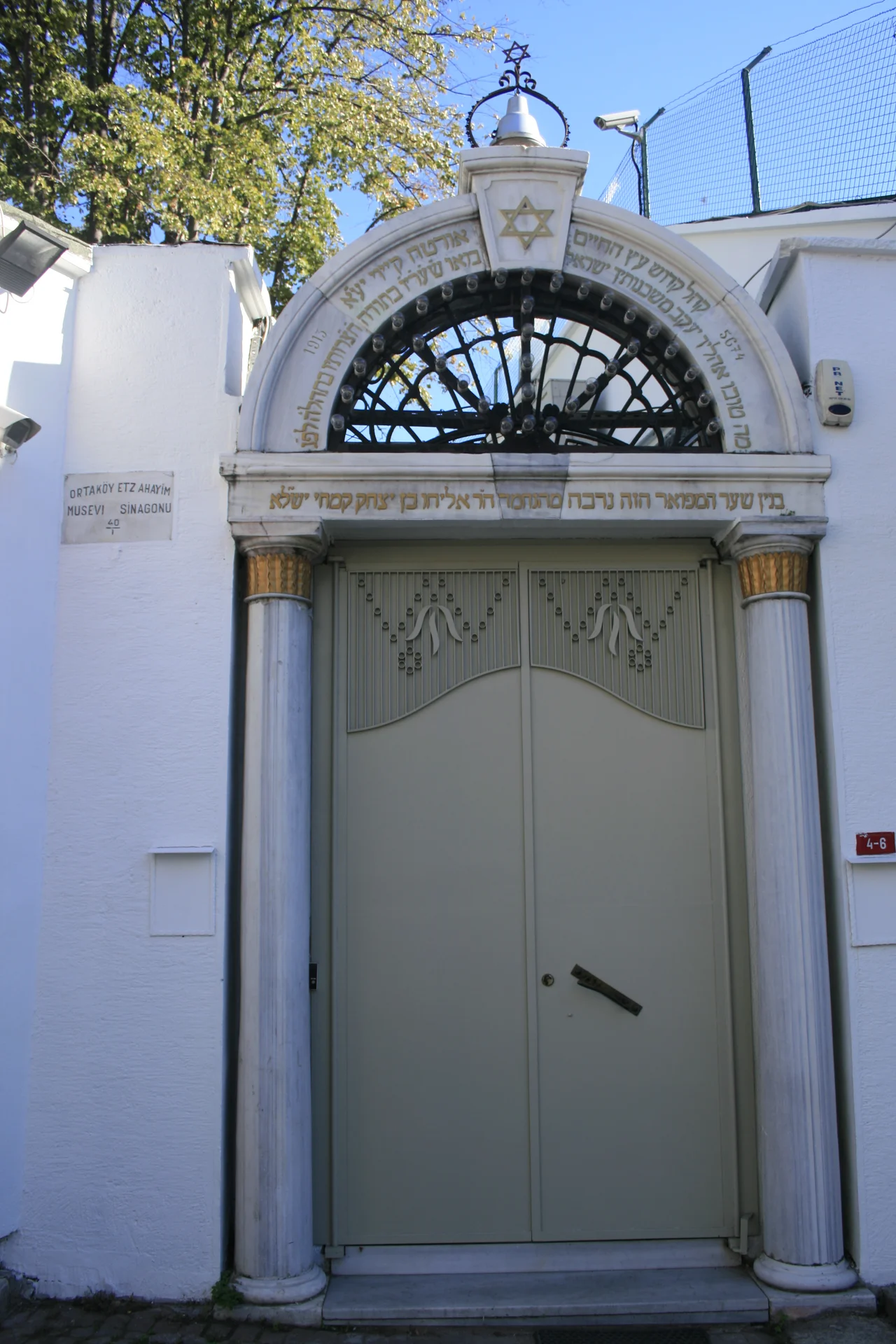

Etz Ahayim Synagogue
On the Yom Kippur night of October 1, 1941, a candle overturned in a section of the Etz Ahayim Synagogue being used as an oil warehouse. The fire that followed consumed the building. When the smoke cleared, one thing had survived intact: the marble Aron Kodesh, the sacred cabinet that holds the Torah scrolls. It was the second time the synagogue had burned on Yom Kippur — the holiest night of the Jewish year. The first fire had come in 1914. The ark had survived that one too. There is no comfortable explanation for a coincidence like that. But the congregation rebuilt, twice, and the synagogue on Icadiye Street in Kuzguncuk still stands today on the Asian shore of the Bosphorus.
A Tree Older Than Its Records
The name Etz Ahayim is Hebrew for 'Tree of Life' — one of Judaism's most enduring symbols, representing wisdom, continuity, and the Torah itself. How old the synagogue actually is, nobody can say precisely. The earliest confirmed documentary evidence dates to before 1703, when an Ottoman decree permitted the building's restoration, suggesting a congregation already well established by then. The community had likely been present in Kuzguncuk for generations before that document was written. For more than a century, the synagogue also housed a yeshiva, a religious academy where students came to study Jewish law and texts. That dual role — house of prayer and house of learning — was common in Jewish communities across the Ottoman Empire, where Jews had found a degree of tolerance and stability unavailable to them elsewhere in the world.
The Ottoman Welcome
The deep roots of Istanbul's Jewish community stretch back to 1492, when Ottoman Sultan Bayezid II opened his empire's doors to the Jews expelled from Spain by the Inquisition. Hundreds of thousands arrived over the following decades, bringing with them Ladino — Judeo-Spanish — along with their traditions, their scholarship, and their skills. They settled throughout the empire, and Istanbul became one of the great centers of Jewish life in the world. Kuzguncuk, on the quieter Asian shore of the Bosphorus, became home to a particularly tight-knit community. By the early twentieth century, roughly eight hundred Jewish families lived in the neighborhood — thousands of people whose lives revolved around the synagogue, the market, and the rhythms of the Jewish calendar alongside their Muslim and Christian neighbors.
Fire, Stone, and Survival
The 1914 fire destroyed the building, but the marble ark endured. The congregation rebuilt. Then came the second fire, in 1941, with the same result: the building gone, the ark standing. That the same object survived the same kind of catastrophe on the same night of the year — twice — became part of the synagogue's story, woven into the way the community understood itself. The rebuilt synagogue serves both Ashkenazi and Sephardic worshippers today, a reflection of the mixed heritage of Istanbul's remaining Jewish community. Turkish authorities have listed the building in the national cultural inventory as a revitalized historic structure. The congregation is small now: only a handful of Jewish families still live in Kuzguncuk itself, part of an estimated fourteen thousand Jews who remain in all of Turkey.
Kuzguncuk's Quiet Plurality
What makes Kuzguncuk unusual is not just its Jewish history but the way that history sits alongside everything else. Within a few short streets, two synagogues, two Greek Orthodox churches, an Armenian church, and two mosques have coexisted for generations. The neighborhood became known, even celebrated, as a symbol of the pluralism that was once more common across Ottoman Istanbul. That reputation has brought writers and photographers and journalists to Kuzguncuk over the years, looking for evidence that such coexistence was possible. The Etz Ahayim Synagogue, tucked on Icadiye Street near the Bosphorus shore, is one of the physical anchors of that story — a place where a community rebuilt itself twice and kept its roots in the ground even as the community around it changed beyond recognition.
From the Air
The Etz Ahayim Synagogue sits at approximately 41.048°N, 29.025°E in the Kuzguncuk neighborhood on the Asian shore of the Bosphorus, just south of the first Bosphorus Bridge (officially the July 15 Martyrs Bridge). From the air at 3,000 feet, the strait's blue water and the bridge's distinctive towers make orientation easy. The European skyline — Dolmabahçe Palace, the minarets of Beşiktaş — lies directly across the water. The nearest major airport is LTFM (Istanbul Airport) on the European side, approximately 35 km to the northwest. Approach from the north along the Bosphorus for the clearest view of the Kuzguncuk shoreline.
Nearby Stories
- Kocaeli Peninsula 7.6 km away
- Second Battle of Çatalca 11 km away
- Istanbul's Rural Outskirts 14 km away
- MV Struma 20 km away
- HMAS AE2 36 km away
- Bursa 66 km away
- Sangarius Bridge 71 km away
- Januarius MacGahan 101 km away