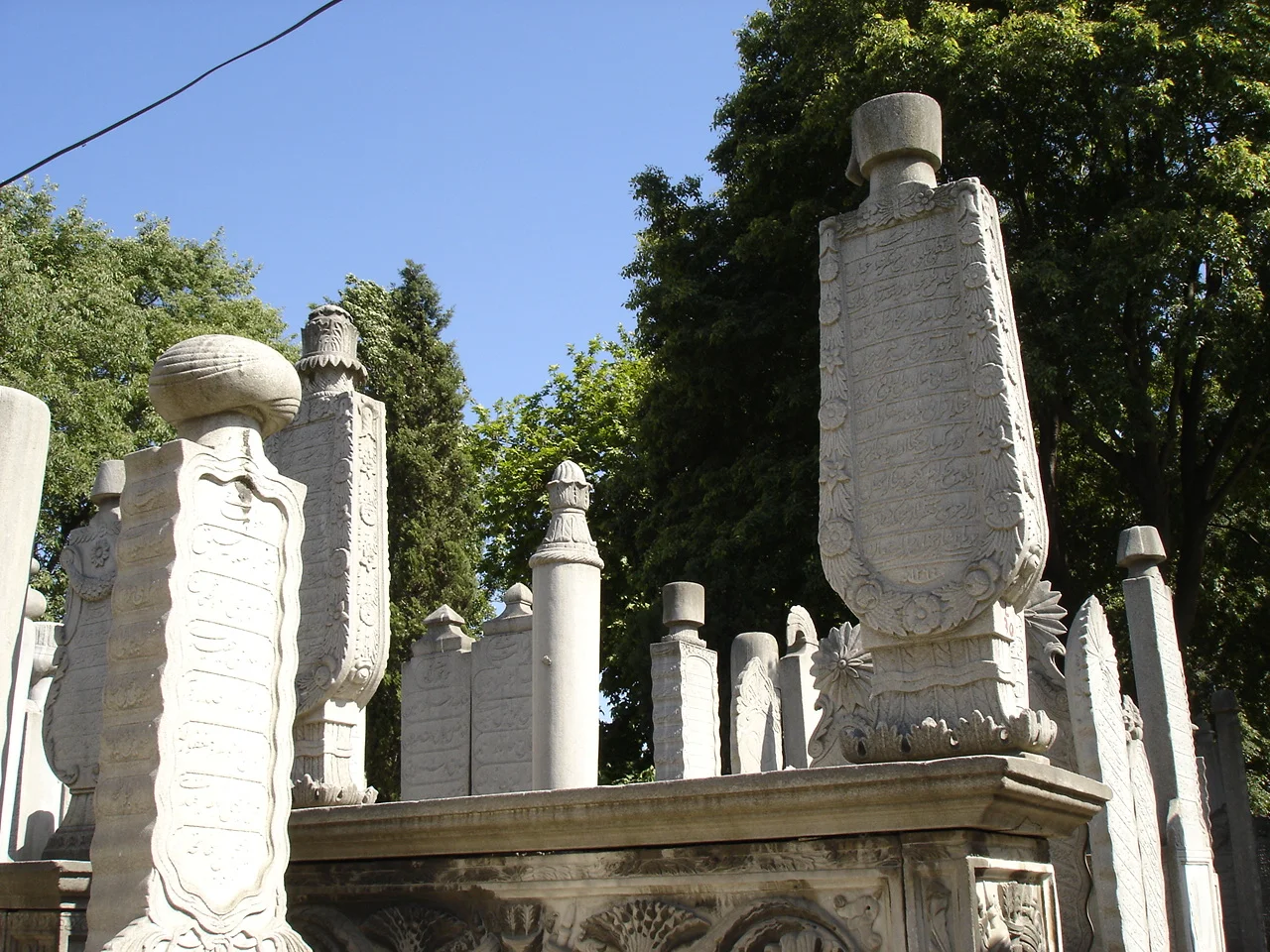

Eyüp Cemetery
The hillside above the Golden Horn has been accumulating the dead for more than five centuries. Cypress trees mark the ridgeline. Ottoman-era headstones rise from the grass at angles the soil has chosen over generations, their carved turbans and tall fez shapes denoting the professions and ranks of those below. Some stones have no inscription at all — blank faces turned toward the sky, the names deliberately withheld. The Eyüp Cemetery is not a quiet place in the sense of emptiness. It is dense with presence: the presence of everyone who ever wanted to be buried near the holiest point in Istanbul, close to the man the faithful call Eyüp Sultan.
The Companion Who Stayed
Abu Ayyub al-Ansari was born around 576 CE in Medina and became one of the closest companions, a sahaba, of the Prophet Muhammad. When the Prophet emigrated from Mecca to Medina in 622, it was in Abu Ayyub's home that he first stayed. Decades later, in the 670s CE, Abu Ayyub joined the First Arab Siege of Constantinople, the Byzantine capital. He died there — outside the walls, far from home — and was buried where he fell, requesting that his grave be placed as close as possible to the city. For nearly eight centuries, the exact site was lost. After the Ottoman conquest of Constantinople in 1453, Mehmed II's court mystic Akşemseddin claimed to have discovered the tomb. A shrine was built above the grave and a mosque erected in Abu Ayyub's honor. From that moment, the surrounding hillside became one of the most sought-after burial grounds in the Islamic world.
Who Rests Here
For five centuries, Ottoman sultans and their courts, grand viziers and military commanders, poets and religious scholars all sought burial in Eyüp. The desire was not merely status: to lie near Abu Ayyub was understood as an act of spiritual proximity, a final statement of faith. Among those buried here is Mehmed V (1844–1918), the 35th sultan of the Ottoman Empire. Khidr Bey (1407–1459), a Hanafi scholar and poet who became the first Ottoman judge of Constantinople after 1453, rests here too. So does Husein Gradaščević (1802–1834), the Bosniak general who led a famous rebellion against Ottoman centralization. The composer Haci Arif Bey (1831–1885), one of the masters of Ottoman classical music, is buried here alongside Sadettin Heper (1899–1980), a Mevlevi music composer. The range of those buried here — conquerors and rebels, artists and administrators — speaks to how broadly the cemetery's sanctity was understood.
The Executioners' Hill
Not everyone buried in Eyüp rests in sanctified company. On Karyağdı Hill, adjacent to the main cemetery, a separate burial ground existed for the Ottoman state's public executioners — men who could not, by social law, share ground with ordinary citizens. Their funerals took place in secret, in the night. Their headstones bear no names, no dates, nothing that might allow the families of those they had executed to find the graves and seek revenge. Most of those blank stones have since been lost to road construction and time. Only a few survive. They stand without inscription in the grass, which is perhaps the only memorial available to men whose profession made memorial impossible.
The View from Pierre Loti's Hill
At the summit of the cemetery hill, a café bears the name of the French novelist Pierre Loti, who spent time in Istanbul in the late nineteenth century and is said to have written here overlooking the Golden Horn. Whether the story is wholly accurate matters less than what it points to: the view from this hilltop is one of the finest in Istanbul. The Golden Horn stretches below, the old city spreading across the ridge to the south, the domes and minarets of centuries stacked against the sky. Visitors climb through the cemetery to reach the café — past the leaning headstones, the cypress shadows, the silence that accumulates where people have been mourning and remembering for five hundred years. The cemetery stretches from the Golden Horn's western bank all the way to Edirnekapı, outside the old walls of Constantinople. Road construction in the modern era damaged sections of it. What remains is still vast.
From the Air
The Eyüp Cemetery lies at approximately 41.052°N, 28.933°E on the European side of Istanbul, along the western bank of the Golden Horn inlet. Flying at 2,500–3,000 feet from the west, the cemetery's dense band of cypress trees on the hillside above the Golden Horn is clearly visible. The Golden Horn itself — a curved inlet stretching southeastward from Eyüp toward the Bosphorus — is the primary navigation landmark. The Eyüp Sultan Mosque is visible at the base of the hill. The nearest major airport is LTFM (Istanbul Airport), approximately 25 km to the northwest along the European shore.
Nearby Stories
- Kocaeli Peninsula 7.6 km away
- Second Battle of Çatalca 11 km away
- Istanbul's Rural Outskirts 14 km away
- MV Struma 20 km away
- HMAS AE2 36 km away
- Bursa 66 km away
- Sangarius Bridge 71 km away
- Januarius MacGahan 101 km away