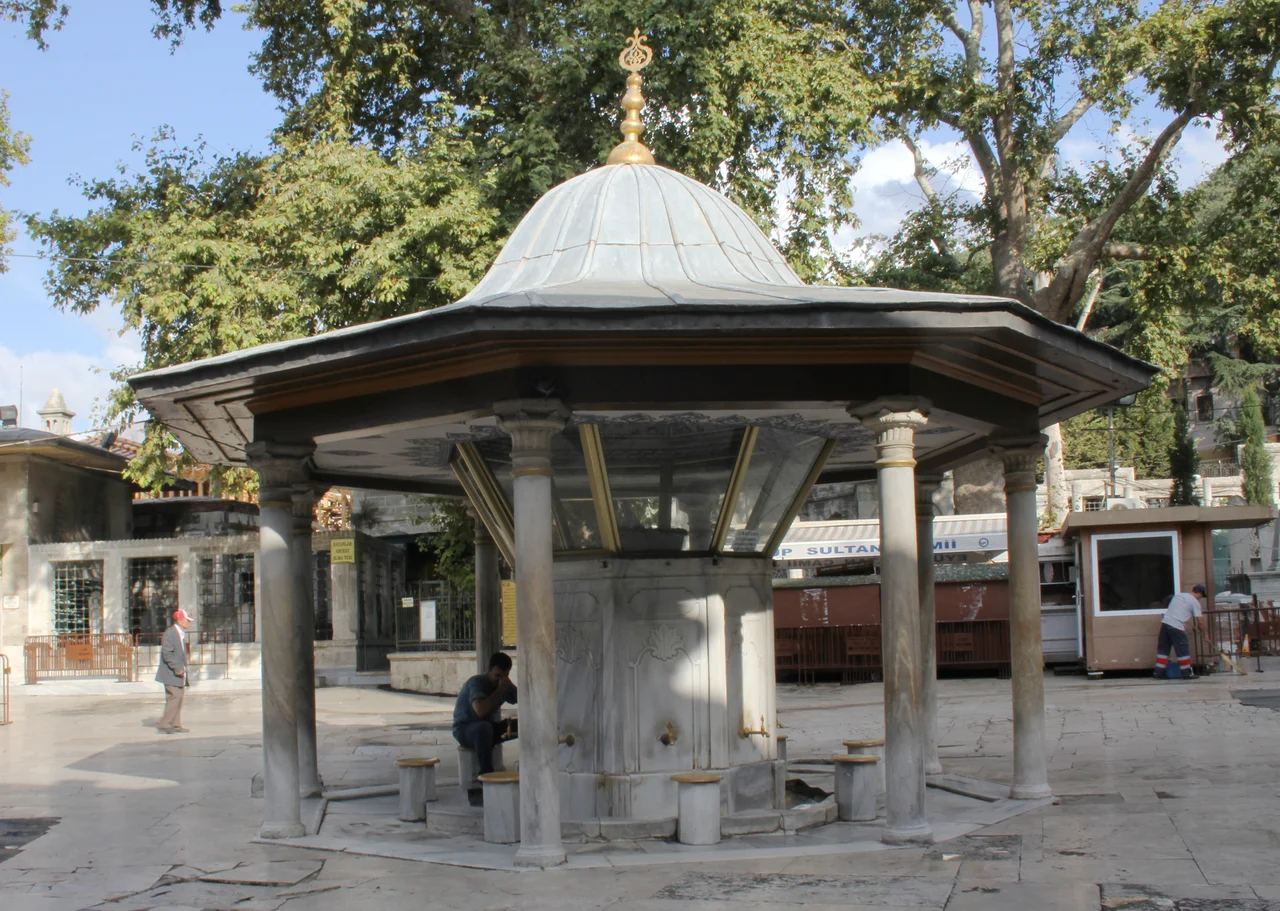

Eyüp Sultan Mosque
Every Ottoman sultan who came to power made a journey here first. Before the court, before the celebrations, before the first acts of governance — the new sultan came to Eyüp, to the mosque at the head of the Golden Horn, and received the Sword of Osman in the courtyard. The ceremony, called the girding, was the formal investiture of imperial authority. Without it, the reign had not truly begun. That a mosque outside the old city walls, built over a seventh-century grave, could hold that weight for four and a half centuries tells you something about what Eyüp Sultan means to Istanbul — and to the Islamic world it served.
A Grave Rediscovered
Abu Ayyub al-Ansari was a companion of the Prophet Muhammad — among the first to accept Islam, and among the most trusted. When the Prophet traveled from Mecca to Medina in 622 CE, Abu Ayyub was the man in whose home he first stayed. Decades later, Abu Ayyub joined the First Arab Siege of Constantinople in the 670s CE. He died there, outside the walls of the Byzantine capital, and was buried where he fell. His wish was to rest as close as possible to the city. For nearly eight centuries, the site was unmarked and forgotten. After Mehmed II's conquest of Constantinople in 1453, the Ottoman court mystic Akşemseddin reportedly located the tomb through a vision. Whatever the circumstances of the discovery, Mehmed II accepted it, built a shrine over the site, and in 1458 — just five years after the conquest — erected a mosque in Abu Ayyub's honor. It was the first mosque built by Muslims in Istanbul.
The Sword of Osman
The mosque became the site of the most important ritual in Ottoman political life: the girding ceremony, in which each new sultan received the Sword of Osman, the legendary weapon of the empire's founder. Ottoman sultans traveled to Eyüp at the start of every reign, entering the courtyard in procession and being girded with the sword before representatives of the court and the religious establishment. The ceremony was not merely symbolic. It connected each new ruler to the founding moment of the Ottoman state and to the sanctity of the site itself — the grave of a man who had stood at the Prophet's side. To be recognized at Eyüp Sultan was to have one's authority consecrated by the most sacred place in the city.
Rebuilt in White and Gold
The original 1458 mosque survived for more than three centuries before the 1766 Istanbul earthquake damaged it severely. Repairs in 1776 were judged insufficient, and Sultan Selim III ordered a complete reconstruction, completed in 1800. The mosque that stands today reflects that Baroque Ottoman style: white marble facades, gilded details, and a central dome approximately 17.5 meters in diameter supported by eight pillars. Two slender minarets frame the courtyard. Inside the adjacent mausoleum — the türbe — that houses Abu Ayyub's tomb, Iznik tiles from the sixteenth century line the walls in deep navy and turquoise, their glazed surfaces catching and holding light. The British Museum holds a panel of similar Iznik tiles from around 1550, considered among the finest examples of the art.
A Living Place of Pilgrimage
Eyüp Sultan is not a museum. It is one of Istanbul's most actively visited mosques, drawing worshippers from across Turkey and from Muslim communities around the world. Families bring boys here for circumcision ceremonies, dressed in white suits and small crowns, accompanied by relatives and music. The mosque's courtyards fill during Friday prayers and especially during Ramadan. In the narrow streets surrounding the complex, vendors sell prayer beads, religious texts, and food for the crowds. The adjacent tomb of Abu Ayyub al-Ansari receives a continuous stream of visitors who come to pay their respects and offer prayers at the grave of the man who lies at the center of all of this — a companion of the Prophet who died far from home and, in doing so, made this corner of Istanbul permanently sacred.
From the Air
The Eyüp Sultan Mosque stands at approximately 41.048°N, 28.934°E at the northern end of the Golden Horn on Istanbul's European side, in the Eyüp district. From the air at 2,500 feet, the mosque's two white minarets and central dome are visible at the point where the Golden Horn begins to narrow toward its head. The cemetery's cypress-covered hillside rises directly behind it. The nearest major airport is LTFM (Istanbul Airport), approximately 25 km to the northwest. The Golden Horn — the distinctive curved inlet splitting the European city — is the primary navigation reference.
Nearby Stories
- Kocaeli Peninsula 7.6 km away
- Second Battle of Çatalca 11 km away
- Istanbul's Rural Outskirts 14 km away
- MV Struma 20 km away
- HMAS AE2 36 km away
- Bursa 66 km away
- Sangarius Bridge 71 km away
- Januarius MacGahan 101 km away