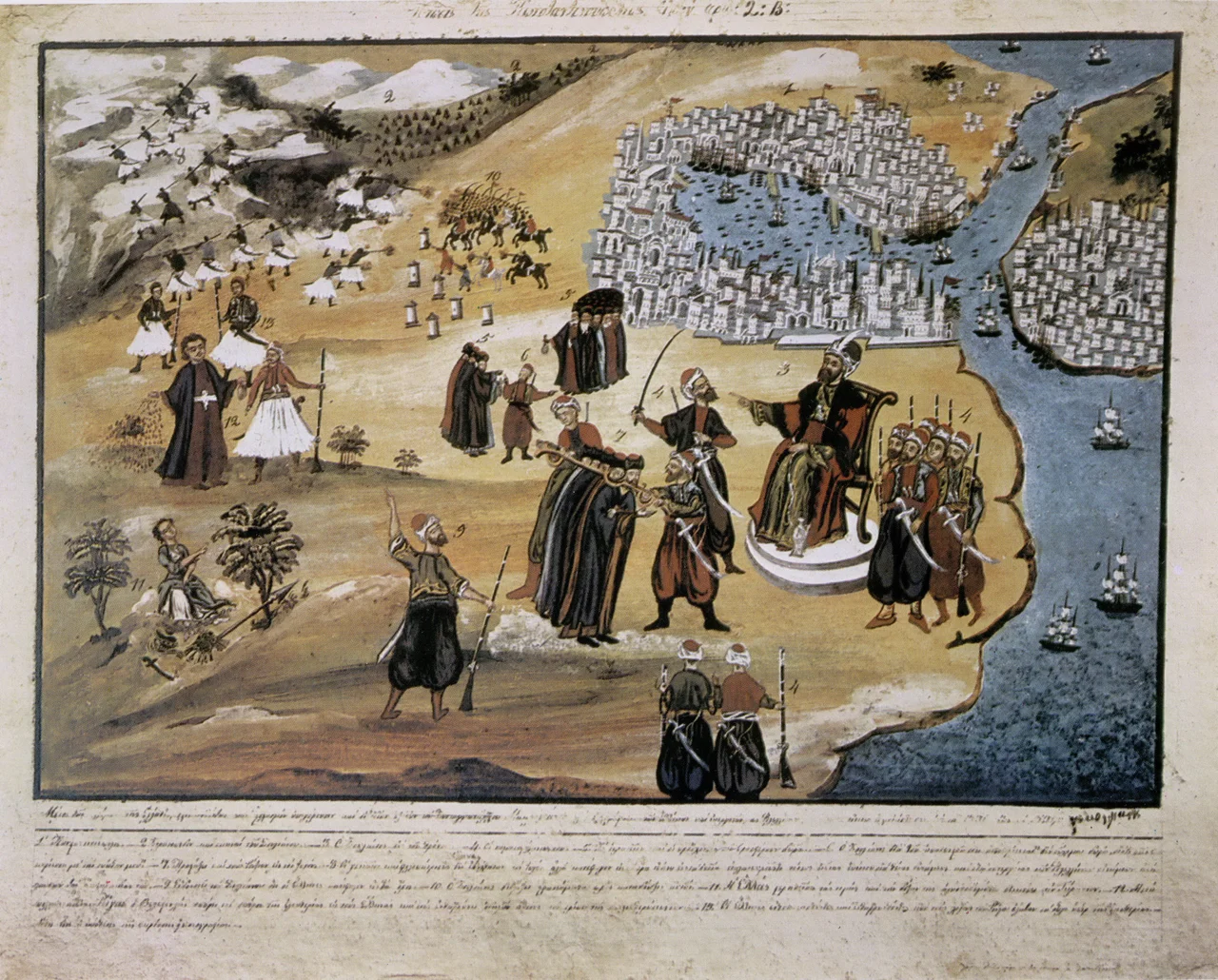

Fall of Constantinople
Seven days before the walls broke, the moon went dark. On the night of 22 May 1453, a partial lunar eclipse spread over Constantinople, and those inside the city took it as a sign. Their emperor, Constantine XI Palaiologos, had ruled for eight years over a city that had been shrinking for generations — from half a million people at its Byzantine peak to perhaps forty or fifty thousand souls now, isolated inside the ancient Theodosian Walls while Ottoman forces circled outside. The defenders prayed, processed icons through the streets, and watched the moon disappear. They knew what was coming. The question was only when.
A City Already Diminished
Constantinople in 1453 was a ghost of what it had been. Once the largest city in the Christian world, the crossroads of Europe and Asia, the inheritor of Rome's eastern legacy, it had spent two centuries contracting. The Fourth Crusade's sack in 1204 had shattered the city and the empire both, and recovery never came fully. By the time Sultan Mehmed II — twenty-one years old, ambitious, and determined — assembled his forces outside the walls in early April 1453, Constantinople was a patchwork of neighborhoods separated by fields and ruins within its ancient fortifications. Emperor Constantine XI commanded roughly seven thousand defenders, including a few hundred Genoese volunteers and a small Venetian contingent, against an Ottoman army estimated at sixty to eighty thousand. The city had appealed to the Christian West for help. Meaningful help did not come.
The Walls and What Broke Them
The Theodosian Walls had stood for a thousand years. Built in the fifth century, they had repelled every assault the ancient and medieval world threw at them — Arab sieges, Bulgar invasions, Crusader threats before the Fourth Crusade's eventual breach. Mehmed understood that he could not take the city by starvation alone. He brought cannon. The largest was designed by a Hungarian engineer named Urban and required sixty oxen and four hundred men to move. It fired stone balls roughly six hundred millimeters in diameter. Over fifty-three days of siege, the Ottoman artillery fired thousands of rounds at the walls. The defenders repaired the gaps between barrages, filling breaches with rubble and earth and timber. They held longer than most observers had thought possible. In the final hours before dawn on 29 May, the assault came at multiple points simultaneously. The breach, when it came, was at the Gate of Saint Romanus — a small gate that became the hinge of history.
The Last Emperor
Constantine XI Palaiologos did not survive the morning. He was last seen fighting at the walls when the final breach occurred, tearing off his imperial regalia so that he would not be taken alive as a symbol of defeat. His body was never definitively identified. No reliable eyewitness account recorded his death. What historians agree on is that he chose to die with his city rather than flee — an option available to him. He had no heir. The dynasty ended with him, and with it an unbroken succession of Roman and Byzantine emperors stretching back to Augustus, to 27 BCE. Constantine died as one of the last rulers of a tradition more than fourteen hundred years old. His choice to stay was noted by both sides, and it became the one element of the catastrophe that people on both sides of the conflict tended to remember with something like respect.
What the Sack Cost
The customary rules of siege warfare in the fifteenth century granted besieging forces three days of plunder when a city resisted rather than surrendering. Constantinople had resisted. What followed 29 May 1453 was violent and brutal. Thousands of people were killed. Tens of thousands more — men, women, children — were enslaved and marched into Ottoman territories. Churches were looted. Manuscripts were destroyed. The citizens who had crowded into Hagia Sophia seeking divine protection were taken captive when the soldiers entered. The great church, which had served as a Christian cathedral since 537 CE — 916 years — was converted to a mosque on Mehmed's orders that same day. The human cost of the fall fell heaviest on the people of the city: the Greek and Italian and Jewish residents who had lived within the walls, who had no armies and no power, and who bore the weight of a political and military cataclysm they had not made.
The World That Followed
The news traveled fast. In Egypt, celebrations were held in Cairo. The Sharif of Mecca wrote to Mehmed in admiration. Mehmed himself took the title Kayser-i Rum — Caesar of the Romans — claiming continuity with the empire he had defeated. He allowed the Orthodox Church to continue functioning under a patriarch appointed with his approval, and he eventually repopulated the devastated city, bringing in Greeks, Armenians, Jews, and Muslims from across his domains. Constantinople became Istanbul, the capital of an Ottoman Empire that would last until 1922. In the generation that followed, the last remnants of Byzantine power collapsed: the Peloponnesian fortress of Mystras fell in 1460, the independent Byzantine state of Trebizond in 1461. Constantine's brothers fled or surrendered. The heirs of Byzantium scattered to Rome, to Venice, to the courts of Eastern Europe, carrying their claims and their manuscripts and the memory of what had been.
From the Air
The Fall of Constantinople took place across the entire historic peninsula of Istanbul, at approximately 41.009°N, 28.975°E (the approximate center of the old walled city). The Theodosian Walls that the siege targeted run north-south along the western land edge of the historic peninsula, visible from the air as a distinct fortification line. The Gate of Saint Romanus — where the decisive breach occurred — lies near 41.011°N, 28.928°E, roughly midway along the land walls. Hagia Sophia's massive dome, converted to a mosque on 29 May 1453 and still dominating the Sultanahmet skyline, is clearly visible from the air. The nearest major airport is LTFM (Istanbul Airport), approximately 40 km to the northwest. A flight path approaching from the west at 4,000 feet puts the full length of the Theodosian Walls in view before the historic peninsula opens out toward the Bosphorus.
Nearby Stories
- Kocaeli Peninsula 7.6 km away
- Second Battle of Çatalca 11 km away
- Istanbul's Rural Outskirts 14 km away
- MV Struma 20 km away
- HMAS AE2 36 km away
- Bursa 66 km away
- Sangarius Bridge 71 km away
- Januarius MacGahan 101 km away