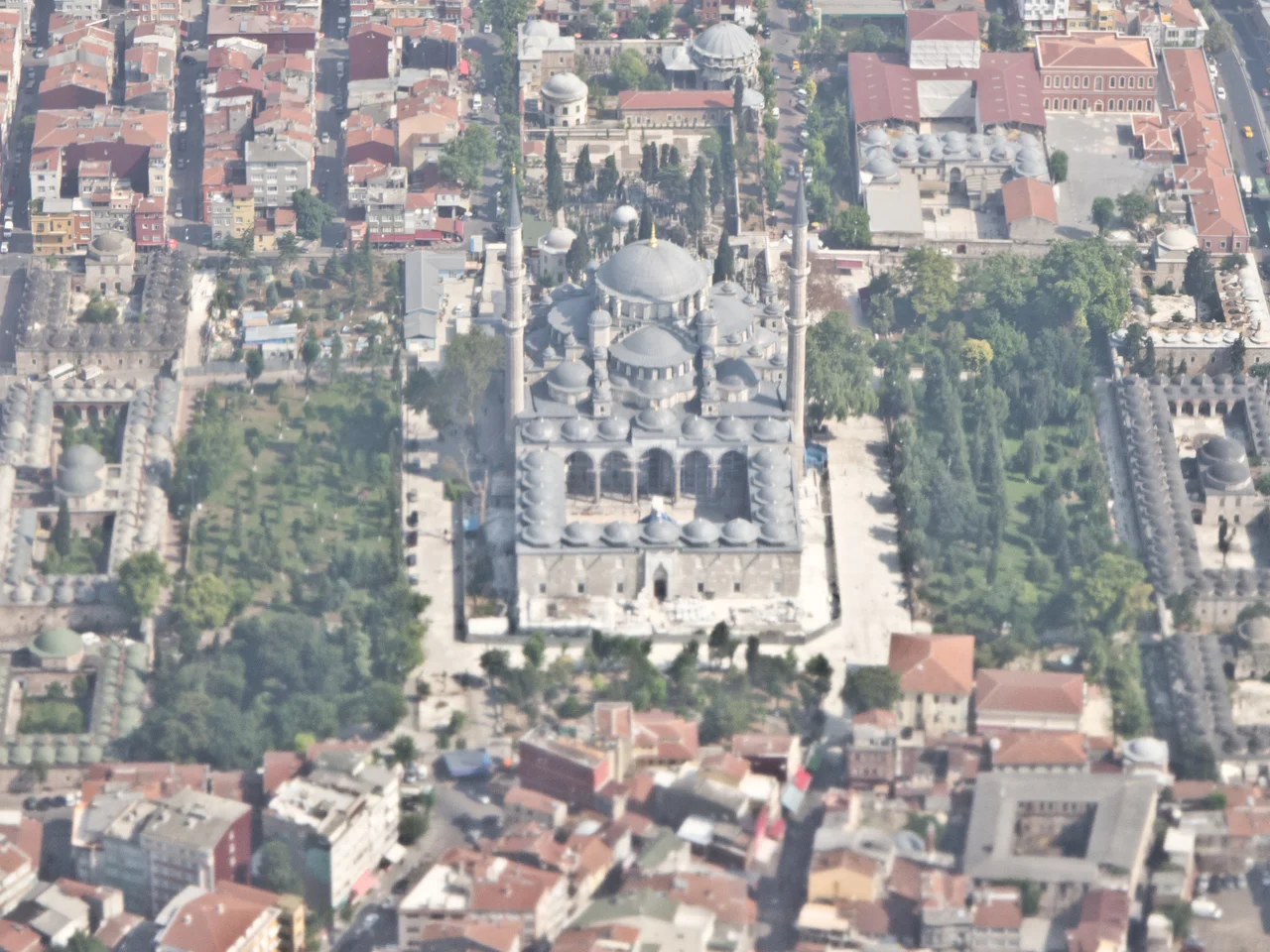

Fatih Mosque, Istanbul
Where the Church of the Holy Apostles once held the tombs of Constantine the Great and his successors, Mehmed II ordered a mosque. The choice was not accidental. The fourth-century church — once the second most important in Christendom after Hagia Sophia — had fallen into disrepair after the Fourth Crusade stripped it of its treasures. When Mehmed conquered Constantinople in 1453, the Ecumenical Patriarch could not even get permission to repair its crumbling walls. In 1461, Mehmed had it demolished. By 1470, the Fatih Mosque stood in its place: not just a house of worship, but an announcement carved in stone that a new civilization had taken root on the Bosphorus.
The Conqueror's Blueprint
The Fatih complex was unlike anything the Ottomans had built before. This was the first monumental project in the Ottoman imperial architectural tradition — a deliberate act of city-building on a scale that matched the ambitions of the sultan himself. Eight medreses fanned out around the mosque, each one dedicated to a different field of inquiry: theology, law, medicine, astronomy, physics, mathematics. A hospital, a library, a caravanserai, a public kitchen for the poor, a primary school, a hamam, and a market all radiated from the central mosque. Two hundred and eighty shops helped fund the complex's operation. The whole ensemble covered a nearly square area of 325 meters on the ridge above the Golden Horn. Mehmed was not building a mosque. He was building a city within a city, an intellectual capital for an empire that intended to endure.
The Astronomer at Court
Among the scholars Mehmed drew to his new complex was Ali Qushji, a Turkic astronomer of exceptional reputation. Mehmed invited him personally to Istanbul, and Qushji accepted, becoming the guiding intellect behind the Sahn-ı Seman Medrese — the educational heart of the Fatih complex. Qushji had already written treatises challenging the Ptolemaic model of the cosmos and advancing the mathematics of astronomical tables. At the Sahn-ı Seman, he helped establish an intellectual tradition that combined Islamic learning with the natural sciences. The medrese attracted students from across the Ottoman world. Mehmed's mosque was not just architecture; it was patronage made visible, the sultan's power expressed through the minds he gathered around him.
A History Written in Rubble
The original mosque did not survive intact. An earthquake in 1509 badly damaged it. Aftershocks in 1557 and 1754 damaged it again. Then, on 22 May 1766, an earthquake collapsed the main dome and left the walls beyond repair. What stands today is not Mehmed's mosque but the replacement commissioned by Sultan Mustafa III — an entirely different design, built between 1767 and 1771. The two centuries of seismic punishment that erased the original structure are also, in a sense, part of Istanbul's story: this is a city built atop geological fault lines, where grandeur and catastrophe have always existed in proximity. The current mosque was itself heavily restored in 2009 and again around 2019, finally reopening to worshippers in 2021.
A Living Quarter
The mosque sits at the center of the Fatih district, one of Istanbul's most densely religious and traditionally observant neighborhoods. On Fridays, thousands of worshippers spill into the broad courtyard between the minarets. The grounds contain the türbes — domed mausoleums — of Mehmed II and his wife Gülbahar Hatun, drawing a steady stream of visitors who come to pay their respects to the man who remade this city. The surrounding streets are lined with religious bookshops, tea gardens, and markets. The Fatih quarter has the feel of a place that takes its history seriously without displaying it for tourists — it is lived in, prayed in, argued in, every ordinary day.
Stones on Stones
Stand in the courtyard of the Fatih Mosque and consider what you cannot see. Beneath this ground are the ruins of Constantine's mausoleum, the foundations of the Church of the Holy Apostles, the layered memory of eleven centuries of Byzantine rule. Mehmed's builders used some of the original church's material in their construction — stone on stone, civilization upon civilization. The practice was practical, but it was also something else: a physical threading of one era into the next that makes Istanbul unlike any other city on earth. Every monument here contains multitudes. The Fatih Mosque is Ottoman in its proportions and Byzantine in its bones, and the fact that most visitors never know this is part of what makes the city inexhaustible.
From the Air
The Fatih Mosque stands at approximately 41.0197°N, 28.9497°E on the third hill of historic Istanbul, clearly visible from the air as a large domed complex with two minarets rising above the surrounding Fatih district roofscape. Approaching from the west at 3,000–5,000 feet, the mosque appears along the spine of the peninsula between the Golden Horn to the north and the Sea of Marmara to the south. Nearest airport: LTFM (Istanbul Airport), approximately 35 km to the northwest on the European side. The landmark sits roughly 3 km northwest of Hagia Sophia and is best identified by the twin minarets flanking the large central dome.
Nearby Stories
- Kocaeli Peninsula 7.6 km away
- Second Battle of Çatalca 11 km away
- Istanbul's Rural Outskirts 14 km away
- MV Struma 20 km away
- HMAS AE2 36 km away
- Bursa 66 km away
- Sangarius Bridge 71 km away
- Januarius MacGahan 101 km away