
Fenari Isa Mosque
In 908, a Byzantine admiral named Constantine Lips built a nunnery in the valley of the Lycus River in Constantinople, in the presence of Emperor Leo VI the Wise. He dedicated it to the Virgin Theotokos Panachrantos — the Immaculate Mother of God. What he could not have anticipated is that the modest complex he inaugurated would still be standing more than eleven hundred years later, having served as a nunnery, a mausoleum for empresses, a mosque, an abandoned ruin, an archaeological dig site, and a mosque again. The Fenari Isa Mosque, known in Byzantine times as the Lips Monastery, accumulates history the way old walls accumulate patina: layer by layer, each era leaving its mark on the one before.
A Nunnery for Empresses
Constantine Lips built the original north church to house a community of nuns — around 50 women, according to the monastery's typikon, plus a small hospice with fifteen beds for laywomen. After 1453, when the Ottoman conquest reorganized the city, the complex passed through other hands. But in the Byzantine centuries, it had become closely associated with the imperial Palaiologos dynasty. Empress Theodora Palaiologina chose the Lips Monastery as her burial place, and several members of her family followed: her son Constantine, Empress Irene of Montferrat, and Emperor Andronikos II, who reigned from 1282 to 1328. Anna of Moscow, first wife of Emperor John VIII Palaiologos, was also buried here in 1417. The church had become, in effect, a dynastic necropolis for the last great Byzantine ruling house — a dynasty that would be extinguished within decades of Anna's burial.
Two Churches in One Skin
What makes the Lips complex architecturally unusual is that it comprises two distinct churches pressed together over the centuries. The north church, built by Constantine Lips in 908, is intimate in scale — its nave measures just 13 meters by 9.5 meters. Its masonry follows the Byzantine technique of alternating brick and rough stone courses, with bricks sinking deep into thick mortar beds. A south church was added later, larger and more elaborate, its central dome surmounted by a heptagonal apse decorated in a triple order of niches. The brickwork of the south church forms intricate surface patterns: arches, hooks, Greek frets, sun crosses, and fans woven in alternating bands of white stone and dark red brick. This is considered the earliest known appearance of that decorative system in Palaiologian architecture — a distinctive visual language that would spread through late Byzantine building across the eastern Mediterranean.
What the Ground Revealed
In 1929, archaeologists excavated the site and found twenty-two sarcophagi — probable remains of the imperial burials that Byzantine sources had recorded but that had been otherwise lost to view. The ground had been raised by 80 centimeters during the Ottoman period, and the filled soil contained artifacts that helped scholars piece together the building's layered history. The complex had survived a fire in 1918, suffered structural damage repaired poorly in earlier decades, and endured the indignity of road-widening in the 1950s that left it sitting 2 to 3 meters below street level — a monument swallowed by the rising city around it. A minaret was demolished in 1942 and later rebuilt. Comprehensive restoration work begun in 2012 concluded in 2019, stabilizing the fabric and correcting decades of inadequate repairs.
A Building That Refuses to Simplify
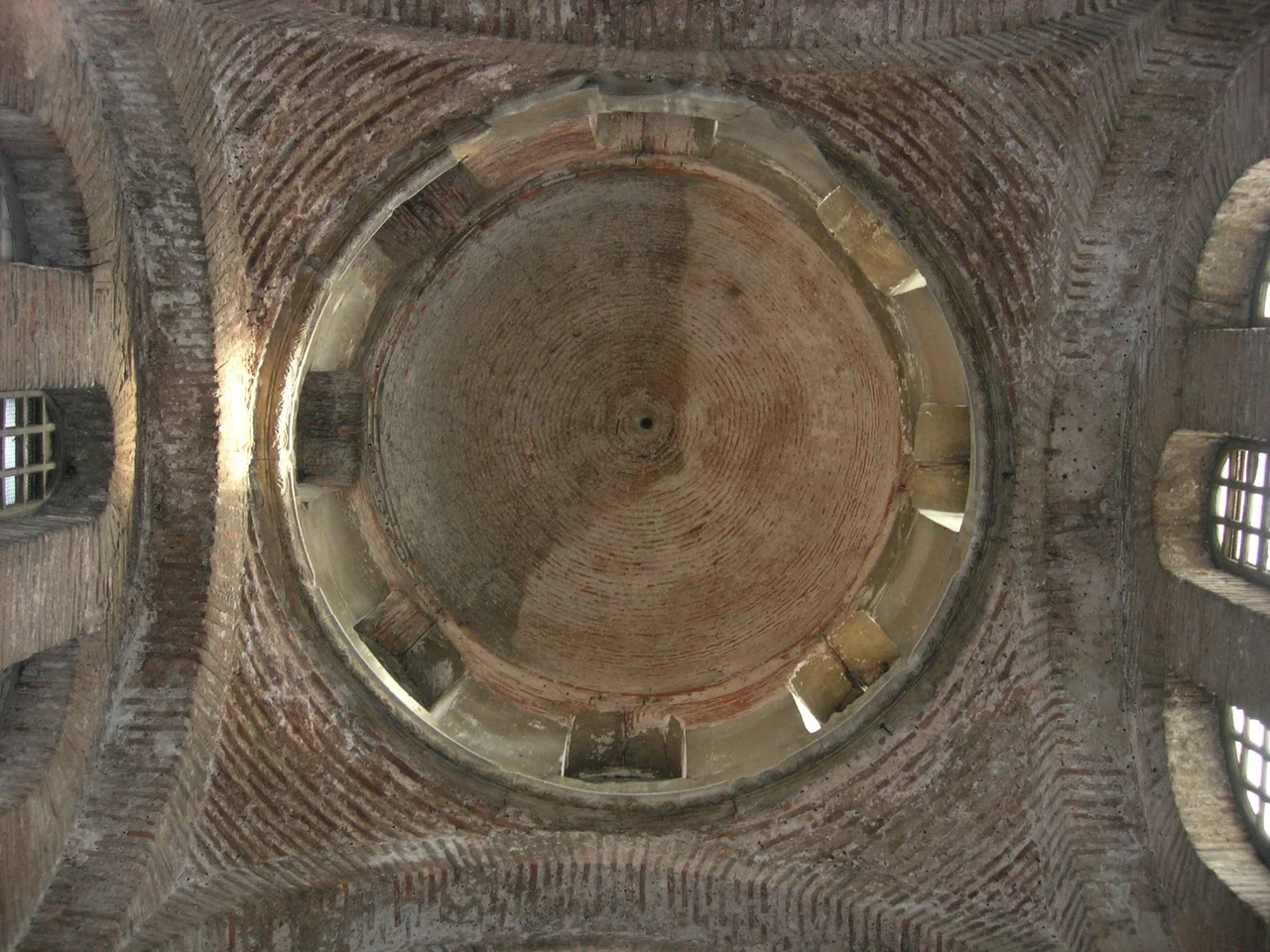
Visitors who find the Fenari Isa Mosque — and finding it requires navigating off Adnan Menderes Boulevard, down to where the building sits below the road — encounter something that resists easy description. It is a mosque, but built on the bones of a church, itself built on an ancient Roman cemetery. The Ottoman dome crowning the north church is pierced by eight windows that flood the interior with shifting light. Marble sarcophagi remain in the parekklesion — the side chapel of the south church — their imperial occupants now long anonymous. The brick patterns on the exterior walls speak to a craftsman's tradition that connects Constantinople to Thessaloniki to Mystras. This is not a building that announces its complexity; it simply embodies it, for whoever has the patience to look.
From the Air
The Fenari Isa Mosque sits at approximately 41.0154°N, 28.9440°E in the Fatih district of Istanbul, along Adnan Menderes Boulevard. From the air it appears as a modest domed complex partially below street grade, roughly 1 km southwest of the Fatih Mosque. Viewing altitude 1,500–3,000 feet gives context against the surrounding dense urban fabric of Fatih. Nearest airport: LTFM (Istanbul Airport), approximately 33 km to the northwest on the European side. The building is not visually prominent from altitude but is identifiable by its position along the main boulevard, flanked by the distinctive two-church massing and a single minaret.
Nearby Stories
- Kocaeli Peninsula 7.6 km away
- Second Battle of Çatalca 11 km away
- Istanbul's Rural Outskirts 14 km away
- MV Struma 20 km away
- HMAS AE2 36 km away
- Bursa 66 km away
- Sangarius Bridge 71 km away
- Januarius MacGahan 101 km away