.jpg)
Fener
Every 6 January, the Patriarch of Constantinople walks to the shore of the Golden Horn and throws a cross into the water. Swimmers plunge after it, racing through the cold current to see who can bring it back. This is the Blessing of the Waters, the Feast of the Epiphany as observed in the Orthodox world — and in Fener, the Greek-Orthodox quarter midway up the Golden Horn, it is one of the moments when the quarter's ancient identity surfaces most visibly. The neighborhood's Turkish name derives from the Greek word phanarion, meaning lantern, after a column topped with a light that once guided travelers through these streets in Byzantine times. The lantern is long gone. But the community it named — the Phanariotes, the Greeks of the Phanar — has never entirely left.
After the Conquest
When Mehmed II took Constantinople in 1453, the city's Greek population reorganized around the neighborhoods they still occupied — and Fener became their center. The Ecumenical Patriarchate, the spiritual seat of Eastern Orthodox Christianity worldwide, relocated to Fener in 1602 and remains there today. The analogy is imperfect but instructive: Istanbul's Greeks sometimes refer to the Patriarchate as their Vatican, a compact walled world of sacred authority in the middle of a Muslim-majority city. The Patriarchal Church of St. George, at the heart of the compound, was rebuilt after a fire in 1720 destroyed the original basilica on the site. Its neo-Classical facade is unexpected for an Orthodox church — the current building dates largely from the nineteenth century. One gate in the compound wall has been sealed shut since 1821, when the then-Patriarch was hanged there as Ottoman authorities suppressed the Greek rebellion that began that year. It has not been opened since.
The Phanariotes
During the Ottoman centuries, the Greeks of Fener occupied an unusual position. The Phanariotes — as they were called — were neither subjects without standing nor citizens with full rights, but something in between: a cultivated elite who served the empire as dragomans (official translators and interpreters), diplomats, and provincial administrators. Several Phanariote families governed Wallachia and Moldavia as hospodars between 1711 and 1821, extending Ottoman reach into the Balkans through Greek intermediaries. The arrangement was pragmatic on both sides. The Phanariotes accumulated wealth and influence; the Ottomans gained educated administrators fluent in European languages and customs. When Greek independence came in the nineteenth century, it shattered that accommodation — and with it much of the political standing the Fener community had built over generations.
What the Streets Still Hold
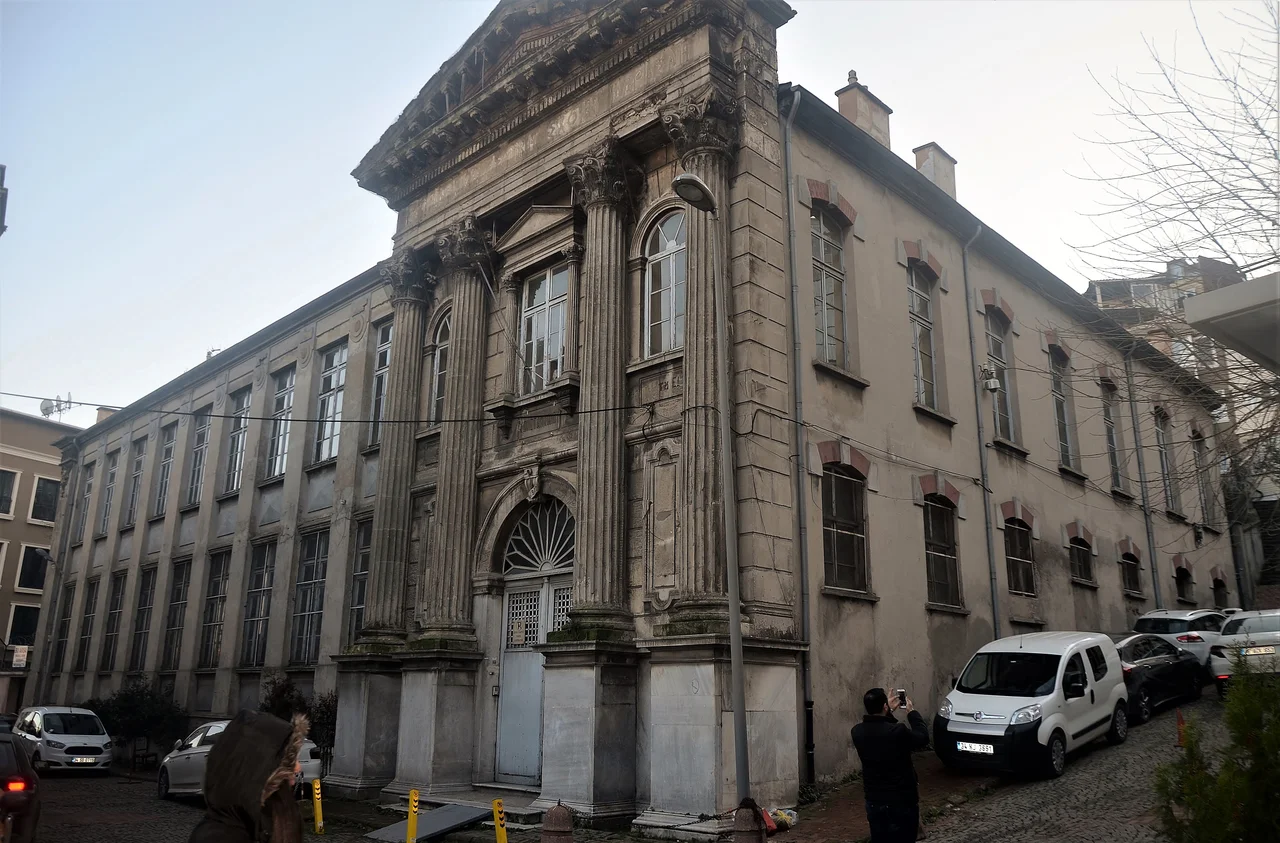
The Church of St. Mary of the Mongols, inland and uphill from the Patriarchate, holds a distinction unlike any other building in Istanbul: it is the only church in the city that was never converted to a mosque after the Ottoman conquest. The architect Atik Sinan is said to have persuaded Mehmed II to allow it to continue serving the Greek population, and a copy of the sultan's decree — the ferman — still hangs on the church wall. Nearby, the massive red-brick Phanar Greek Orthodox College once drew students from across the Greek Orthodox world; the historian Dimitri Cantemir studied here in the seventeenth century. Today the college has only a handful of pupils — a measure of how dramatically the Greek community has contracted over the past century. The buildings remain: imposing, a little elegiac, inhabited by a community that has outlasted several empires but has never stopped shrinking.
Stone Houses, Bay Windows, and Remnants of Walls
Walk the back streets of Fener and the texture of the place asserts itself. Two- and three-story terraced houses lean over narrow lanes, many fitted with cumbas — the bay windows that project out over the street, letting residents watch the neighborhood without stepping into it. Some grander mansions along the Golden Horn shore were once used to store timber imported from the Black Sea region; one now houses Istanbul's Women's Library. Fragments of the Sea Walls that once sealed Constantinople off from the Golden Horn still skirt the neighborhood's edge. The Ayakapı gate through those walls is attributed to Mimar Sinan, dated to 1562. The walls are battered and patched, keeping nothing out and nothing in — but still standing, still marking the boundary between the city that was and the one that is.
The Lantern's Light
The Phanar's role as the seat of the Ecumenical Patriarchate gives this small neighborhood a symbolic weight out of proportion to its size. Patriarch Bartholomew I, who has led the Patriarchate since 1991, is recognized by Orthodox Christians worldwide as first among equals of the Orthodox bishops — a spiritual leader whose authority is moral and canonical rather than administrative, but whose presence in Istanbul is a living connection to a Christian community that has inhabited this city since late antiquity. Greek Orthodox Easter brings crowds from Greece and the diaspora to the Patriarchal Church each year. The rest of the time, Fener is simply a neighborhood on the Golden Horn: quiet, layered, its stone houses wearing the centuries lightly, the water glinting beyond the old walls.
From the Air
Fener sits at approximately 41.0289°N, 28.9519°E on the southern shore of the Golden Horn in the Fatih district. From the air at 2,000–4,000 feet, the neighborhood is identifiable as a dense urban quarter on the Golden Horn's south bank, with the red-brick mass of the Phanar Greek Orthodox College visible as a distinctive landmark. The Golden Horn itself — a long inlet running southwest from the Bosphorus — is the primary navigational reference for this location. Nearest airport: LTFM (Istanbul Airport), approximately 30 km to the northwest on the European side of Istanbul.
Nearby Stories
- Kocaeli Peninsula 7.6 km away
- Second Battle of Çatalca 11 km away
- Istanbul's Rural Outskirts 14 km away
- MV Struma 20 km away
- HMAS AE2 36 km away
- Bursa 66 km away
- Sangarius Bridge 71 km away
- Januarius MacGahan 101 km away